
A mortality census schedule can name a person who died shortly before the regular federal enumeration and therefore never appears among the living in that year’s population schedule. The United States collected mortality schedules in 1850, 1860, 1870 and 1880. Start with the death interval and the surviving state holdings, then inspect the original schedule and test the reported death details independently.
Calculate the death window before you search a surname
The federal mortality schedules enumerated people who died in the 12 months before the population census reference date. NARA gives the concrete example that the 1860 schedules cover deaths from June 1, 1859 through May 31, 1860. Therefore the schedule named “1860” is not a list of all people who died during calendar year 1860. Establish the target death month and identify which census return could include it before attempting a name search.
A death in the latter half of 1860 is outside that federal schedule’s reference period, even though the family may say “died in 1860.” Preserve uncertainty where a grave inscription gives only a year. The same principle applies to the other decennial returns, but always inspect the form and guide for the specific enumeration you are using. A negative search outside the eligibility window tells you nothing about record survival.
Choose the surviving state and county schedule, not any database
The Census Bureau and NARA distinguish these mortality schedules from standard named population schedules. They were nonpopulation records and their surviving originals are held in a patchwork of federal repositories, state archives and other institutions. A database title might suggest broad national coverage while its collection actually excludes a state or year. Begin with an availability list, select the relevant state and county and note the custodian and series.
Some local repositories provide an index or a transcription but not a linked image. In that case, record the exact image, microfilm or manuscript call number requested. If the institution does not have a particular year, log “schedule not located in the consulted holding” rather than “no death recorded.” State, county and collection gaps make claims of absence especially unsafe.

Read the month, age and cause as reported—not medically proven
Mortality schedules can list the person’s name, age, sex, birthplace, occupation, death month, reported disease or cause and length of illness. Later forms changed some columns and sometimes added an attending physician and place where illness was contracted. The Census Bureau lists potential fields across schedules but does not promise that every year contains the same complete set. Transcribe the actual headings on the original image before building a standardized dataset. Our guide “U.S. Agricultural Census Schedules, 1850–1880” adds more detail on this.
Reported causes reflect nineteenth-century vocabulary, available medical knowledge and the informant’s understanding. Do not map an unfamiliar term to a present-day diagnosis without sound historical support. A physician column identifies a person reported in a record; it does not make the entire entry a certified medical finding. Use the death cause only as a historically attributed description and keep a direct quotation separate from any modern interpretation.
| Source or period | What it can show | What it cannot prove |
|---|---|---|
| Mortality schedule | Death month and reported personal details | Not a certified exact death date |
| Population schedule | People counted as living | Not a list of the recent deceased |
| Probate or burial record | Independent event and location clues | Not automatic proof of cause |
Reconcile the mortality row with a named population census
A decedent normally does not appear as a living member of the household on the population schedule taken at the end of the mortality reporting window. Search the preceding census, city directories, probate records, cemetery registers and any available civil or church death record. A same-name survivor in the 1850 population schedule may be a different individual rather than an obvious transcription error. Establish identity using locality, age and the wider household timeline.
For a fictional research example, suppose a family note says a child called Clara Ellis died in 1859. The 1860 mortality form could be relevant only if her reported death falls within its preceding year. Compare any mortality match against the family’s residence, other children and cemetery evidence. A different age or distant county is a reason to test a competing Clara, not permission to silently adjust the family tree.

Turn an ambiguous death month into a bounded date statement
A schedule that gives only a month does not automatically supply a date of death. If the column says December and the enumerator’s reference year is established, cite “reported December” rather than inventing a day. Record the schedule year, month of death and jurisdiction in three separate fields. If a modern index supplies an exact day not present in the manuscript, locate its source before repeating it.
When a death certificate or obituary disagrees, compare who supplied each statement and when it was recorded. The mortality census may have been taken later than the death and relies on information available to the enumerator. An original certificate is not infallible either; preserve the conflict and explain which source is more direct for the specific claim, such as death date versus a relationship mentioned in a notice.
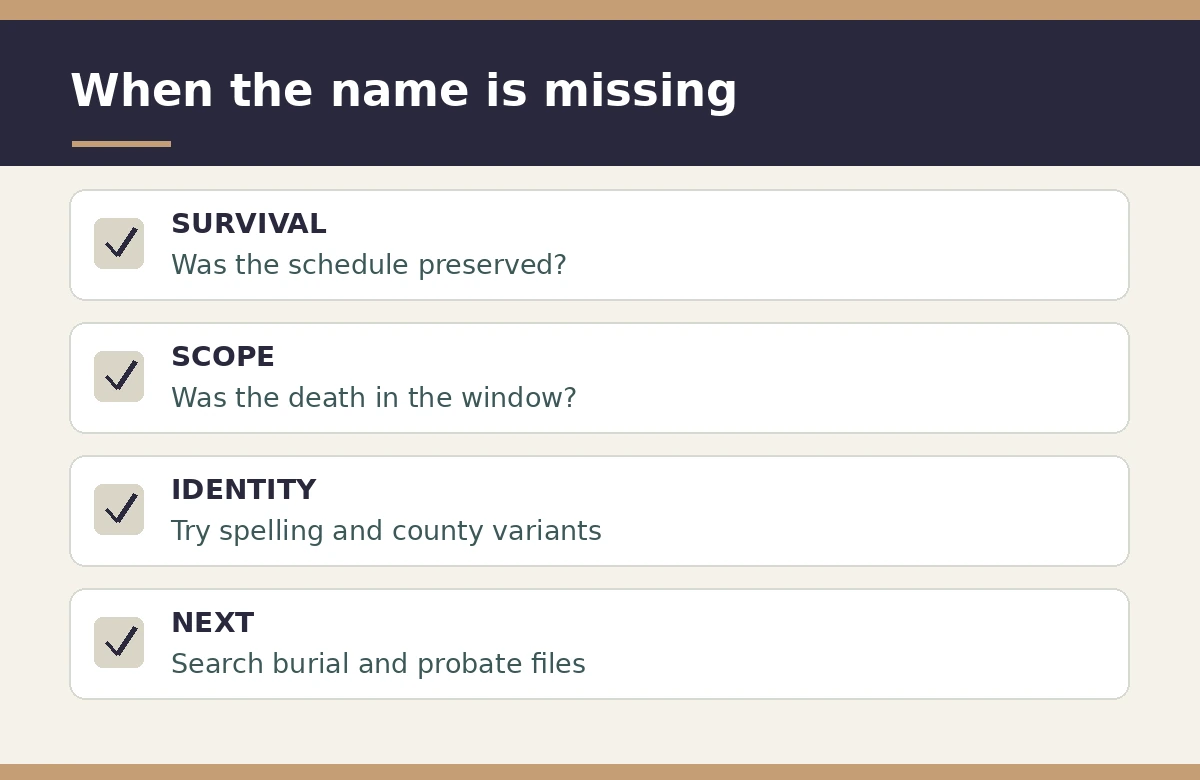
Close the search with a survival and evidence statement
Finish with a three-part note: whether the correct schedule survives, whether a candidate row was located and exactly what that row says. Include the manuscript citation, locality, enumerator or page locator when present, the collection provider and the day you accessed it. Distinguish a schedule image from an index abstract; neither substitutes automatically for a certified vital record.
If your search produces no candidate, identify the next source class—probate, church burial, cemetery, local newspaper or an earlier census—to test the same place and period. Death records are often sparse before comprehensive state registration, but that makes the mortality schedule one item in a carefully reasoned evidence set, not a blanket substitute for a missing certificate.
How We Research Us Mortality Census Schedules 1850 To 1880
GenHis bases this guide on the listed original-archive research pages and documented descriptions of the collection. We checked the period, repository arrangement, terminology, access limitations and the distinction between an index or transcript and the original manuscript. Fictional examples are used only to demonstrate method; they are not real archival citations. We do not claim to have opened a named ancestor’s record, and all conclusions require independent identity verification.
More Records and Archives Guides
Official repositories and primary collection guides for Mortality research
NARA mortality schedules and the 12-month period before census enumeration (archives.gov).
U.S. Census Bureau listing of mortality census years and typical fields (census.gov).
Missouri State Archives examples of changing fields, state-level index and manuscript availability (sos.mo.gov).
Editorial disclosure: This educational archive guide contains no paid recommendation or verified affiliate arrangement. See the GenHis affiliate disclosure. Historical records may contain outdated or discriminatory language; report it as an attributed historical statement, not a present-day judgment. Costs, accessibility and indexing may change, so confirm current conditions with the institution before requesting records.
No. They were intended to record deaths in a specific preceding 12-month period, not a calendar-year death index.
The decennial mortality schedules relevant here are 1850, 1860, 1870 and 1880; some 1885 state and territorial censuses also included them.
No. Holdings and access vary; use a state-and-year availability guide before inferring a person was not recorded.
No. It is a historical report using the language and knowledge of the period, which may be imprecise.
No. Cite the month reported and seek another contemporary record for a more precise date.