
U.S. agricultural census schedules for 1850, 1860, 1870 and 1880 can describe a farm’s acreage, animals, crops and estimated value, but they were not a register of land titles. Start with the correct county and minor civil division in the population census, locate the corresponding surviving agricultural page and identify the named farmer or manager before interpreting its figures. Small farms were sometimes excluded, so a missing agricultural entry does not mean the family had no land or crops.
Identify the farm year and jurisdiction before opening an index
The National Archives treats agricultural schedules as nonpopulation returns taken alongside the decennial population census. These are distinct manuscripts, even when the same enumerator visited the area. Choose one of the four relevant years and establish the historical state, county and township or equivalent subdivision. County boundaries and township names may have changed; a modern address alone can point to the wrong volume. Keep a citation to the corresponding population schedule as your starting locator.
Record the farmer’s stated residence, occupational description, family or dwelling reference and neighbors, but do not assume that every agricultural page is organized in exactly the same sequence as the population page. Use the original state-specific holdings guide to establish whether the nonpopulation schedule survived and whether scans, microfilm, or a state archive supply it. A catalogue entry for an entire census series is not proof that your individual county appears there.
Apply the inclusion thresholds before calling a farmer missing
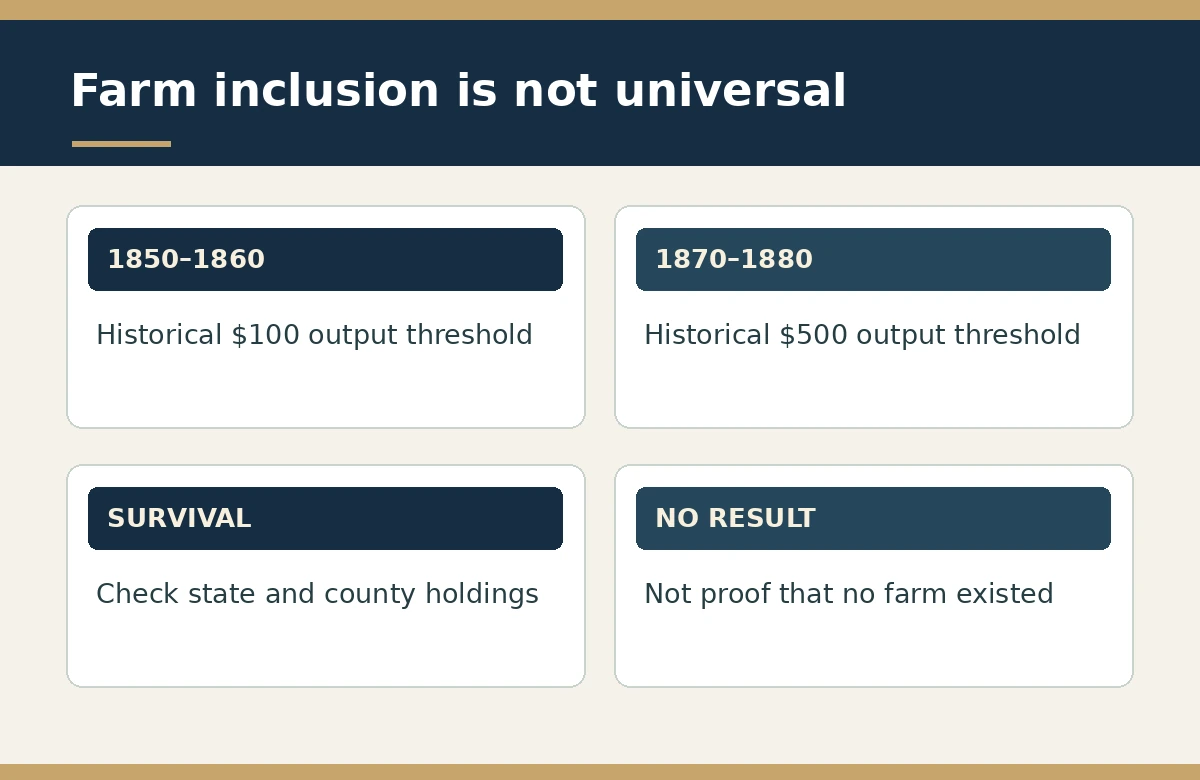
The census instructions did not aim to capture every kitchen garden or subsistence plot. NARA describes a production-value threshold of $100 for 1850 and 1860 and $500 for 1870 and 1880, with other rules affecting smaller holdings. A tenant farming below the minimum could appear in the population census but not on the separate farm schedule. Assess the historical threshold rather than interpreting an unsuccessful name search as evidence that the family did not farm.
Agricultural schedules themselves also varied by year. In 1880 the form expanded crop-specific acreage and poultry and egg reporting, so a column available in 1880 may not have an equivalent in 1850. Read the actual year’s blank form from NARA before transcribing a faded heading. Preserve the unit of measurement and distinguish the census reference period for harvested output from the one-day enumeration of residents.
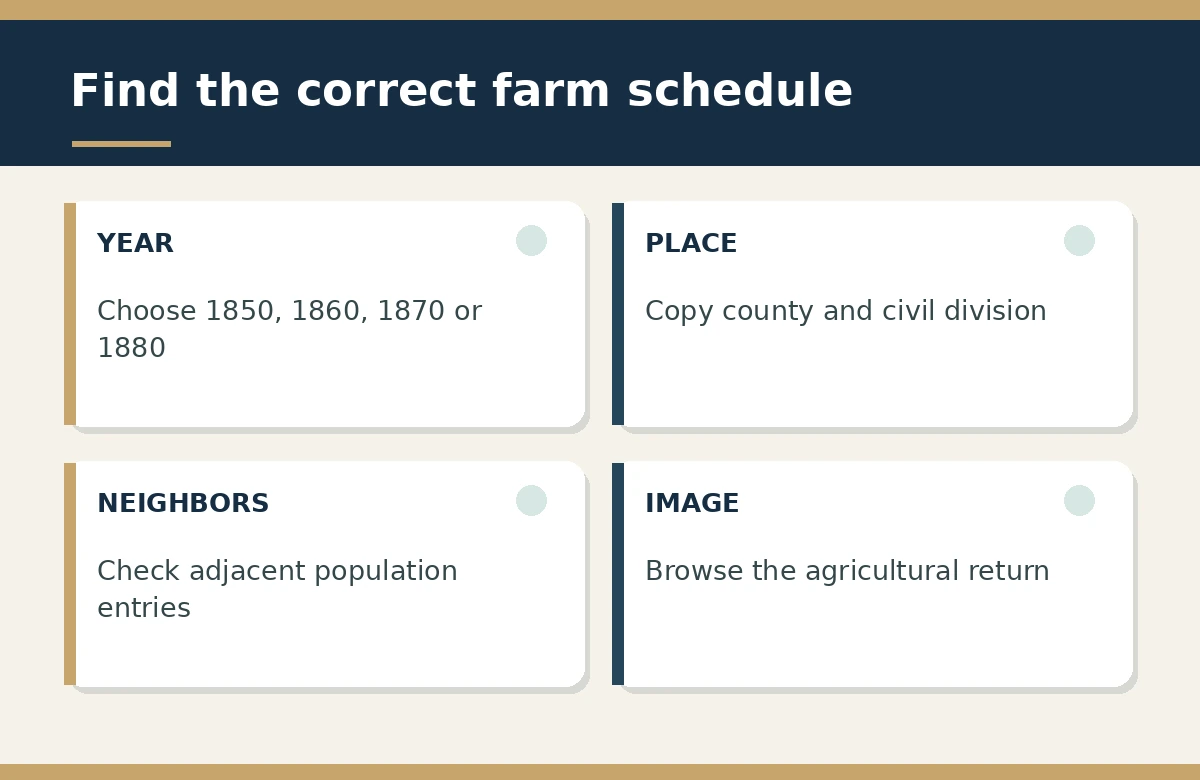
Find the manuscript through population census neighbors and place
First, search the named resident in the regular population census and capture both their household and the neighboring farms. Next browse the agricultural volume for that locality, searching a cluster of surnames rather than relying on the exact appearance of one family name. Spelling errors, separated farm operations and different page order can make a direct person-to-person lookup unreliable. If an online site has only partial indexing, browsing images of the actual district is the appropriate recovery method.
For a fictional example, suppose a family appears in the 1870 Ohio population return with a farmer and two adult laborers. An agricultural entry in the same township reports a farm under the father’s name, but not every family member is named. The correct conclusion is that a named farm operator is represented in that agricultural entry; the adult laborers’ involvement and precise ownership must be established with independent tax, deed or estate records.
| Source or period | What it can show | What it cannot prove |
|---|---|---|
| Population census | Named residents and locality | Not farm output or title |
| Agricultural schedule | Named operator, land and production | Not every farm or all farm workers |
| County deed or tax file | Transfer or assessment evidence | Needs parcel and date match |
Separate acres, livestock and value from legal ownership
An agricultural schedule can report improved and unimproved acreage, numbers of animals, machinery value and output such as grain or dairy production. Enter each numerical field with its year and original column heading. “Cash value of farm” and machinery or livestock values are different measures and should not be combined into a claimed estate value without explanation. A dramatic rise in crop output may reflect acreage, weather or reporting changes; it does not by itself prove an inheritance.
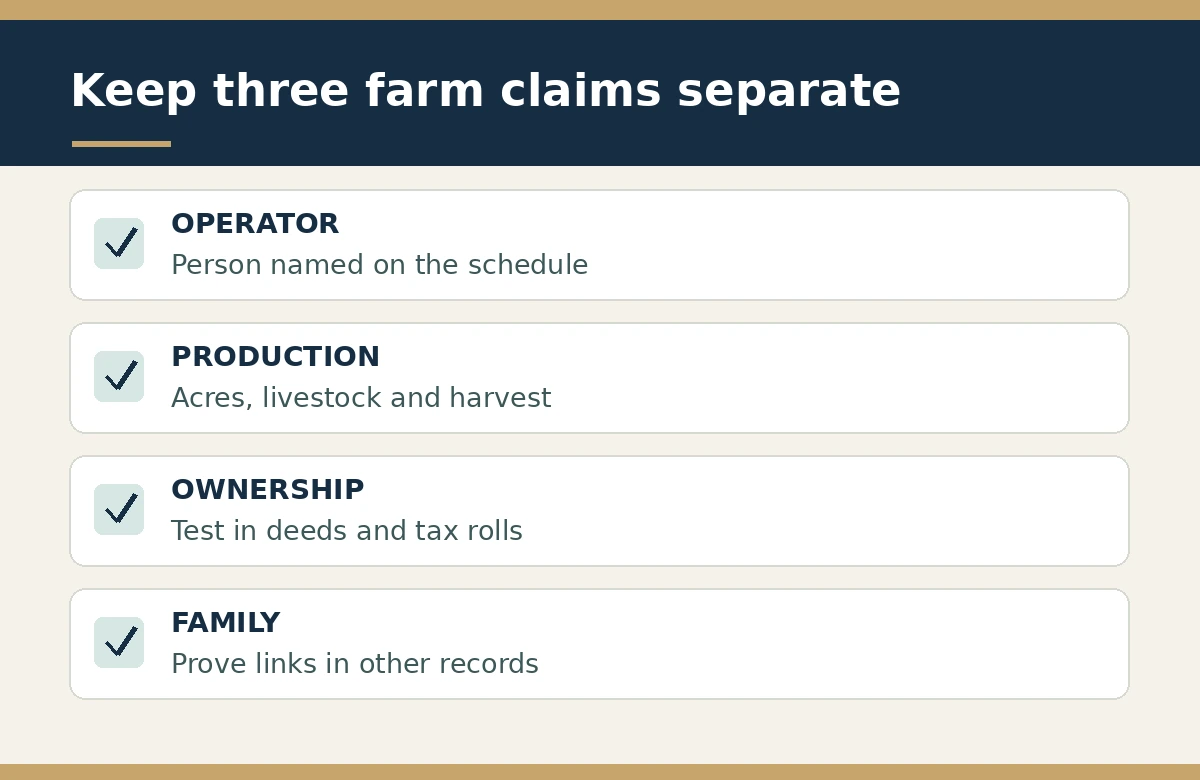
The name at the head of the farm return may be an owner or manager. Even when the enumerator uses the word farm, an operational census entry is not a deed, mortgage or proof of residence at the tract. To establish a purchase, consult local deed indexes and the actual conveyance. To establish residence, compare the population schedule, taxes or directories. Keep three distinct conclusions in your notes: named operator, economic characteristics and legal title.
Handle missing counties and doubtful entries as documented limits
NARA provides a state-by-state guide because agricultural schedules are not uniformly held in one complete national collection. States received many of these manuscript schedules, and copies were not always preserved or digitized. Search the holdings of the relevant state archive and NARA before concluding a county has no surviving pages. Where the record does not survive, a land-tax list or county agricultural report can offer contextual evidence, but neither replaces the missing individual schedule. Our guide “U.S. Mortality Census Schedules, 1850–1880” covers how to find a death and test the evidence.
If you encounter two candidates with the same surname, compare the minor civil division, neighboring operators and farm characteristics against independent evidence. Never identify the household only because its reported farm value resembles a figure from family lore. Your research log should preserve the exact image range browsed, the form year, county and all name spellings checked. That makes a negative search reproducible and allows a later discovery to change the result.
Write a narrow farm history and select an independent next record
A careful narrative can state that the schedule attributes specified acres, livestock or crop output to the named operator in the enumerated district. Cite the schedule and its repository or image identifier; separately cite the population page used for matching. Mark crop quantities as enumerator-reported statements rather than present-day verified measurements. Where handwriting is unclear, retain the literal reading and the uncertainty instead of inserting an attractive rounded figure.
End with one testable question: Did this operator rent, own or manage the tract? Was a later listed farm the same parcel? Did a reported young adult live on the premises? Select a deed, probate file, tax roll or later enumeration that can actually answer that question. A productive farm-history article links two different record types; it does not mistake an economic survey for proof of a family relationship.
How We Research Us Agricultural Census Schedules 1850 To 1880
For this farm-schedule guide we checked the National Archives account of nonpopulation enumeration, year-specific blank forms and its explanation of under-threshold farms. We reconciled the changing dollar thresholds with NARA’s description of 1850–1880 coverage and confirmed that holdings differ among state repositories. The worked farm scenario is invented solely to demonstrate a township-to-county lookup, not a claimed discovery of a particular family. Our conclusions distinguish enumerated production and a named operator from an actual recorded transfer of property.
More Records and Archives Guides
Official repositories and primary collection guides for U.S. Farm research
NARA explains the agricultural schedules, 1850–1880 farm thresholds, major fields and state-by-state holdings (archives.gov).
NARA explains locality-first searching and exclusion thresholds and warns about lack of comprehensive indexes (narations.blogs.archives.gov).
Also, NARA hosts separate blank agricultural forms for 1850, 1860, 1870 and 1880 (archives.gov).
This is an independent educational guide to historical agricultural records. No paid placement, referral fee or archive partnership is asserted. Our site policy is explained in the GenHis affiliate disclosure. Please check the relevant state archive for current copy services, fees and accessibility. Enumerator-reported farm values and older administrative classifications should be interpreted in their original period, rather than mistaken for today’s legal or economic findings.
The principal federal agricultural schedules exist for 1850, 1860, 1870 and 1880, but manuscript survival depends on the state and county.
No. It generally names the farm operator or manager, not a full roster of laborers or relatives.
Small-farm thresholds, losses, county coverage, indexing gaps or residence under another operator may explain the absence.
No. Use deeds and other title sources to test ownership separately from operation and production.
Use the person’s population-census locality and neighbors to browse the surviving county and township nonpopulation pages.