
Swedish parish moving registers can provide the missing link when an ancestor disappears from one household-examination volume and appears in another parish. The moving-out book (utflyttningslängd) often names the destination; the moving-in book (inflyttningslängd) identifies an arrival and can direct you to a page in the household record. These are complementary observations, not automatic proof that every intended move happened. Search the historical parish’s B-series, compare both ends and verify the person again in the A-series household book.
Identify B I and B II before opening another household book
Riksarkivet organizes parish books by record class. Its genealogy guide identifies B I as incoming-migration records and B II as outgoing-migration records; A-series books contain household examinations and later parish registers. A householder who vanishes from one A-series volume may have moved to a different parish, died or changed residence within the same parish. Read the margin for a departure or page reference before guessing the cause of the disappearance. For a related choice, see our guide “Finnish Communion Books”.
The terms inflyttning and utflyttning refer to moves into and out of a parish, not necessarily international immigration or emigration. A move from one Swedish parish to another may produce two entries, while overseas departures can require additional registers or passenger records. Keep both the church-administered parish and the actual village or farm name in the notes, since a settlement can belong to a different parish today. Our guide “Swedish Emigration Records, 1783–1951” adds more detail on this.
Start with a known household and its marginal move notation
Locate the person’s last certain household-examination entry or later parish-book entry. Copy name, birth date and birth parish exactly, together with farm or address, book years and page number. Look at the marginal column for utflyttad, a destination or a cross-reference to the outgoing-migration book. Because handwriting and names vary, retain original spellings before normalizing the destination. Never move a person to the first same-named parish you find without testing the archival context.
The Riksarkivet church-archive guide notes that the outgoing register records the parish to which an individual departed and that incoming registers often give the destination village and A-series page number. Use these as directions rather than as a complete life story. If a move note gives only a year, browse the corresponding B II volume in chronological order rather than insisting that a modern searchable index must contain it.

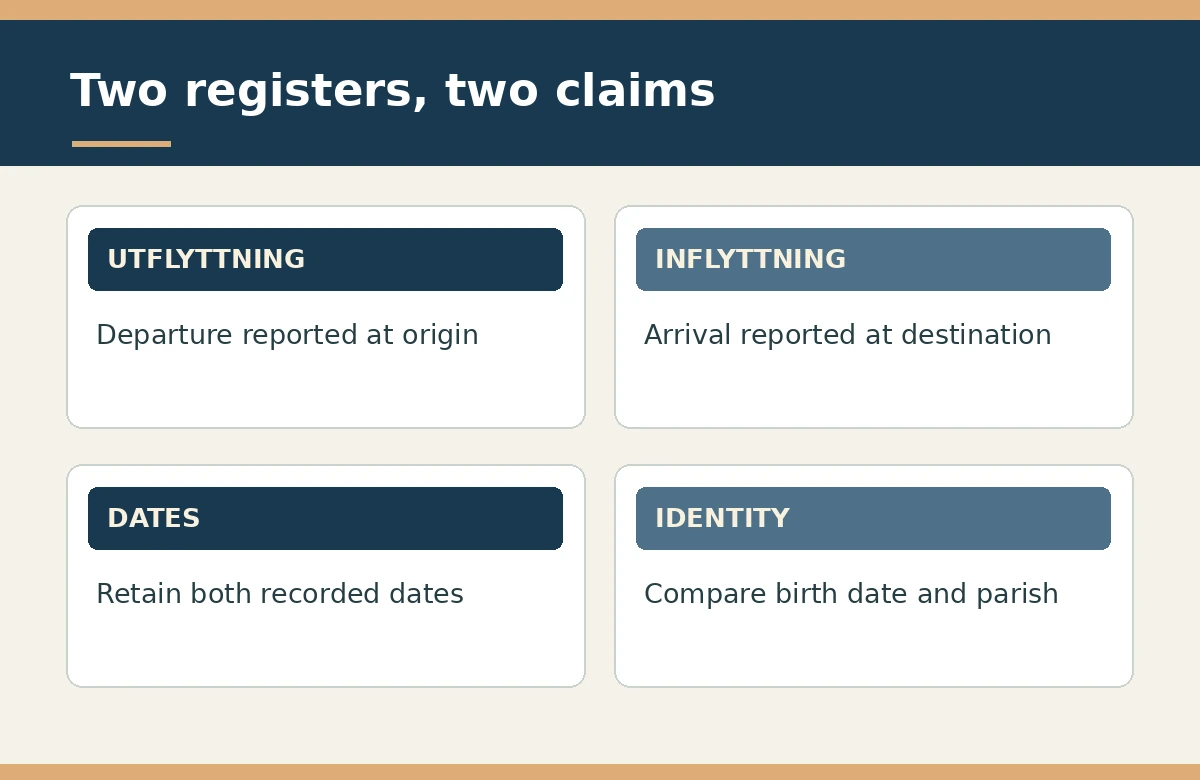
Match the out-move and in-move as two separate entries
Find the person in the old parish’s B II book and transcribe the move date or certificate reference as written, destination, occupation and any other distinguishing details. Then locate that destination parish’s B I book and search the period around the move. Compare full name, birth date, birthplace, originating parish and any household page pointer. A similar name alone is insufficient; a migration chain is especially vulnerable to merging two laborers of the same age.
For a fictional example, suppose an Anna Andersdotter leaves a rural parish in 1876 and an Anna with the same patronymic enters a nearby town. If their birth dates differ or the arriving woman names another birth parish, do not join them. Check intervening records and the A-series household page identified by the B I entry. If the two moving registers disagree on the month, preserve both reports and explain why the identity remains likely or uncertain.
| Source or period | What it can show | What it cannot prove |
|---|---|---|
| B II outgoing book | Reported departure and destination | Not proof of arrival |
| B I incoming book | Reported arrival and origin | Not lifelong residence |
| A-series household book | People and location over a span | Not a single dated move certificate |
Verify the destination in the household-examination volume
A B I entry often points into a household-examination register. Follow that page reference and check whether the person appears in the correct household under a farm, street or employer. Compare ages, birth place and reported position before attaching spouse or child relationships. The A-series entry provides the context of a residence through time; the B-series supplies a dated administrative move event. Neither on its own guarantees that the person stayed at the address for the entire period. Our guide “Swedish Household Examination Rolls” goes into more detail.
When the A-series book gives a different year or a further departure, capture the sequence as separate events. A household book may have been maintained across several years, with marginal notations added later. Avoid describing the volume’s cover date as the person’s arrival date. A careful timeline lists the outgoing certificate, incoming entry and household appearance independently, then chooses a baptism, marriage or employment record to settle any conflicting identity detail.
Expect earlier gaps and understand how registers developed
Riksarkivet’s historical account explains that moving registers were not uniformly mandatory at first and that standardization strengthened in the nineteenth century. Some earlier books never existed, some survive only in parts and attachments could be discarded. The absence of a B I or B II entry is therefore not proof that a person did not move. Search the parish archive inventory for actual years, and look in household-book margins, moving certificates or later local records where the formal register is missing.
This is particularly important if a family-history tree shows a neat succession of towns without citations. A place in a birth entry, a farm in a household examination and a destination named in a move register are different kinds of location evidence. Record the event date attached to each and do not infer long-distance travel from a single certificate. Sensitive or modern records can be subject to access restrictions; use publicly available historic material and follow archival rules.
Produce a two-parish citation and a defensible migration conclusion
Your final source list should cite both parishes and both B-series volumes with their archival references, chronological entry or page numbers and image links, plus the destination A-series household page. If only one side survives, say which side is missing and what substitutes were searched. Preserve Swedish terminology in citations so another researcher can distinguish an incoming entry from an outgoing one and retrace your route through the archive.
A defensible conclusion is that an outgoing entry from parish A and an incoming entry in parish B report a move by a person matching a particular set of identity features, with destination residence supported by the household book. That is stronger than a single unsourced arrow on a family tree. If the identity is still uncertain, identify the competing candidate and one record that would discriminate between them before extending the lineage.

How We Research Swedish Moving In Moving Out Parish Registers
Our Swedish record routing follows Riksarkivet’s inventory explanation for parish A- and B-series material and its historical account of incomplete early moving registers. We separately examined the Church of Sweden’s description of the parish books. The two-Parish Anna example is a simulated identity conflict, included to show why a move-out entry and an arrival entry must be matched on more than a patronymic.
More Records and Archives Guides
Official repositories and primary collection guides for Swedish Parish research
Riksarkivet explains B-series in-and-out moving books, page links and parish routing (sok.riksarkivet.se).
Riksarkivet describes A-series household books, B I/B II moving books and H II supporting attachments (sok.riksarkivet.se).
Riksarkivet explains historical inconsistency, voluntary early moving books, later standardization and survival limits (forvaltningshistorik.riksarkivet.se).
Church of Sweden provides the role of parish registers and recorded migration in family research (svenskakyrkan.se).
This guide contains no affiliate links. Details of site-level commercial disclosures are at GenHis affiliate disclosure. Parish registers may use older terminology and are subject to survival and access conditions that depend on place and date. Consult the responsible repository directly; do not pursue restricted records of living people through an unapproved route.
B I is generally the moving-in register; B II is the moving-out register for a parish.
Either helps, but starting from a documented A-series household usually gives the most reliable move clue.
No. Look for the matching incoming register and destination household page.
Early books may be incomplete or absent, the parish may have changed, and names or years may be mistranscribed.
Identify each parish, archive series and volume, year and page or entry, image reference and any related household-book page.