
Swedish Emigration Records, 1783–1951 is a compiled search collection also called Emigranten Populär, not one continuous passenger manifest. Its collection description identifies five source databases covering port departures, emigrant-agent letters, passports, Swedish America Line passengers and certain sailors. A hit is useful only after you record which source produced it. Then work back through the Swedish National Archives parish moving-out lists and household records to test the traveler’s identity.
Read the five Emigranten Populär source names before searching
EmiHamn indexes travelers in departure-port lists; EmiLarsson concerns correspondence with the Larsson Brothers emigration agents; EmiPass covers early passport holders; EmiSal concerns Swedish America Line passenger material; and EmiSjo covers selected sailor records. Their dates and source purposes differ. An EmiLarsson correspondence reference is not a ship departure, and an EmiPass passport is not proof that its holder reached North America. Note the precise component database shown by every result.
The umbrella span 1783–1951 describes the compilation as a whole, not uninterrupted coverage for each port, every traveler or each type of document. The collection’s description specifies, for example, Göteborg port records from 1869 to 1951 and EmiPass passports from 1783 to 1860. Some records may include a destination or ship name, while another component may contain only correspondence or an agent reference. Base your claim on the source-specific field list instead of a database-wide label.
Use ports and dates to interpret EmiHamn departure entries
The EmiHamn part of the compilation includes departures from Göteborg and several other ports, including Malmö, Stockholm, Copenhagen and Hamburg, with different year ranges. A passenger who left Sweden via Denmark may therefore appear under a foreign departure port. Begin with the strongest Swedish birthplace or last parish, possible departure decade and surname spelling, then widen to other routes only as necessary. A Swedish-American family story about “leaving from Göteborg” is a starting hypothesis, not proof of the actual port. For the next step, our guide “Hamburg Passenger Lists, 1850–1934” explains how to find the departure record.
Transcribe name, date, port, destination, origin, record number and any ship or agent clue exactly. Emigration destination fields can name an intended location, not the final settlement. Compare the result with immigration manifests and an American census or naturalization petition without assuming the same ship continued across the Atlantic. A traveler might have taken a feeder vessel to a continental connection. Each leg should be recorded separately and supported by its own evidence.

Identify letters, passports, line travel and sailors correctly
An EmiLarsson reference points toward correspondence of Larsson Brothers & Co., whose archive is connected to Göteborg; a letter may describe plans or an actual voyage, depending on its wording. EmiPass is an early passport source and does not stand in for a border arrival register. EmiSal deals with the Swedish America Line in the twentieth century and includes traffic in both directions. EmiSjo tracks selected sailors who were discharged, deserted or died outside Europe rather than ordinary emigrant families.
Make a source-key in your research log before interpreting any result: component, source purpose, recording body, event recorded, date and location. A sailor’s recorded discharge may explain later absence from a home parish, but it does not prove permanent immigration. A letter headed for Chicago may express an intention not an arrival. Verify whether an original letter, passport entry or passenger list is available in Swedish holdings before turning a derived database phrase into a biographical fact.
Move from an index hit to a Swedish parish household
Riksarkivet explains that parish utflyttningslängder are lists of people who moved out, often noting destination parish. Parish husförhörslängder and later household books can record family members, dates of birth, residence and movement. Start from the exact home locality in the migration index, identify its historical parish and find the household before the supposed departure. This gives a stronger identity foundation than comparing a common patronymic name with a U.S. surname. For a related choice, see our guide “Württemberg Emigration Index”.
Keep Swedish terminology precise: an emigrant can leave a parish before leaving the country, and the destination in a moving-out book may be another Swedish parish. Follow the next recorded move rather than jumping directly to America. A household page may contain a marginal migration note or a moving-out certificate reference, which should be transcribed in the original language. Spelling and surname practices changed over time; do not make a patronymic name match alone establish a family relationship.
Test a same-name traveler with a birth date and locality
Imagine a fictional Anna Andersdotter in an 1880s port index. Many Swedish women shared that name, so the indexed age and intended destination cannot independently connect her to a specific U.S. family. Locate her parish birth entry and follow the predeparture household through a dated moving-out entry. Build a parallel timeline for any other Anna Andersdotter of similar age from the same region. Compare precise birth day, parents, residence and movement path. For the fuller picture, see our guide “Swedish Moving-In and Moving-Out Registers”.
When a U.S. document uses Johnson instead of Andersdotter, separate the surname-change hypothesis from the evidence of actual movement. Passenger index and Swedish household book may both be accurate yet refer to different people. The conclusion should state each independent marker and unresolved conflict, including approximated age. Do not count multiple websites repeating the same Emigranten Populär entry as separate corroboration. Use another original series that was created for a different administrative purpose.
Avoid false negatives caused by coverage and access limits
Sweden’s National Archives describes its online emigration sources largely in relation to legal emigration, when a person requested the relevant moving-out certificate. A person who left without completing local paperwork may not appear in that record stream. Ports have distinct date ranges, and some original materials are not indexed with the same spelling or fields as the published compilation. A blank surname search therefore does not show that no emigration occurred.
Widen one variable at a time: alternate spelling, birthplace, year, port, or one of the other four component databases. If an indexed result links only to a subscription site, use the source description to identify the original archive or parish material and check what Riksarkivet makes available. Do not claim a free online image exists merely because a free finding aid is accessible. Record the database used, the access status and the archival series still to be consulted.

Write a migration proof chain with honest event labels
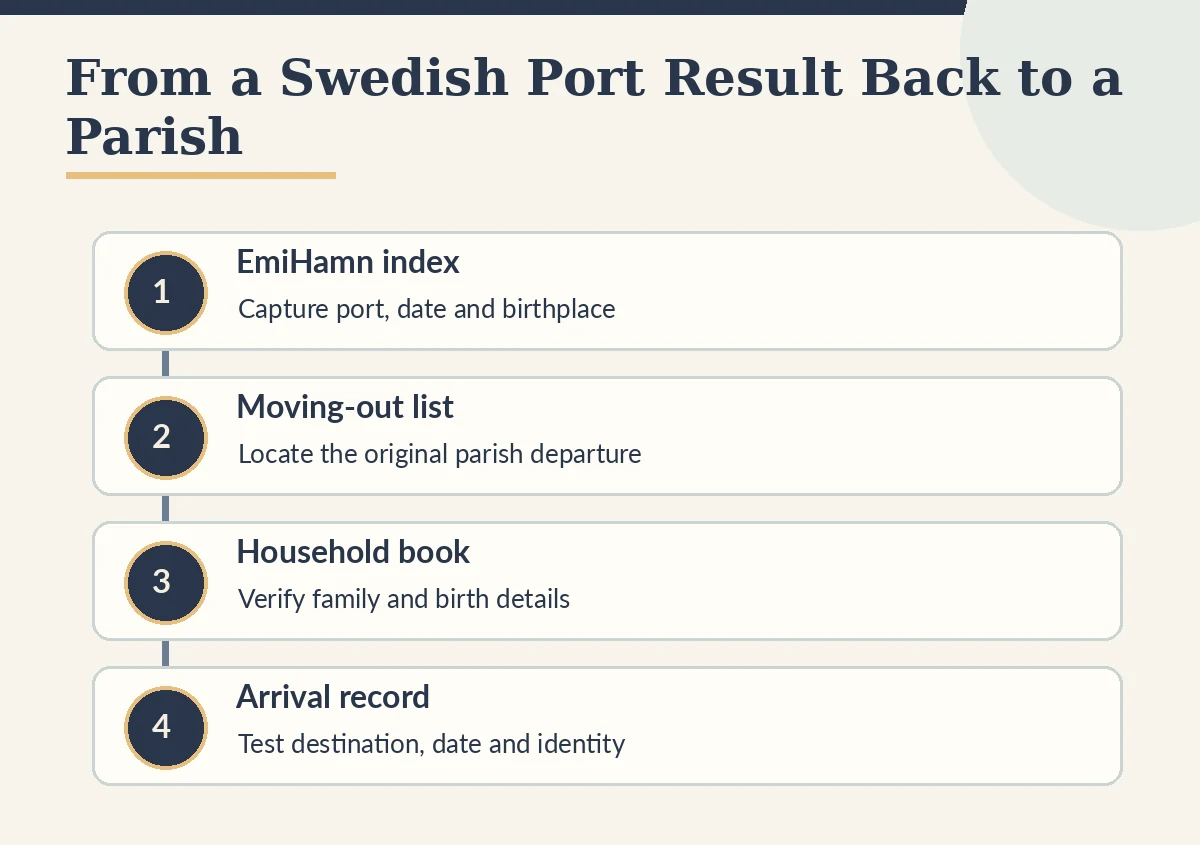
A strong chain might read: Swedish parish household at a dated residence; moving-out entry naming destination; EmiHamn departure observation; arrival record at a later port; and a subsequent household or naturalization source confirming identity. Each line carries a repository and date, not just a name. If one link is missing, retain it as an open research question. Travel could be delayed, rerouted or abandoned, and an emigration plan does not imply successful arrival. For a related choice, see our guide “U.S. Passport Applications, 1795–1925”.
Cite Emigranten Populär by component database and any original reference supplied, then separately cite the Swedish parish register and the receiving country record. Preserve diacritics in quotations while logging sensible search variants. The final conclusion should identify what was documented, what remained inferred and what further source would resolve the uncertainty. That is more useful than a single undifferentiated passenger-list search result.
More Records and Archives Guides
How We Research Swedish Emigration Sources
We reviewed the published Emigranten Populär component list and compared it with Riksarkivet guidance for emigration and Swedish parish records. We label intended migration, passport issue, letter, departure and arrival as separate events. Access and coverage vary by source and we do not imply every archival document is freely downloadable. See affiliate disclosure; no subscription affiliation is claimed.
No. Emigranten Populär combines five different databases with distinct dates, places and source purposes.
Selected port passenger departures; coverage and dates vary among Göteborg and other ports.
No. An issued passport is not independent evidence of travel or arrival.
Use Riksarkivet parish household books, moving-out records and birth entries to test the indexed identity.
Port gaps, spelling differences, incomplete indexing or unrecorded migration can explain a negative search.