
For nineteenth-century Poor Law emigration, MH 20 registers can lead to correspondence in MH 19 between the Poor Law authorities and other government departments. The records concern administrative decisions and exchanges, not a complete list of families who sailed. Under the Poor Law Amendment Act of 1834, local provision could be made for poor people’s emigration at a parish’s expense. A proposed or approved scheme still needs a separate record to establish that a named person actually departed.
The practical method is to distinguish a catalogue locator, a document you have actually read, and an independently verified conclusion. Use the relevant National Archives research guide to understand what this series was created to record. Start a research log with your exact question, place, time period, preferred spelling variants and the piece reference; a search result alone is not a complete citation.
Why departmental correspondence matters for family research
The Poor Law Amendment Act of 1834 allowed provision for the emigration of poor people with costs borne by their home parish. This created questions about finance, authority and destination arrangements that could be discussed between central departments. The National Archives identifies MH 19 as correspondence with other government departments and MH 20 as the related registers; these are not simply local workhouse admission books.
A family might appear in a proposal, a request for instructions or a discussion of how a scheme would operate. Such records can explain the administrative context around a move even when a passenger list is missing. However, a letter about a group of emigrants does not prove a particular family joined the party. Keep each level of evidence separate from the beginning.
Start with the department and period, not a guessed name
The registers in MH 20 and the linked correspondence are arranged by government department. The National Archives therefore recommends identifying which departments the Poor Law authorities were dealing with on the subject. For emigration, consider colonial administration and other bodies named in the relevant paperwork. Searching a surname across an undifferentiated national series may miss the correspondence entirely.
Prepare a department-date matrix recording the union or parish, colonial destination, the date of an application and the institution that may have been consulted. Use historical department names appropriate to the date. If no department can be identified, start with local Poor Law union records and discover where a request was forwarded before attempting a broad MH 20 search.
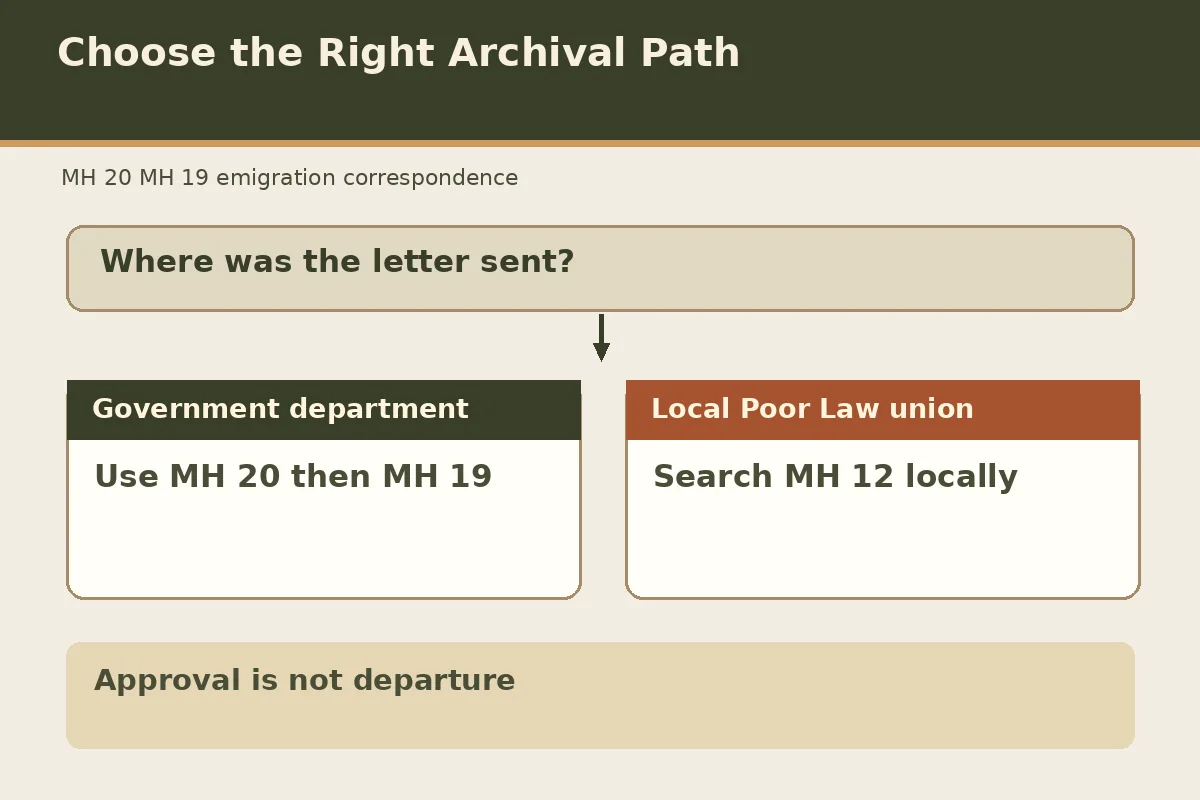
Read an MH 20 entry as a pointer to MH 19
MH 20 registers are finding aids that help locate entries of interdepartmental correspondence in MH 19. An entry may establish the subject and a letter route, but it is not the letter itself. Copy its numbers, dates and any reference to the originating department exactly. Follow the reference to the surviving paper before reporting what any official said or decided.
The National Archives gives MH 19/22 as an example of correspondence concerning the Colonial Land and Emigration Commissioners, covering 1836–1876, and MH 13/252 for 1853–1854. These are examples to guide a search, not guarantees that every parish or family appears. Record the particular correspondence bundle you actually checked, not just the broader series name.
Differentiate proposal, authorization and travel
Poor Law emigration generated distinct stages: families might apply, guardians might deliberate, officials might authorize costs, a passage might be arranged and people might sail. The stages are not interchangeable. A signed letter approving funding cannot alone demonstrate an embarkation, and a later report of departures cannot always identify each traveler without a list.
Build a decision ledger with one row per dated stage and columns for who created the record, what action it describes and whether it names the family. For actual passage, look for shipping records, contemporary letters, or arrival documentation. If a person was approved but appears in later local records, investigate the apparent conflict rather than treating approval as completed migration.

| Record | What it can establish | What it cannot establish |
|---|---|---|
| MH 20 register | Letter subject and reference | That a journey occurred |
| MH 19 letter | Administrative proposal or reply | Every named person traveled |
| MH 12 or passenger list | Union or journey evidence | Automatic identity match |
Use MH 12 for local context, not as an interchangeable series
The National Archives directs researchers to MH 12 for Poor Law Union correspondence from 1834–1900; searchable terms may include ’emigration,’ ’emigrant,’ destination names or lists of people. MH 12 can contain local union-specific material, whereas MH 19 is interdepartmental correspondence. The differing administrative creators affect what a document can prove and how it can be found.
For a named individual, search guardian minutes, settlement documents, workhouse records or parish material held locally where appropriate. A family described collectively in a central letter may be individually named in the union’s papers, or vice versa. Distinguish two separate sources even if one quotes the other; transcription from the same original does not count as independent confirmation.
Build a family timeline across both ends of the journey
Connect the administrative record to evidence at the destination. First, compare each person’s identity and household with a dated pre-departure source. Next, establish the transport event if a list or reliable account exists. Finally, check early settlement records in the destination country for age, associates, occupation or birthplace. Do not assume that a common name in Canada or Australia identifies the person mentioned by an English Poor Law board.
Time gaps matter. A proposal recorded in spring may be followed by a delayed or canceled departure; an arrival date could relate to a different journey. Note uncertainty in ages and name spellings rather than forcing them to align. If records name only a group or vessel, present a provisional hypothesis and identify what would falsify it.

Explain the scope of a failed MH 20 search
A missing MH 20 entry can mean the correspondence went through another department, fell outside the period searched, was indexed unexpectedly or did not survive. It does not by itself show that the emigration scheme was never discussed. Try alternate subject terms, possible department names and adjacent dates; consult the archive’s arrangement guidance before declaring the result meaningful.
Record each MH 20 register examined, the related MH 19 correspondence searched and any local MH 12 or other source checked. Describe the strongest established fact: a proposed passage, a government reply, a local decision or a documented departure. Keep the distinction clear so future researchers can continue the inquiry without inheriting an unsupported migration story.
More Records and Archives Guides
How We Research This Archive Route
We checked the first official archival guide against the second repository guide and compared the series purpose, documentary limits and access instructions. The illustrations are explanatory reconstructions, not scans or transcriptions of an archival document; no imaginary named ancestor has been inserted into a record.
Use a reproducible evidence log: the exact piece reference; what was actually consulted; the document creator and date; a transcription of critical words; contrary evidence; and the next document needed. A page in a catalogue and a page of evidence serve different purposes. When a record is missing, closed or only available in a reading room, state that limitation rather than inventing its contents. A request for assisted emigration is not proof of embarkation. Please read our affiliate disclosure; this research guide does not assert any paid provider relationship.
MH 20 contains registers of interdepartmental correspondence; MH 19 contains associated correspondence with government departments.
No. MH 12 concerns individual Poor Law unions and is useful for locally focused searches.
No. Seek a passenger, arrival or another contemporaneous source documenting the departure.
The National Archives mentions MH 19/22 (1836–1876) and MH 13/252 (1853–1854) as relevant examples.
Test department routing, subject terms, spelling and dates; a missing central letter does not disprove a local emigration event.