
Poor Law Inspectors MH 32 is useful only when its record type answers the question you actually have. Start with the historical place and date, determine what the creator was trying to document, then retrieve the original piece or image. An archive index is a locator rather than a substitute for the underlying record. This guide separates documented facts, official or personal reports and claims that still require independent verification.
Know Why an Inspector Wrote to Central Government
MH 32 is correspondence of Assistant Poor Law Commissioners and later Poor Law Inspectors, not a continuous admission register for every workhouse. The National Archives dates this material to 1834–1904. Inspectors covered districts containing multiple Poor Law unions and reported on administration, schools, accommodation and conditions. Their names and districts can therefore locate correspondence that a search for an individual pauper will never find. Begin by deciding whether the research question is about institutional oversight or one person’s entry and exit.
An inspector’s criticism proves that a concern was reported, not that every resident experienced it. A building described as overcrowded may be relevant family context, but it does not make an ancestor a documented inmate. If you need admission, discharge or family relationships, local union registers are a separate route.
Choose Inspector, District, Union and Year
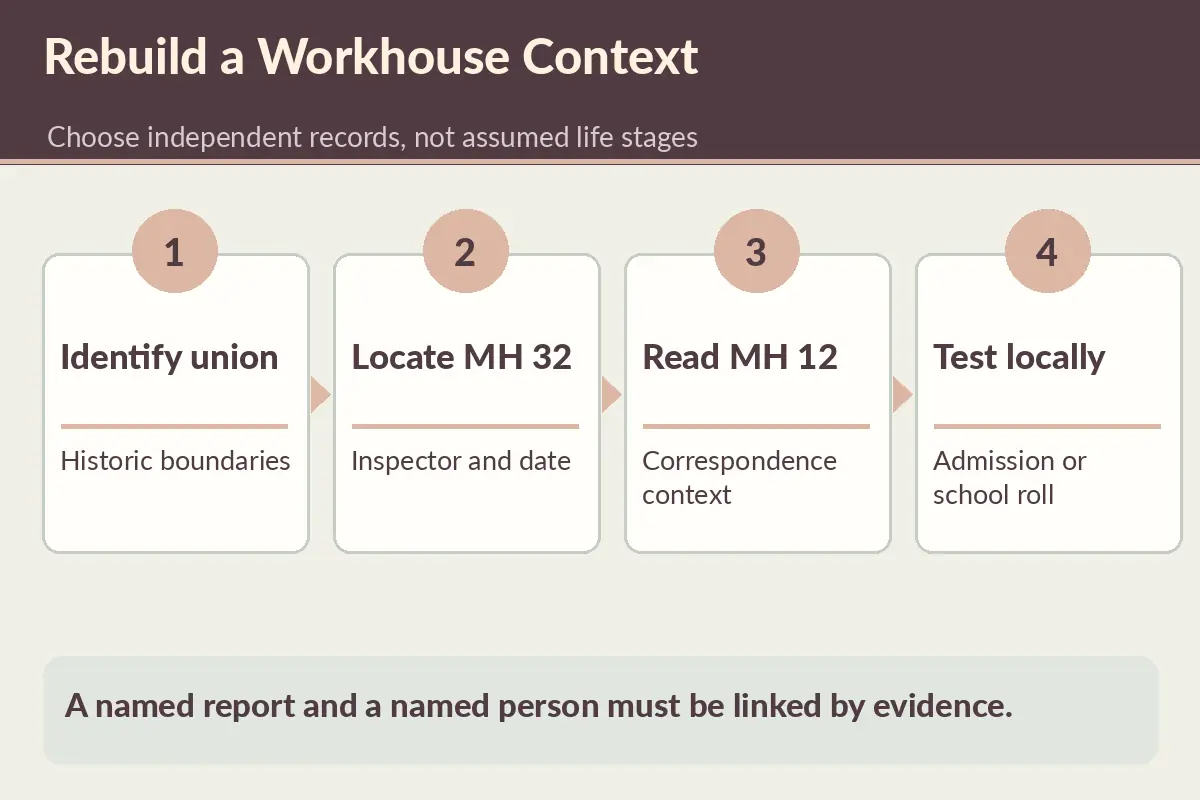
The Archives recommends searching MH 32 by an Assistant Commissioner’s or Inspector’s name or by the district. Identify the historic Poor Law union and the time frame before treating a modern town name as the right archival key. A workhouse could stand in a town different from the union name. Inspectors’ areas changed over time, so a district found in one year may not correspond exactly to an earlier administrative arrangement.
Keep a jurisdiction worksheet with event year, historic county, union, inspector or assistant commissioner and MH 32 piece. Use catalog descriptions as finding aids; the collection may require document ordering or on-site viewing depending on the item. Write down which years you actually searched to avoid interpreting an unexamined series as empty.

Locate School and Children’s Reports Separately
The Archives guide to children in care identifies MH 32 for reports on district schools, accommodation for pauper children and industrial training. School inspection is not necessarily a list of pupils. A complaint about a dormitory or a description of teaching may establish institutional context, staffing or a concern brought to central officials. To identify a child, look for name-bearing school admissions, local guardians minutes or parish records where they survive.
Do not assume a school named in an inspector’s report employed, enrolled or housed every child in a nearby family. Distinguish a visit date from a child’s residence span. When an inspector interviewed someone, record whether the answer was quoted, summarized, or reported by an official writing later.
Compare MH 32 With MH 12 Correspondence
MH 12 primarily holds correspondence between Poor Law unions and central government, with portions digitized and many pieces catalogued at union and date level. MH 32 follows the inspector or assistant commissioner’s oversight correspondence. These are complementary perspectives and may refer to the same incident but do not form an automatic chronological chain. Use the union, district, year and named people to test whether two letters concern the same matter.
A union memorandum might request advice on a case, while an inspector could report an institutional visit. If the two accounts disagree, keep the provenance visible. A description from the center should not silently replace a local record made at the time of admission or a named resident’s own statement.

Find Individual Workhouse Records Locally
For a specific inmate or employee, check the appropriate county or metropolitan archive for workhouse admission and discharge registers, births and deaths, staffing lists and guardians minutes. The Archives’ workhouse guide cautions that local survival varies and that many images are not online. A reported place in an inspection district should prompt a union identification search, not a claim that individual records survive at Kew.
Construct an evidence table: MH 32 establishes oversight context, MH 12 may identify union government correspondence, and an admission book may record named arrivals or departures. None is a substitute for an original civil birth, marriage or death entry. Avoid publishing potentially sensitive details about identifiable later residents without checking restrictions.
Describe Conditions Without Overstating a Family Story
An accurate conclusion might say an inspector inspected a named school or district in a particular year and described a stated problem. Cite MH 32 piece, report or letter date, the correspondent and page or folio. Add independent local sources for assertions about a relative’s attendance, medical care or family status. Different institutions with similar names must remain separate until linked by their historic union and site.
If an inspector’s letter is missing, do not assume no oversight took place. Record the catalogue scope, dates examined, and other possible custodians. A useful family history can combine administrative conditions with a proven local admission entry, but readers should see precisely which source supports each part of the account.
How We Research Archival Evidence and Its Limits
We reviewed the principal National Archives research guide and a second official archival guide on 28 October 2026, then checked their statements on series scope, historical dates, finding aids, custody and evidence limitations against this article’s diagrams. This was an editorial check of publicly described holdings, not an inspection of every original piece. Any stylized document in the cover illustration is an illustration, never an authentic manuscript or archive scan. Search results, translations and reported testimony are identified separately. A zero-result search in a catalogue is not proof that an event never occurred.
More Records and Archives Guides
Build Reproducible Citations and Ethical Conclusions
The primary guide establishes that MH 32 contains correspondence of assistant poor law commissioners or inspectors, searchable by inspector name or district; inspectors covered groups of unions.. The second helps verify that MH 32 correspondence includes reports on district schools, accommodation and children’s training, 1834–1904.. When reporting a new discovery, identify the creator, series and piece, original date, folio or page, names and their roles, how the document was accessed, and the exact claim it supports. Mark contradictions for review rather than merging names on intuition. Protect potentially living people where records contain sensitive details. GenHis explains relationships and referrals in its affiliate disclosure; these archive citations are not claims of commercial endorsement.
No. It contains oversight correspondence of assistant commissioners and Poor Law inspectors.
An inspector or assistant commissioner name, a district and an appropriate date.
Surviving admission and discharge registers are commonly held by county or local archives.
MH 32 follows inspector correspondence; MH 12 follows correspondence from unions to central government.
Not without a name-bearing register or other direct evidence that identifies that child.