
MH 33 comprises registers of correspondence linked to Poor Law Assistant Commissioners during 1834–1846. The registers help researchers find the subject of an inspector’s work and sometimes redirect an entry to a union sheet. They are a navigation aid, not a register of workhouse inmates or proof that an inspection recommendation was adopted. The crucial choice is between following an inspector’s MH 32 correspondence and tracing a union paper in MH 12. This guide gives a precise source route, identifies what the archive can and cannot show, and names the independent documents needed before a personal or geographic conclusion becomes defensible.
Identify the Union and Historical Inspecting District
Poor Law unions were formed after the 1834 reform by grouping parishes under elected boards of guardians. The central Poor Law Commission sent Assistant Commissioners into districts to help establish unions and supervise implementation of orders. Districts and union boundaries could shift, so modern local authority names can mislead. Start with the historical poor law union, approximate year and, if known, the Assistant Commissioner or Inspector. A workhouse building’s village is not always the name of the union in central catalogues.
The National Archives notes that inspector correspondence in MH 32 spans 1834–1904, whereas the MH 33 registers cover the narrower interval 1834–1846. That distinction matters if a family story concerns a later workhouse scandal or dismissal. An absent MH 33 entry after 1846 cannot be evidence that an inspector never wrote. Record both the event date and the record’s creation period, then check whether the likely report is better pursued via MH 32 or another central-government series.

Read “Particular Subject” as an Index Field
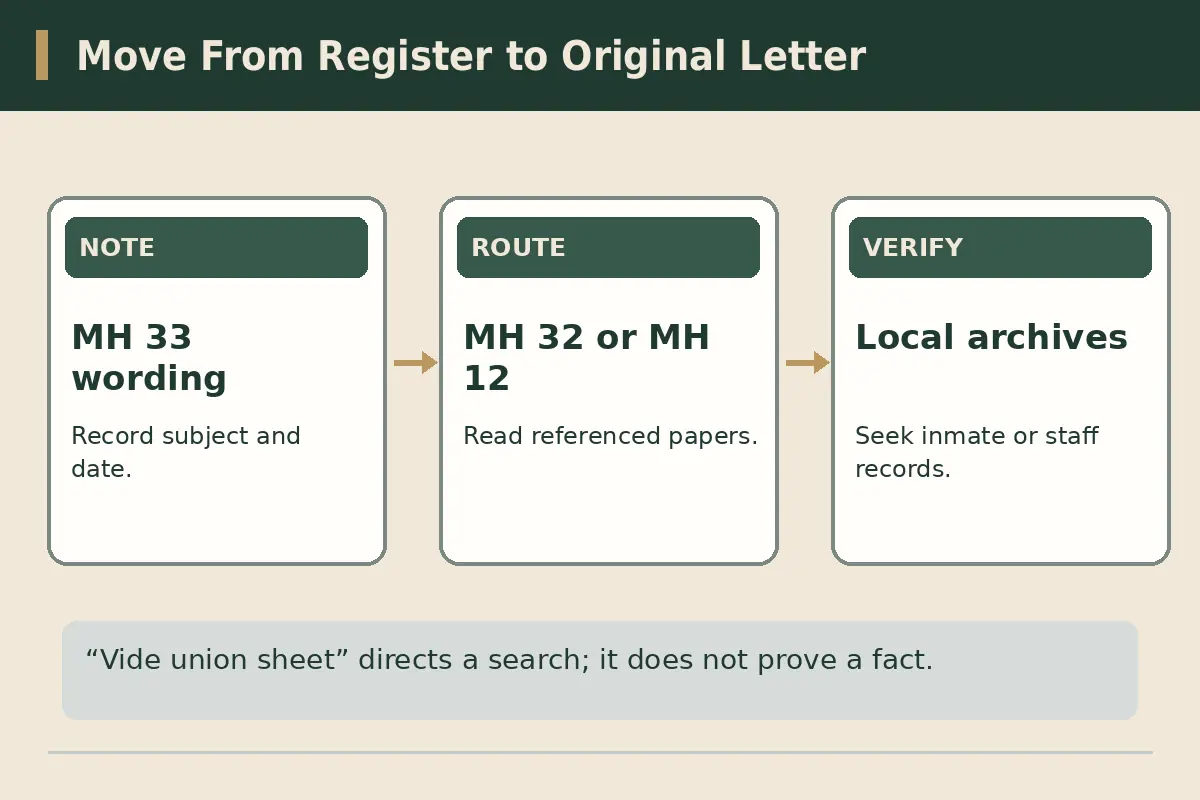
The official poor-law guide explains that MH 33 registers indicate the subject matter covered in inspectors’ correspondence. Some entries concern particular unions and are labelled “vide union sheet” in the “particular subject” column. Preserve the phrase exactly when transcribing it. It directs the reader to an additional finding route; it does not say that a complaint was upheld, a staff member was dismissed or an inmate was moved. Index terms can be abbreviations and may reflect office filing conventions rather than a full description of the issue.
Create a literal transcription with the MH 33 volume, entry date, officer if present, subject, any correspondence number and the precise cross-reference. Then add a separate interpretation column in which you state the search route. Resist the temptation to rewrite a brief entry as an official conclusion. For an issue that appears institutional, identify the union’s number and name, not just the geographic town where the event occurred. This small discipline makes the following correspondence hunt reproducible.
The MH 12 guide gives a separate example of central paper-number practice in MH 15: 64/3178/571 identifies a year, paper number and union number. Do not automatically import that syntax into every MH 33 entry or assume identical indexing conventions across volumes. Instead reproduce the actual numbers and consult the appropriate contemporary finding aid. A reference formula from another register is helpful background only after the entry’s own organization has been confirmed.

Follow Union Papers Into MH 12 or Inspector Papers Into MH 32
For union-specific papers flagged in MH 33, test the linked material in MH 12. That series comprises correspondence from poor law unions to central authorities, mostly arranged by county, union and date. Most volumes are described only at this broad level rather than indexed by personal name. When the register gives a paper number, use the date and the correct union catalogue entry to locate the item. Keep the exact correspondence number and the full MH 12 piece reference together.
If the subject concerns an Inspector’s district, work, report or instructions rather than a union’s own letter, search MH 32 by the person’s name and district. The two series can complement one another, but they do not necessarily contain duplicate copies of the same event. You may find an allegation sent by local guardians and a separate inspector response. Compare who wrote each text and whether it records a proposed response, a direction or a later report of an action actually taken.
Keep Personal Names Apart From Administrative Findings
A central letter might mention an individual pauper, a workhouse porter or a medical officer, yet an MH 33 reference is not a comprehensive personnel list. Admission, discharge, birth and death records were usually created and kept locally, and surviving local records are generally the better starting point for an inmate’s history. A claim that someone was resident in a workhouse must be tested against dated registers, population schedules or other individual-level sources that cover the correct institution.
For a workhouse staff question, compare central correspondence with registers of paid officers in MH 9 where the relevant period survives. A report about misconduct is not a finding of guilt; an instruction to replace a master is not proof of the replacement’s arrival. In each transcription identify whether the person is the writer, subject, proposed appointee, witness or named resident. Do not collapse those very different roles into one job or family relationship.
Document an Unsuccessful Search and Its Limits
A useful negative-search log might say that a particular MH 33 date range and subject heading was checked, that a “vide union sheet” pointer was found, and that the matching MH 12 correspondence was unavailable or not yet read. This is a real research result, but it is not evidence that the underlying event never took place. Changes in names, damaged papers, unindexed volumes and later record loss all restrict the conclusions that can be drawn from a blank database search.
For any final note, cite the MH 33 register and full piece, its exact wording, any linked MH 32 or MH 12 references and a separately identified local source. Keep a confidence label for each assertion: located index, original letter viewed, administrative opinion documented, or event independently established. When a reader follows the same steps, they should be able to understand why the register led to a particular file and where the argument still needs original evidence.
If the research question concerns parish settlement before the reform of 1834, local overseers’ accounts, vestry records and settlement examinations are often more useful than MH 33. If it concerns 1850 or 1880, MH 33 is usually outside its date range even though MH 32 and MH 12 continue later. Choosing the right century and custody before entering a family name saves time and prevents confident interpretations of false negatives.
More Research Method Guides
How We Research This Archive Series
This guide starts with the official description in The National Archives’ research guidance, not a claim that we have inspected a particular person’s private file or a specific original piece. The archival statements here concern the series or research method. A hypothetical example is labelled as such; it is not a newly discovered historical event. We use the Discovery search guidance to distinguish keyword matches from archive holdings and document contents, because catalogue descriptions do not transcribe every word of an original.
For every real candidate, record its historical place or person’s name, the creator, document type, date, full MH 33 piece or item reference, access restrictions, and the exact claim being tested. The official citation guide explains how to document those references so another researcher can retrace them. An unread document remains a catalogue lead, never proof of imagined details. If a record is missing, preserve the searched terms and dates and examine survival and alternate custodians before interpreting the gap.
Before sharing a conclusion, audit the difference between original source wording and your interpretation. Require independent evidence for any further claim about an individual, property owner, legal effect, or completed action. Respect archival access limits and living people’s privacy. This website also provides an affiliate disclosure; no paid partnership or commercial access is implied by these archival references.
The official guide dates these Assistant Commissioner correspondence registers to 1834–1846.
It signals that an entry involving a particular poor law union should be followed through union-related papers, including MH 12.
No. It is an index to central administrative correspondence, not a daily inmate roll.
MH 32 holds inspectors’ correspondence over a longer period; MH 33 registers subjects of correspondence in an earlier period.
No. Read the underlying letter and independent follow-up before drawing a conclusion about what happened.