
The Films subseries within Board of Trade records BT 64 helps investigate British film-quota regulation after the Cinematograph Films Act 1927. A regulatory file does not demonstrate that a named cinema showed a particular film or that every recorded proposal became an enforceable decision. This guide gives a precise source route, identifies what the archive can and cannot show, and names the independent documents needed before a personal or geographic conclusion becomes defensible.
Start With the Date of the Quota Rule
Histories of a local cinema often jump from the existence of British film quotas to the claim that a favorite movie played at the neighborhood picture house. Those are separate propositions. The National Archives guide to government film-making points researchers to the Films subseries of BT 64, part of Board of Trade material. The Cinematograph Films Act 1927 introduced rules intended to increase the proportion of British films shown and distributed. Later legislation changed that framework. An administrative paper can explain official concerns or definitions without documenting an individual screening, a ticket purchase, or a filmgoer.
The first research decision is chronological. Ask whether the event or disputed claim belongs to the regime originating with the 1927 Act or to its later changes, particularly the Cinematograph Films Act 1938. The official guide states that the 1938 law extended the quota system while changing the treatment of films from parts of the British Empire. Do not apply a single modern definition of a “British film” to the entire period. Write down the exact year, the legal provision being applied, and the kind of business concerned—producer, distributor, or exhibitor.

Search the Board of Trade Film Files
Begin in Discovery with the reference BT 64 and the Films subseries, then refine by relevant years and terms such as “film quota,” “cinematograph,” “distributor,” or the name of a company. A broad series may contain policy, industry correspondence, and other administrative subjects. Read the full catalogue title and covering dates before expecting a particular kind of paper. Record the piece number, file or item title, date range, and whether access requires a visit or copy order. A digitized search result is not a transcript of all papers inside the file.
When examining a specific piece, label what you see: a proposal, ministerial briefing, memorandum, complaint, investigation, circular, or final departmental response. A letter requesting exemption is not proof that exemption was granted. A draft calculation is not proof of accepted compliance, and discussion of an individual cinema does not by itself document a program. Record which organization wrote each letter and whether the record shows an official action or only an interested party’s position. If the file is one side of correspondence, search for a separate reply or later report.
A practical film-history grid has columns for legislation date, quota category, BT 64 piece, document author, apparent action, theater or company named, and independent exhibition record. It is important to keep a separate status column for “proposed,” “reported,” and “confirmed.” Without it, a file containing several competing estimates can be misread as a single authoritative statement of what cinemas displayed.
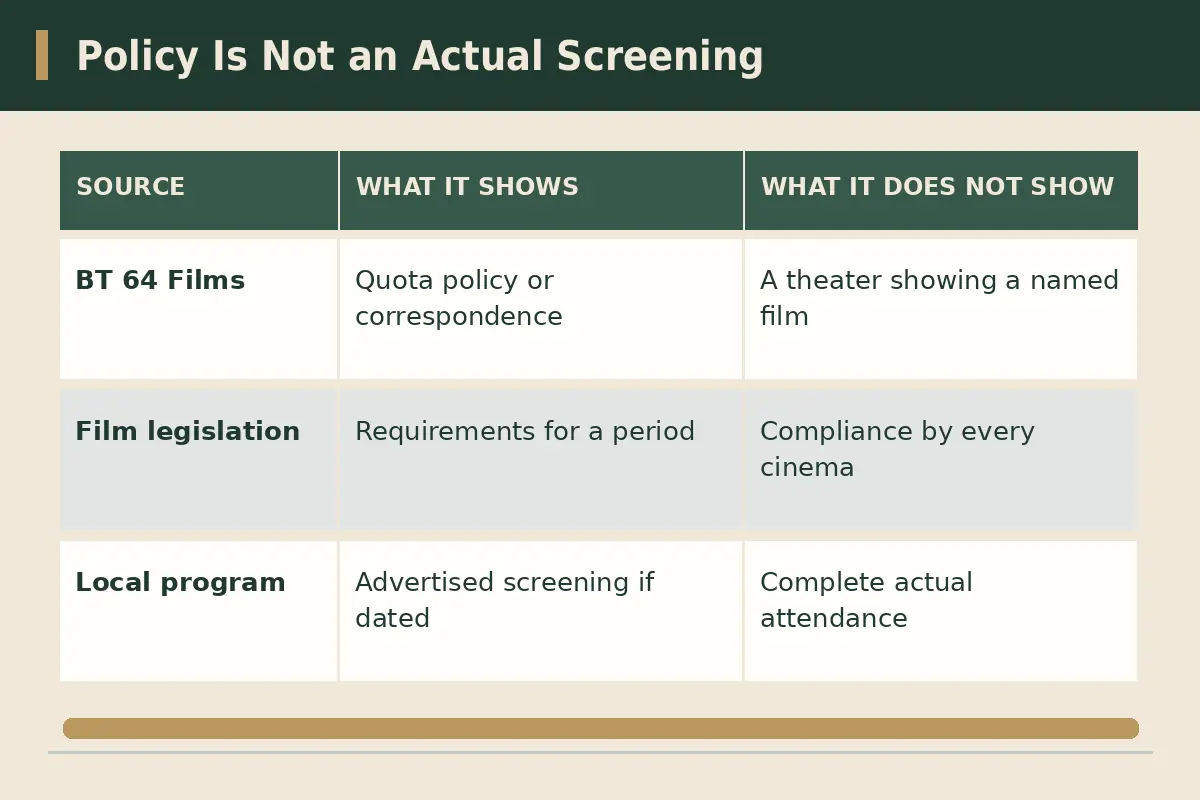
Separate Distribution From Exhibition
Quota systems were designed to influence both the distribution and exhibition of films. A statement of required proportions does not identify actual films screened at a named address. To test that second question, obtain contemporary cinema advertisements, trade listings, local newspapers, dated programs, or business papers. An advertisement may show an intended program while an inspection, dated review, or box-office book may be stronger evidence of what happened. Do not convert planned bookings into attendance counts or infer the names of viewers from city population statistics.
Suppose a fictional cinema appears in a complaint about quota calculation in 1931. The complaint establishes that someone made an assertion about that cinema; it does not independently prove the complaint was valid. Compare the letter with the file’s later disposition and contemporaneous venue records. A film could have been licensed or distributed in one district without a surviving record of exhibition at every venue. Keep the policy date, film classification, commercial transaction, and local public showing as distinct rows in the research log.
Avoid Anachronistic Film Classifications
Historical language for nationality, production, and distribution is specific to a legal regime and should be reported with its date and source. The National Archives film guide describes the 1927 law as a ten-year quota regime and notes a subsequent extension under the 1938 Act. Do not silently apply modern British Film Institute categories or current citizenship concepts to a 1930s memorandum. The same film could have a complicated multinational production history; the administrative classification used for quota purposes is not an exhaustive cultural or creative definition.
When citing a legal requirement, consult the text of the relevant Act using the official legislation service and check which provisions were in force for the date. If a paper quotes a proposed amendment or departmental interpretation, label it as such rather than treating it as the statute. Quota compliance, film nationality, and suitability for children were not interchangeable regulatory questions. Newspaper reviews and cinema memories may help interpret local experience, but they have different evidential purposes from the Board of Trade’s regulatory correspondence.

Turn a Regulatory File Into a Dated Cinema History
A solid account can say that a British film policy applied to a defined category of business during a stated period, or that a particular BT 64 file records a department considering a quota-related question. Only a separate evidence trail should be used to assert that an identified cinema presented a named title on a particular day. Keep exact references for any statute, archive piece, and local notice, and reproduce the language of conclusions rather than the language of an initial complaint.
If no local showing can be verified, the absence should be described as an evidence gap rather than evidence that the film did not run. Try alternate cinema names, theater management changes, trade press, and regional newspapers; record newspaper issue dates and OCR failure risks. Avoid attributing a cinema job, ownership interest, or particular audience membership on the strength of a quota file. A research note that carefully distinguishes law, industry correspondence, and actual exhibition is useful even when it does not produce a definitive program.
Do not use a later film-company address as proof that a firm operated at the same place in 1927. Company mergers, distribution agreements, and name changes can shift identities across decades. Link a business by registration or contemporaneous corporate evidence, then link a venue by historical name and street. When only an uncertain newspaper item survives, cite the issue and make the date uncertainty visible.
More Research Method Guides
How We Research This Archive Series
This guide starts with the official description in The National Archives’ research guidance, not a claim that we have inspected a particular person’s private file or a specific original piece. The archival statements here concern the series or research method. A hypothetical example is labelled as such; it is not a newly discovered historical event. We use the Discovery search guidance to distinguish keyword matches from archive holdings and document contents, because catalogue descriptions do not transcribe every word of an original.
For every real candidate, record its historical place or person’s name, the creator, document type, date, full BT 64 piece or item reference, access restrictions, and the exact claim being tested. The official citation guide explains how to document those references so another researcher can retrace them. An unread document remains a catalogue lead, never proof of imagined details. If a record is missing, preserve the searched terms and dates and examine survival and alternate custodians before interpreting the gap.
Before sharing a conclusion, audit the difference between original source wording and your interpretation. Require independent evidence for any further claim about an individual, property owner, legal effect, or completed action. Respect archival access limits and living people’s privacy. This website also provides an affiliate disclosure; no paid partnership or commercial access is implied by these archival references.
It can supply Board of Trade records concerning regulation and support of the film industry, including quota matters.
No. The 1927 Act introduced quotas; the 1938 Act extended and changed their scope.
No. Use a dated local advertisement, program, business record, or other exhibition evidence.
A complaint records an allegation; check the investigation and final action before stating an outcome.
Use the statute applicable to the event date, including any amendments or commencement provisions.