
A daily office diary can show what an administrator recorded about the early National Archives, but a diary entry is not automatically a complete attendance list or proof that a named ancestor was hired. The National Archives describes a daily diary of the Executive Officer covering 1935–1942 in Record Group 64, section 64.2.3. The same section separately identifies daily work reports of the Director of Archival Service for 1935–1941. Those sources can complement each other but are not interchangeable.
Begin with the RG 64 guide, section 64.2.3. It locates the diary within Executive Staff records; it does not reproduce the diary’s entries or promise an online daily page for every date. Choose the record according to the question: an Executive Officer’s account of office activity, a Director’s work report, or a personnel source that can actually identify a worker. Keep the original creator and date attached to every statement.
Distinguish the Executive Officer From the Director of Archival Service
The Executive Officer’s daily diary, 1935–1942, belongs to one office function. The Director of Archival Service’s daily work reports, 1935–1941, belong to another. Do not merge them into a single institutional diary or use the wider dates of one to fill a gap in the other. Ask for the exact series, office of origin and year, and record whether a document is a personal administrative diary, a formal report or an outgoing memorandum.

A diary note might summarize a conversation or task without preserving every action’s supporting documents. Conversely, a work report might list functions rather than individual visitors. Until a page has been inspected, do not claim which names or details appear. If a family story mentions someone working at the Archives in 1937, the diary can provide context for the office, but a payroll, directory or appointment record is necessary to establish employment.
Establish the Date and Voice of an Entry
Transcribe the entry date exactly as written and distinguish the event date from the day the note was recorded. Check whether the diarist wrote in the first person, summarized correspondence or copied information from another staff member. Words such as “planned,” “requested,” “approved” and “completed” have different evidentiary meanings. A note about a planned meeting cannot be turned into proof that the meeting actually happened.
If the page has marginal additions, initials or cancellations, describe them in the citation. Do not rely on a secondary extract without locating the whole entry; an isolated sentence may lose its subjects and context. A diary’s silence about an event is weak evidence of nonoccurrence because no administrative diary can be assumed exhaustive. Only a clearly defined reporting obligation could strengthen an argument from omission, and the original instructions would need to be found.
Link Daily Notes to a Confirmed Institutional Decision
When a diary mentions a policy change, building procedure or archival project, search for the corresponding memorandum, report or official order. RG 64 also contains letters, general records and annual, quarterly and monthly reports to the Archivist. These are potential independent checks, not automatic continuations of the diary entry. Record whether a decision was proposed, discussed, authorized or implemented, and attach a dated document to each stage.

For example, a hypothetical entry saying “drafted a plan” supports that the diarist recorded preparation of a plan. It does not establish that the plan was adopted. Find the signed approval, later administrative action or final report before declaring an outcome. Agency organizational changes can also alter titles and responsibilities; use the organizational history from RG 64 when comparing people who held similar-sounding jobs at different dates.
Name Staff Members Without Inventing Their Roles
A person named in an administrative diary might be a staff member, correspondent, visitor, official from another agency or subject of a note. A name alone does not establish the role. Identify how the diarist refers to the person and compare a contemporary directory, appointment letter, personnel list or payroll. RG 64’s broader administrative records include personnel lists and telephone directories dated 1935–1949, but these should be examined as separate sources.
For names repeated in the diary, make a chronology with spelling, title, office, context and source reference for each occurrence. Distinguish two people with similar surnames using dates and independent employment evidence. Do not assert that someone visited the building because a memo was addressed to them. A letter between officials can refer to someone who was elsewhere. For a family history, a narrow documented administrative contact is better than an invented career story.
Handle Access Gaps and Archival Descriptions Honestly
The web guide establishes a historical description of the series but does not provide an image of each entry. A search result for the record group is not an item-level citation. Find the relevant series in the current National Archives Catalog and ask for its location, extent, finding aids, access status and reproduction options. Record precisely whether you inspected original pages, a microfilm or digital copy, or only a high-level archival description.
Do not create entries for missing dates, extrapolate an official’s schedule, or infer that no office activity occurred on unrecorded days. If a diary has a gap, mark the extent and explain how you know. A modern exhibition caption or institutional history may supply useful context but should not silently replace the original words. Retain awkward spelling or incomplete names in a transcription, and make editorial expansions visibly distinguishable.
How We Research Executive Staff Diaries
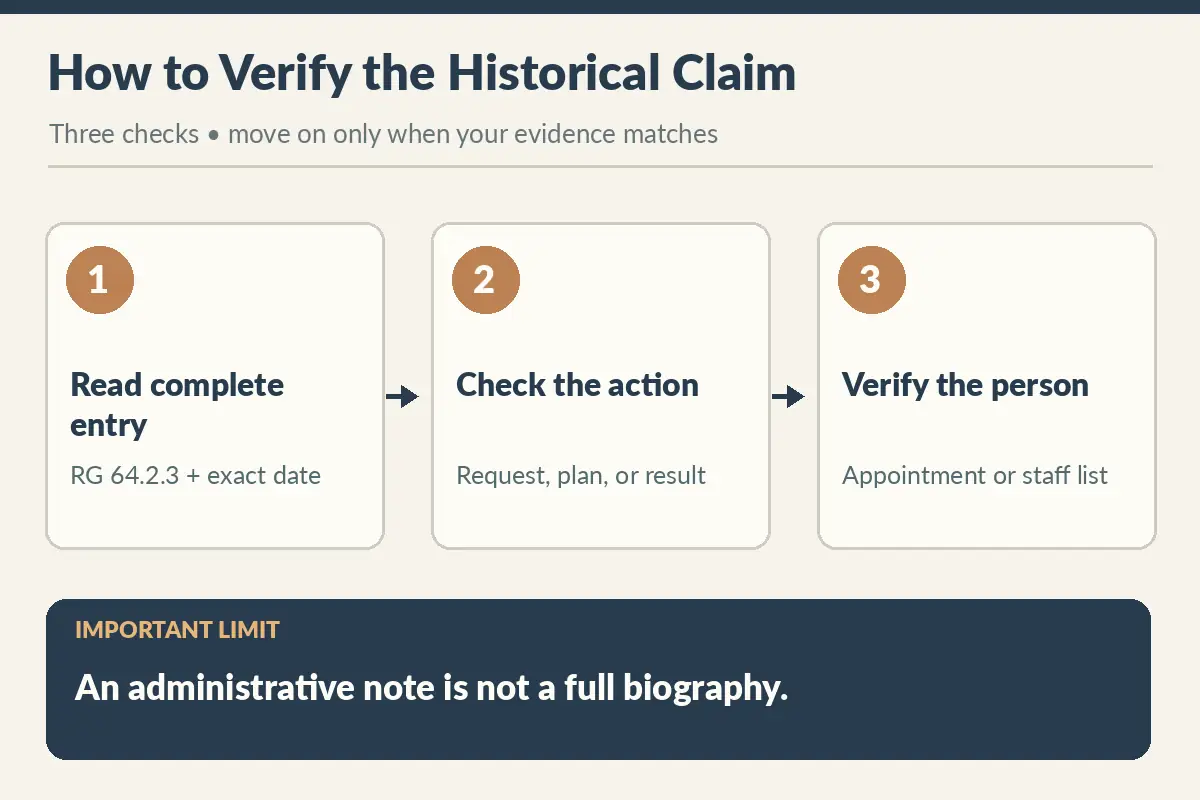
We use three layers: the Executive Officer’s diary, the appropriate administrative document, and independent person-level records. First capture RG 64.2.3, the original date, creator and a complete reference to the page. Next determine whether the entry reports an event, intent, request or result. Then choose a memorandum, meeting minute or personnel record to test the claim. This prevents a brief office note from being mistaken for a final agency decision or a staff roster.
The RG 64 guide and textual-records research instructions provide a starting route, but the current catalog is needed for present holdings. Our diagrams do not recreate authentic diary pages. Keep transcription and interpretation separate, and cite actual examined documents rather than an imagined daily entry. The site’s affiliate disclosure explains link relationships.
More Research Method Guides
Questions Researchers Ask About These Records
The RG 64.2.3 guide dates the daily diary to 1935–1942.
No. Those daily work reports are a separate series dated 1935–1941.
Not on its own. Confirm a job title and tenure with personnel or payroll records.
No. Seek minutes or follow-up records for an actual meeting or decision.
The series guide does not establish online availability for every page; check the current NARA Catalog.