
Photographs of the Archive’s Own Construction
Record Group 64, the administrative records of the National Archives, includes an unusually direct visual trail: 1,013 photographs showing construction of the National Archives Building, dated 1932–1942 in NARA’s guide. The listed photographic group identifiers are NAC and CP. This is a source for studying how a major federal building took shape, but the number is a group-level count, not a claim that every photograph shows a distinct day or every stage of work. Start with a building feature, approximate year, or known architectural event, rather than searching the pictures as a directory of employees.
The National Archives Building is a subject here and the National Archives is also the institution whose administrative files preserved the pictures. That dual relationship makes provenance essential: ask whether a photograph is original to the construction documentation, later copied for an exhibit, or annotated in a different administrative context. A picture of a column being finished can show an observable stage, but it does not identify the mason, contractor, foreman, or date of employment unless a trustworthy caption or separate record supplies those details.
Find NAC and CP Before Naming the Scene
The RG 64 Guide places construction imagery among administrative photographs and explicitly gives NAC and CP as group identifiers for the 1932–1942 set. Use those terms to narrow an archival inquiry, but do not treat either as an individual photograph number. Ask for the exact image or negative identifier and full caption, not merely a gallery screenshot. If the photo was reproduced for an exhibition, locate the underlying archival record and note whether the display caption contains a later interpretation.
Preserve the surrounding album, file, or sequence where available. Adjacent photographs may help establish relative order, but adjacent placement does not automatically mean exposures were made on the same day. The file’s date range can include later documentation of a construction project; a print produced in 1940 might depict an earlier stage. Always distinguish a subject date, a photographer’s exposure date if known, and the date attached to a copy or office filing. Where none is certain, describe the date as approximate and cite why.
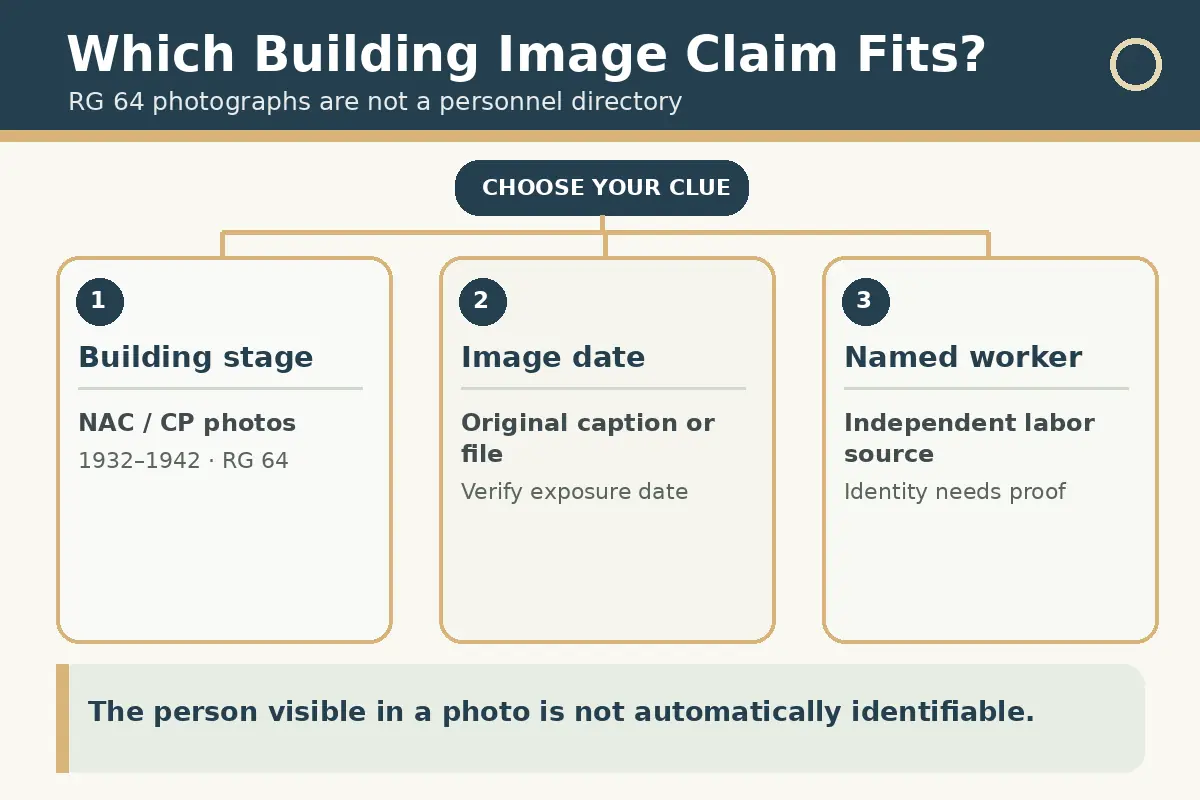
Read the Building Stage From Visible Features
A photo can offer direct physical evidence of excavation, scaffolding, columns, masonry, roof work, entrances, or surrounding street conditions. Describe only the features you can actually see at adequate resolution. A construction photograph may be cropped, reversed, or taken from a misleading angle; compare fixed architectural markers before treating a difference as a new stage. A photo of an unfinished wall establishes its appearance at exposure, not the date that work began or ended. Construction operations can overlap in different parts of a large building.
Use a repeatable visual comparison checklist: building facade or side, camera position, recurring windows or columns, visible temporary structures, and any legible original caption. If two images show different scaffold heights, verify that they portray the same facade before drawing a chronological arrow between them. Temporary equipment can be moved. A photograph without scaffolding does not prove every trade was finished. When uncertainty remains, label the pictured condition instead of forcing a precise construction phase from visual impressions alone.
Separate Historic Captions From Worker Identities
The group description identifies a photographic collection, not a named labor roster. Even a clear photograph of workers does not usually prove who they are. A modern viewer may recognize clothing, tools, or job categories, but a person-level identification requires a reliable contemporary caption or an independent source that links a named individual to that specific scene. A family statement that ‘grandfather built the Archives’ may be meaningful, yet the image should not be retitled with his name solely because a figure appears to match an old family portrait.
To research an individual worker, look separately for verifiable contracts, payroll evidence, union or trade records, census occupation, city directory entries, family letters, and dated photographs with names. Be attentive to the difference between a federal employee, a contractor’s worker, and a subcontractor; administration of a federal project does not mean every builder was on a National Archives payroll. An unlocated payroll is a gap, not evidence that the person did not work on the building.

Compare Photos With Dated Construction Sources
The strongest house- or building-history timeline uses independent dated evidence. A contract, engineering report, official account, or contemporaneous newspaper report may establish when a phase was authorized or reported complete. Such a report and a photograph have different strengths: one may give a date or administrative statement, while the other records a visible condition. Do not force them into agreement if the photo lacks an exposure date. Instead annotate the timeline with the exact claim each source supports and the remaining interval of uncertainty.
Watch for common image traps. Later reproductions can change contrast, hide edges, or omit a caption, while internet reposts can silently assign an incorrect year. Store the original archive citation, image identifier, and screenshot or downloaded copy together. If you create your own diagram comparing stages, label it as an interpretation, not a historical original. That helps distinguish a reader-friendly teaching illustration from archival evidence and prevents invented details from circulating as accepted building history.
Ask NARA for the Specific Photograph
Start at RG 64, the National Archives administrative records, and find the still-image description naming the NAC and CP construction images. Then check the Catalog search instructions for item-level identifiers and access. A good request gives the building side or feature, approximate period, group identifier, any known accession or negative number, and the evidence you already inspected. Ask for the original caption, photo date if known, custody, and options for a higher-resolution reproduction.
Create a citation record with creator or originating office if identified, RG 64, series, photograph number, title or caption, date with its basis, repository, and digital identifier. If a frame contains unidentified people, describe the workers’ visible activity rather than naming them. If a scene is dated only by its position within a series, say that explicitly and seek an independent dated reference before assigning an exact day or week. The result should help another reader locate and test the same photograph.

More House and Local History Guides
How We Research Federal Building Images
We start from the NAC/CP description and the stated 1932–1942 range, not a later repost of an attractive black-and-white image. The group-level count and date range come directly from NARA; exact identities, dates, and construction stages must be established from item-level records and corroboration. We separate the photographed condition from administrative completion claims and distinguish image creators, custodians, copy dates, and later interpretations where the evidence allows.
A photograph can be a strong source even when nobody in it can be named. We keep descriptive confidence proportional to what the source actually shows. NARA’s archival Guide is not guaranteed current for every item, and our affiliate disclosure provides editorial transparency. The practical goal is a correctly dated visual reference and a documented route to any claims about architects, contractors, or named workers.
RG 64 describes 1,013 photographs of National Archives Building construction, with NAC and CP identifiers, dated 1932–1942.
They are group identifiers in the guide; obtain the item-level photograph or negative number for a precise citation.
No. A reliable original caption or independent person-level record is necessary to identify an individual.
Yes, a copy or processing date need not be the original exposure date. Check the source and caption.
Request the series and precise item identifier, original caption, date basis, reproduction availability, and any related administrative context.