
The NAD series in National Archives RG 64 photographs federal records in storage, often before the material was accessioned. NARA’s broad group guide describes 299 pictures dated 1936–1945, while related item-level descriptions include scenes from 1935. This is a reason to inspect the caption of an individual photograph, not to force every image into one inclusive date range. The images can document boxes, rooms, shelving, and some observable physical risks; they do not by themselves prove that a particular document was destroyed. See the National Archives record-group description for the exact scope of this material.
NARA’s still-picture guide credits agency photographer Harry J. Baudu with photographs documenting Washington-area record storage and some other archives. The images include storage settings that look alarming to modern viewers. A pile of files on a floor can reveal handling conditions at an instant, but does not establish what happened to every file afterward. A strong investigation identifies the actual agency, location, date, and accession history before calling the photograph evidence of loss or archival neglect.
Identify the NAD Item and the Building

Begin with RG 64 and the still-picture designation NAD. Record the full original caption, its photograph number, any handwritten location label, and the exposure date. A picture labeled with a department or bureau may show records then in that agency’s custody; it does not mean they were already in a National Archives repository. Note whether the caption refers to a garage, basement, office or storage room. Those differences matter when asking what the image reveals about access and preservation.
The National Archives has used some NAD photographs to explain why federal records required safer custodial systems. Its historical writing includes a State Department storage scene from 1935. That example does not prove that all federal offices stored records the same way. Compare agency by agency and date by date. The group guide also describes some state and foreign archives among NAD holdings, so a recognizable foreign building must not be mislabeled as a Washington federal office.
Read Visible Conditions Without Inventing Damage
An NAD photograph may show improvised shelves, stacked volumes, boxes on floors, inaccessible aisles or exposed paper. Describe what is visible before inferring any cause or outcome. Tilted shelves suggest a structural concern, but a black-and-white photograph cannot measure room humidity or prove mold growth across every document. The surface appearance of one bundle is not sufficient to estimate how many pages were damaged. The date of the exposure is the baseline for any preservation claim.
Look for a caption that identifies the specific room or building and any visible writing on containers. Photograph numbers should be transcribed rather than guessed from faint scans. A photographer may choose a dramatic angle to demonstrate a condition for administrators. That framing is useful evidence of what the photographer intended to show, not an audit of every shelf in the building. Other rooms, transfers, and later conservation efforts must be researched separately.
Separate Storage From Archival Accession
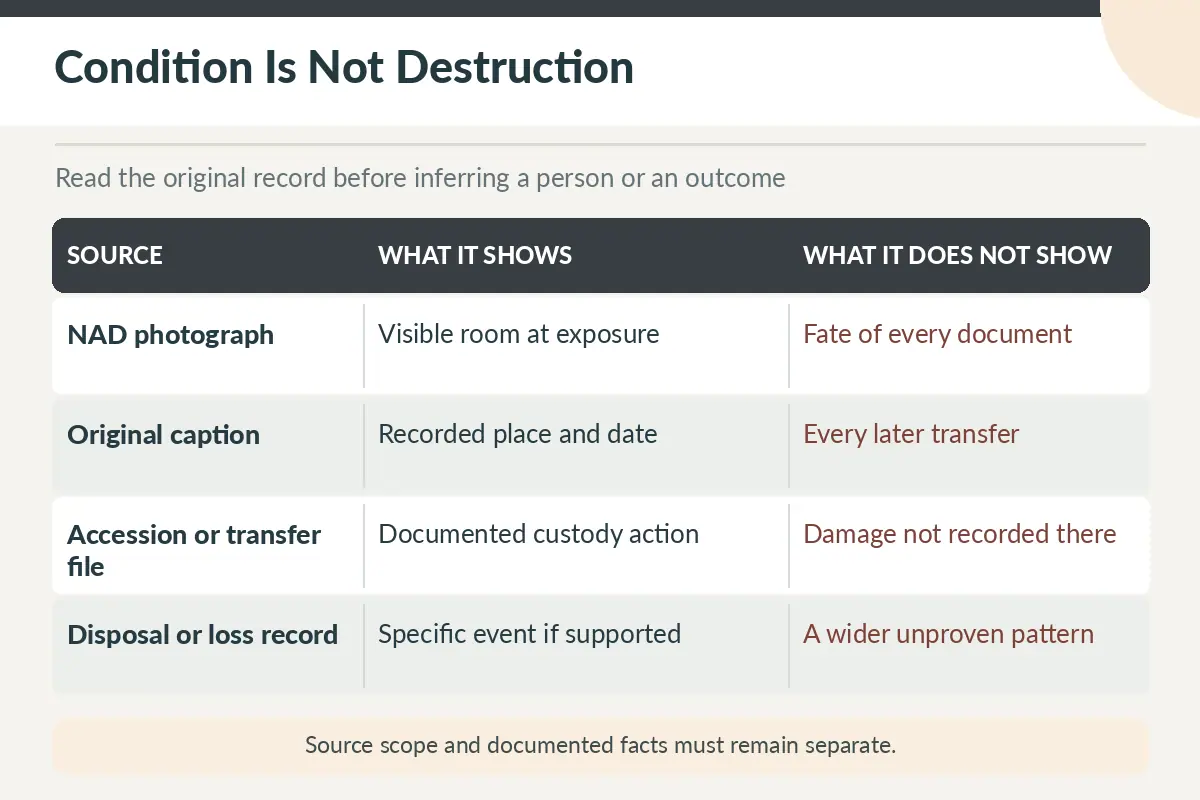
An agency could retain inactive records before sending them to the National Archives. A NAD photograph of an agency room therefore should not be cited as proof that the Archives accepted every box pictured. Accession records, transfer schedules, agency correspondence, and series descriptions are different administrative records with different evidentiary purposes. If a family file is missing, an image of poor storage does not explain the absence without a document connecting that specific file or series to a disposal or loss event.
For a missing-file question, document the creating office, the type of record, the relevant years, any retention schedule, the repository’s present inventory, and what searches have actually been tried. Compare that timeline to the photo date. If the only overlap is that both concern the same department, the relationship remains contextual rather than causal. The conservative statement is that a photograph documented a storage environment; why the requested file is missing is still unresolved.
Compare Photographs With Written Custody Records
A useful evidence ledger has columns for image number, photographed building, date, visible condition, and the source that would confirm custody or destruction. A separate row can record the description of a transferred record series and whether it was subsequently processed. Do not fill that row from an assumption about the photograph. The guide’s figure of 299 NAD images is a series-level total, not an item-by-item inventory or a guarantee that every known federal records room was photographed.
At the National Archives, original photographic descriptions and custodial documents may be cataloged at different levels. Consult the still-picture guide for group context and the Catalog for item metadata or accessible scans. If the original caption conflicts with a later exhibit description, preserve both and explain which was written nearer the event. A reproduction in a modern article is not an original negative; cite the archival identifier for evidence and the article for its interpretation when appropriate.
Test a Claim That a Family File Was Destroyed
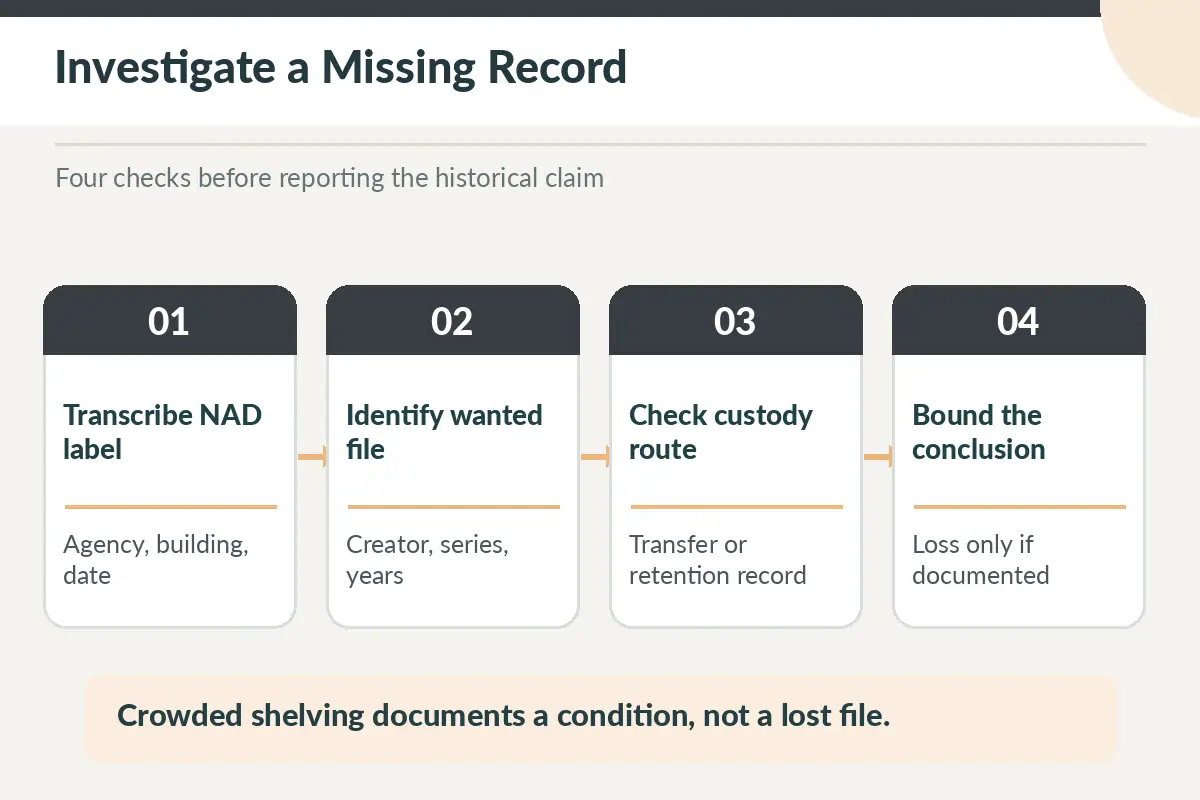
Suppose a family researcher finds an NAD photo of piled files in a government building and concludes a missing ancestor’s case record was thrown away. First check the photo’s actual department, room, and date. Next identify the missing record’s creator and normal retention route. Was the file created before the photograph? Was it kept in that particular office? Does a disposal authority or transfer ledger mention that series? Without a bridge of named evidence, the picture cannot establish the file’s fate.
A narrower but useful finding might be: “A 1935 photograph shows crowded storage at one agency location; the fate of this family file is not established.” If related agency inventories identify the series, request the particular record or record schedule. Repeated searches that find only a description are not equivalent to a formal loss determination. Avoid blaming an individual employee, a department, or a preservation practice for destruction that has not been independently documented.
Use the Photograph Ethically in Family History
Historic photographs can enrich a story about the institutions that held a family’s records. Distinguish an archival document’s provenance from the modern visual treatment used to illustrate an article. Do not crop a date or location from an image and then circulate it as a mystery scene. If preparing a web page, use a caption that states precisely which building and photo number are documented. Note image rights and any repository credit requirements before reproducing a scan.
A preservation lesson should be framed as contextual learning rather than a claim that one pictured shelf caused a known loss. The historical image can motivate better handling today, such as tracking provenance and keeping records identifiable, but it cannot identify a destroyed file simply from clutter. Respect the distinction between the evidence you can see and the administrative outcomes you still need to establish. This distinction keeps a compelling image from becoming a misleading explanation.
More Family Story and Preservation Guides
How We Research and Verify Archival Claims
We compared the record-group guide with the relevant National Archives research guidance, checked the cited record-series distinctions and dates, and reviewed overlap with existing GenHis titles and the supplied WordPress inventory. Our decision charts summarize the scope of the inventories; they are not reproductions of historical maps or documents. Where an individual item has not been examined, the wording makes that limitation explicit rather than claiming a personal find or a confirmed event.
The purpose of this guide is to make the next check reproducible: record RG 64, the exact series or entry, title or item number, original date, later-copy date where applicable, and an independent confirming source. Online descriptions do not guarantee that every sheet or photograph is digitized. Check terms and access requirements for the specific item. Read our affiliate disclosure; this educational guide does not assume any compensated records service or an unverified partner arrangement.
It is the still-picture series designation used for RG 64 photographs of records storage conditions.
The broad RG guide uses 1936–1945, while related individual NAD captions include 1935. Use the date of the actual item.
No. It may document a condition or apparent risk; destruction requires separate evidence.
No. NARA notes that the series also includes views of some state and foreign archives.
Record RG 64, the NAD item number, original caption, depicted location, and the dated original or authoritative reproduction.