
The National Archives lists ten filmstrips in the Social Security Board Informational Service records, RG 47, section 47.3.2. The FS group includes titles such as The Account Number Interview, Families Without Fear, and Women Working for Victory. Those titles are clues to the Board’s public teaching and training, not a list of individuals who applied for benefits. NARA also identifies three accompanying sound recordings; the guide does not claim that a recording exists for each filmstrip. Read the RG 47 official description before searching by title.
A filmstrip is a sequence designed for projection. A slide can depict an interview or account number without recording the historical identity of the drawn person. The ten titles in the guide are undated, so an editor should not automatically assign a 1936, 1942, or wartime release date to a particular strip simply because the parent record group covers those decades. This guide explains how to identify the moving parts of one presentation, cite its actual surviving format, and pursue a personal Social Security question in different records.
Start With the Ten Named FS Filmstrips

The most reliable starting point is the Board’s Informational Service, rather than a generic search for Social Security photographs. Transcribe a title exactly, including words that seem outdated, and specify RG 47, section 47.3.2, filmstrips FS. Titles in the inventory range from procedural instruction, such as The Account Number Interview and Operations of the Control Division, to broad public appeals such as Security for Today and Tomorrow. Those are different research questions. An administrative instruction can establish a procedure taught to workers, while a public appeal can establish the message presented to an audience.
The inventory also names Finding Men and Jobs, I Built That Plane, Looking Forward, Training Trainers to Train Trainers, Families Without Fear, and For the Benefit of All. Treat this as a finding aid, not a promise of online viewing. Search the National Archives Catalog with the phrase and series, note the descriptive unit returned, and request the exact filmstrip or available reference reproduction. If a title search brings up later publications, do not assume it is the same medium or edition.
Keep Narration and Images in Their Own Columns
Filmstrips are not silent evidence by definition: the RG 47 listing mentions accompanying sound recordings, but only three items. A visual strip could have been delivered with speech, printed speaker notes, or other contemporary instructions not established by the series description. If a sound recording can be matched to a title, capture its separate archival identifier and whether that connection is documented. It is misleading to narrate every frame with words borrowed from an unrelated Social Security film or later pamphlet.
Build a frame log before summarizing the filmstrip. Record each visible heading, depiction, symbol, and any legible instructions; in another column record narration only if heard from a confirmed companion recording. A picture of an employer, parent, or retired worker is evidence of a teaching scenario, not a photograph of that person. When an official figure or legal rule appears, compare it against the policy actually in effect at the item’s verified production date rather than using a modern benefits summary to fill gaps.
Do Not Turn Account-Number Training Into a Claim Record
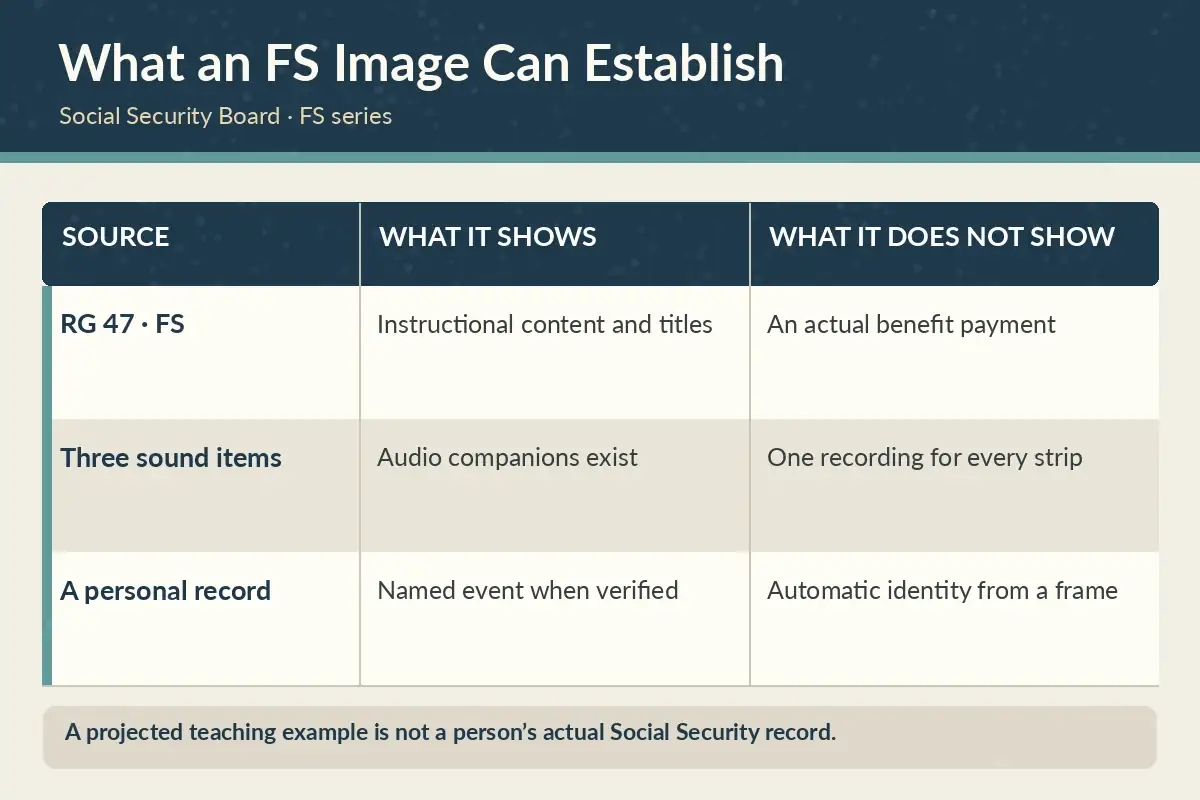
The Account Number Interview sounds close to the documents people seek in family research, and that makes it especially easy to overread. The title shows that account-number procedures were considered suitable instructional material. It cannot identify an ancestor’s Social Security number, establish that an interview was conducted, or prove that a benefit was paid. A demonstration form could contain example numbers or invented details. Do not reproduce a supposed identifying number from a training slide as a real historic identifier without independent provenance.
For a named worker or relative, first ask what is actually being investigated: employment, an application for an account number, an earnings history, or a benefit determination. Those are distinct events with different evidence and access rules. For living or recently deceased individuals, respect privacy and eligibility requirements of any agency record request. The FS collection supplies public context for how the administration explained its processes; the person-level search must stand on its own records rather than on resemblance to a projected character.
Locate the Message in Its Administrative Era
RG 47’s wider Informational Service holdings include public information films from 1936–1940, newsreels, photographs, and audio recordings, but these are not interchangeable with the ten undated FS filmstrips. The Social Security Board administered programs under legislation and practices that changed across the late 1930s and the war. Only a dated item or dated companion record lets you assign a confident period. Do not transfer a date from a nearby film title to an FS strip solely because the words are similar.
When writing about Women Working for Victory, distinguish a wartime theme from a known production year. The title suggests a defense-work setting but does not establish the exact month, audience, or sponsoring employer. Compare title cards, provenance, agency correspondence, and contemporary promotional materials if those can be located. If a date remains uncertain, say “undated filmstrip in RG 47” and explain the institutional context separately. Such precision is more useful than a confident year with no frame-level source.
Cite the Physical or Digital Item You Actually Saw
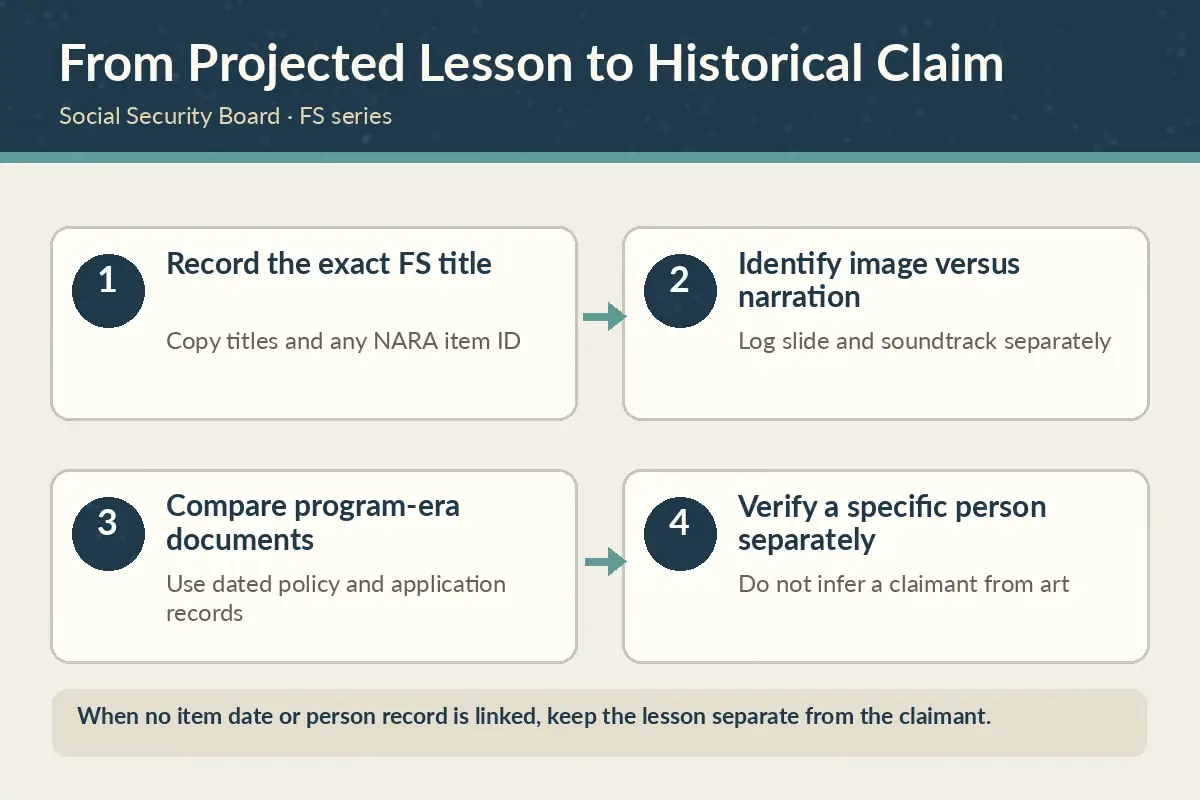
A series-level citation is a good map, not a substitute for viewing the work. For each requested filmstrip document the item or catalog identifier, full title, sequence, any language variant, the source of a soundtrack, and the consulted format. A reference scan or modern transfer may show a different order or cropping from the original projections. If the catalog does not provide an image, note that you worked only from its description and do not write visual observations that you could not have made.
In a published family story, label re-created art as an illustration instead of presenting it as an archival frame. The fact that material resides in a federal record group does not automatically resolve rights in every audio segment or reused image. Check rights and credit lines before reproducing slides. An accurate caption says what a Board presentation taught and carefully avoids asserting that the lesson depicts an actual individual’s application, payment, or eligibility decision.
More Records and Archives Guides
How We Research and Verify the Original Record
We began with the official RG 47 federal records guide and compared the stated series, formats, subjects, and dates with the National Archives still pictures research guidance. The specific inventory claim checked was: RG 47 section 47.3.2 lists ten Social Security Board filmstrips as series FS and mentions three accompanying sound recordings; the individually named filmstrips are undated. The guide describes archival holdings but is not proof that a particular image has been digitized or that every individual mentioned in a related family story appears in the collection. An item-level description and a directly examined copy are necessary before making claims about pictured details.
For reproduction or further reading, preserve the NARA item identifier, series title, uncertain dates and any separate person-level source. We did not assume access to every original photograph or underlying case. If an item is unavailable online, use NARA research-visit and inquiry instructions to ask for its location and access conditions. See the GenHis affiliate disclosure; this article does not assert a sponsored archive partnership or paid access route. The method is deliberately conservative: Read a public lesson as a historical communication rather than treating an illustration of enrollment as a record of a real person receiving benefits.
The guide lists ten filmstrips under the Social Security Board Informational Service in RG 47, section 47.3.2.
No such conclusion is supported. The same entry lists three accompanying sound recordings; an item-level match must be confirmed.
Not by itself. It is a training title, and a real account or benefit event requires a separate person-specific source.
The filmstrip entry does not specify individual dates. Verify a production date from an item record or linked evidence.
The series description does not guarantee digitization. Check the Catalog and ask NARA about the exact title and available copy.