
In RG 64, section 64.3, NARA lists employee suggestion case files dated 1944–1949 among the National Archives’ own administrative records. A suggestion file can reveal how a worker proposed a change to office procedures or services, if that information appears in the original. It does not necessarily prove that managers accepted the suggestion, financed it or changed institutional practice. The word “suggestion” names a submission channel; the final outcome must be established from dated evidence.
This series is useful for workplace and institutional history because it asks a precise question: what idea was recorded, by whom, under which office, and what documented response followed? Before claiming innovation or credit for an employee, read the file’s full sequence, including any later decision or implementation document. A name in a suggestion file is not a complete personnel record, and an unsigned draft is not automatically a formally submitted proposal.
Identify the Administrative Series and Its Dates

RG 64 concerns the National Archives and predecessor administrative organizations. Section 64.3 lists organizational charts, budgets, building management, 1944–1949 employee suggestion case files and other internal administrative records. The presence of these neighboring series is useful context, not a reason to treat them as a single file. First establish the original title and arrangement of the suggestion cases, including chronological or numerical organization if the actual finding aid supplies it.
The 1944–1949 dates define the described series span, not the career of each contributor. A suggestion written in 1948 may refer to a problem that started years earlier, and any subsequent action might occur outside the surviving case folder. Create fields for the proposal date, file number, named submitter if present, reviewing office, decision notation and later corroboration. Leave unsupported fields blank instead of treating the file creation date as an implementation date.
Differentiate Submission, Review and Decision
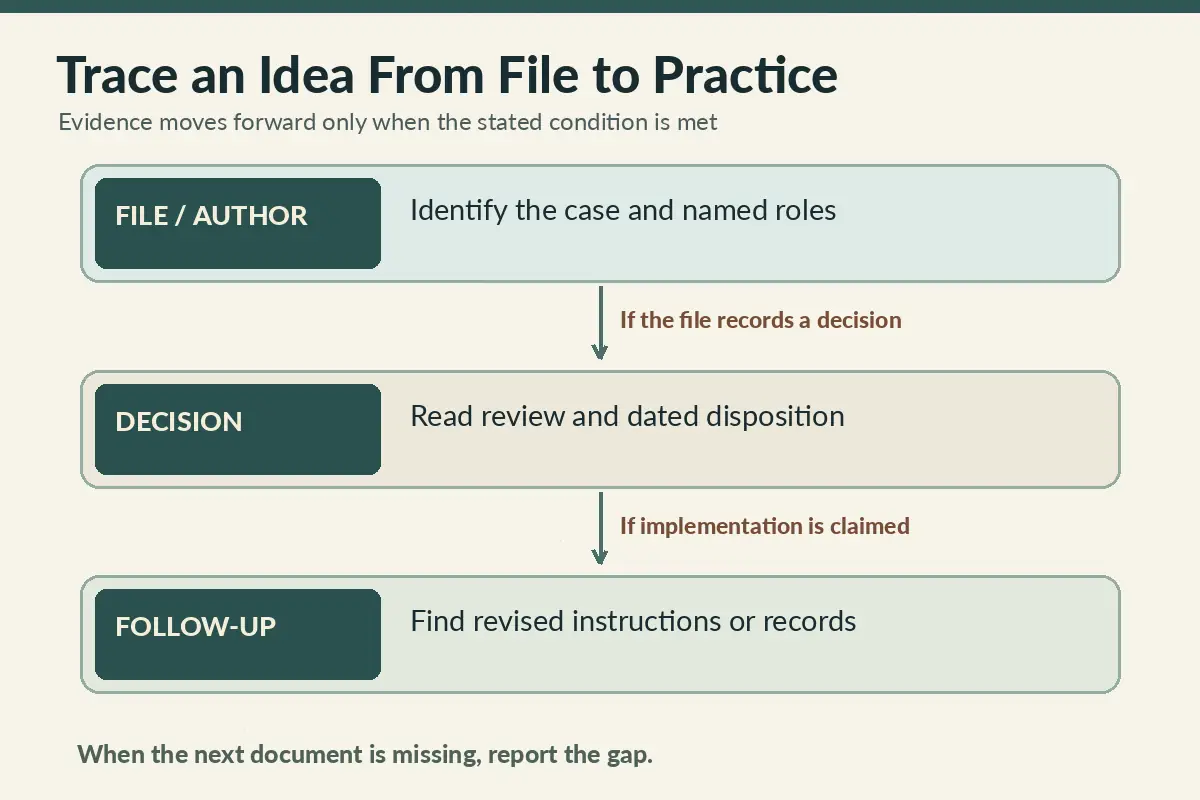
Use an evidence ladder with at least four stages: draft idea, documented submission, administrative evaluation, and implementation. A signed memorandum may establish that a proposal was submitted; a routing slip could show that an office received it; a recommendation may express approval in principle. None of these necessarily proves that equipment was bought, a practice changed or staff performed the new method. If a reviewer recommends rejection, report that instead of describing the idea as an agency achievement.
The original case may include marginal notes, stamps, attachments or a cross-reference. Read the entire page and distinguish a contemporaneous annotation from a later catalog description. An “approved” mark needs context: approved for consideration, approved for reward, or approved for actual use could mean different things. The scope of the proposal matters too. A staff suggestion that refers to one division cannot be claimed to have changed the entire National Archives without further administrative documentation.
Test Whether the Proposal Was Implemented

To establish a change in practice, seek dated circulars, revised forms, procedure manuals, procurement records, budget authorizations or work reports that show the new method operating. RG 64’s other administrative holdings may offer context, but no series-level description guarantees that the necessary follow-up survived. Match the wording and department of the proposal with any subsequent procedure. A later practice that resembles an idea is not proof of causation unless the records connect them.
If the file records an award or a commendation, distinguish recognition of a suggestion from implementation. A reward could recognize usefulness or effort under a particular program; its exact meaning depends on the wording. Likewise, a rejected proposal may still be historically valuable as evidence of staff concerns about preservation, reference work, or building services. Document the proposed problem and response without inventing a success story.
Research a Named Employee With Separate Evidence
An employee’s signed case can supply name, office or job title if those details appear, but it is only one administrative snapshot. Compare staff directories, personnel lists, correspondence or other dated workplace sources before assigning a full career. The same RG 64 section lists personnel lists and telephone directories for 1935–1949; these may help distinguish names or offices but are not guaranteed to cover every worker or year.
Do not assume that a typed name on the file is the author rather than the reviewer, supervisor or filing clerk. Preserve the role indicated by the document. If several people contributed to an idea, credit each only as supported. A signature comparison may help, but name spelling, initials and department context matter more than visual resemblance alone. For people whose later lives are not documented, avoid speculative biographical details.
Request and Cite a Complete Case Folder
Search RG 64 in the National Archives Catalog with the phrase “employee suggestion case files” and the 1944–1949 period. Record the series description and any file-unit identifier. The guide does not say that every case is digitized or indexed by employee name, so ask which repository holds the material and what detail is required to request a file. If catalog results are sparse, a reference inquiry using the exact series description is more useful than guessing a personal record identifier.
A good citation includes submitter or file caption if known, case date and identifier, employee suggestion case files, administrative activities, RG 64, the repository and item pages consulted. In a historical conclusion, use restrained verbs: “proposed,” “reviewed,” “recommended,” “authorized” or “implemented,” depending on the actual surviving document. If there is no follow-up evidence, write “implementation not established.” The limits are part of the finding, not a weakness to hide.
More Records and Archives Guides
How We Research This Archive Series
We checked the RG 64 administrative-records guide and NARA Catalog research guidance. We separated a submitted idea from review, authorization, recognition and demonstrated implementation. We did not presume that named workers had full documented careers or that every case file is available online. See our affiliate disclosure; these archive references do not imply a paid relationship.
The RG 64 guide describes employee suggestion case files from 1944–1949.
No. Look for implementation records such as amended procedures or work reports.
Not without reading its administrative context and subsequent records.
Sometimes it can provide a name and office; verify employment and dates independently.
The series description does not promise a complete name index or full digitization.