
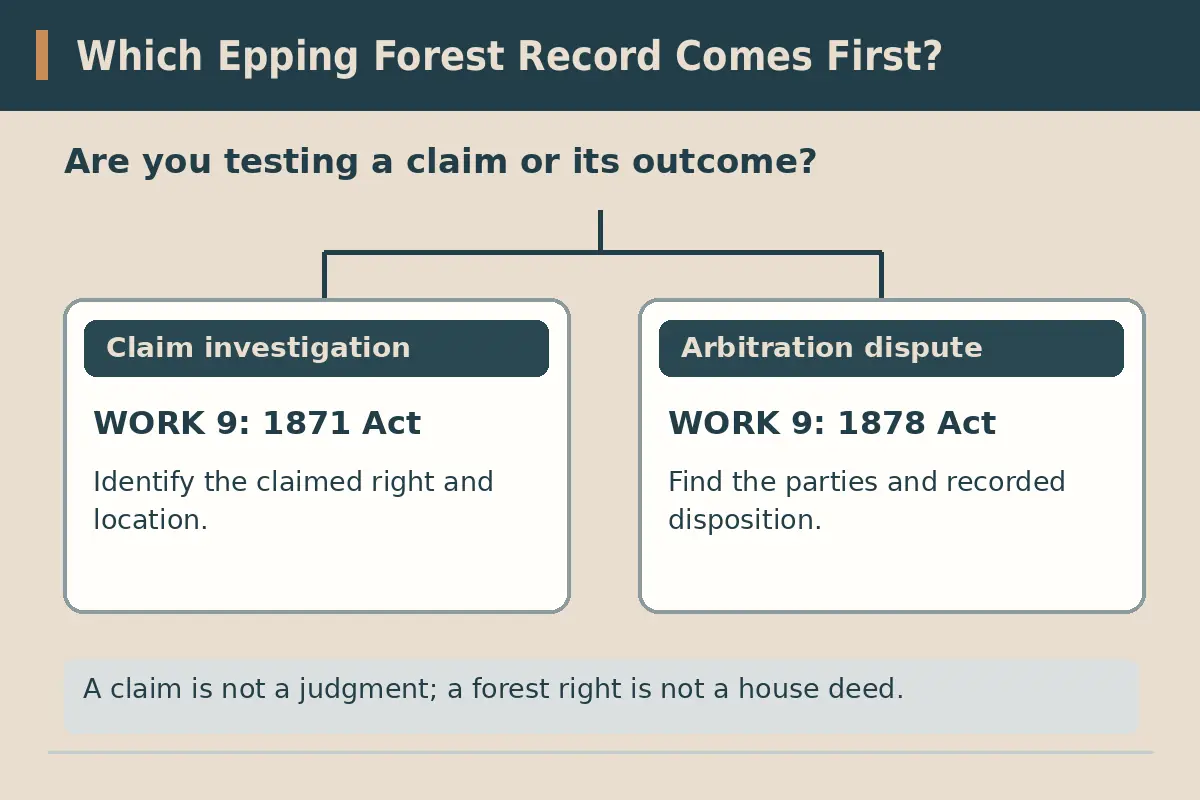
WORK 9 contains records associated with the Epping Forest commissioners appointed under the 1871 Act and an arbitrator dealing with disputes connected with the 1878 Act. An entry about a claimed right is not itself proof that the claimant won, owned a particular house, or exercised the right every year. This guide gives a precise source route, identifies what the archive can and cannot show, and names the independent documents needed before a personal or geographic conclusion becomes defensible.
Begin With the Exact Right, Not a Family Legend
Epping Forest appears in family stories as a place to collect wood, graze animals, or pass across open land. Those memories can supply good search questions, but they do not by themselves identify a legally recognized commoner. The National Archives common-lands guide points to WORK 9 for commissioners’ inquiries under the Epping Forest Act 1871 and for some arbitration material connected with the Epping Forest Act 1878. Both dates matter. A claim considered under one legal process should not silently be recast as a successful decision under the other. First write down the precise right that needs testing, the claimed land, and the date when the family supposedly held it.
Distinguish at least four people or roles: the named claimant, the person occupying an associated holding, the owner of that holding, and the person who later exercised a right. They may coincide, but that conclusion needs evidence. Common rights can be associated with particular property arrangements rather than bestowed on everyone bearing a surname. A nineteenth-century statement that a person had enjoyed a practice is testimony or an asserted entitlement until the proceeding establishes its legal treatment. Preserve contemporary language and avoid converting the word “claimant” into “owner” in a research note.
Browse WORK 9 When Keyword Search Is Thin
The official guide cautions that individual WORK 9 pieces are not described in great detail, so browsing the series can outperform a keyword search for a village or family name. Start with the series description and piece-level covering dates, then identify the likely inquiry or dispute. Keep a search ledger recording which pieces you inspected, their archival references, and why they fall inside or outside the target period. A catalogue record naming the forest as a whole is not an index of everyone who testified. Absence from a keyword result is not evidence that a claimant never appeared.
When original material can be inspected, transcribe each name as written alongside the locality and any property description. Record whether the document is a statement, list, report, order, objection, hearing note, or later summary. Do not assign one document type to every WORK 9 item. Compare dates on an original page with the broader dates in its catalogue description, especially when papers from an earlier investigation appear in later arbitration bundles. If a person is named only as a neighbor or witness, the record proves that documentary role, not that the person personally held the disputed right.
A practical worksheet has rows for each named person and columns for documentary role, date, claimed right, parcel identifier, source reference, decision wording, and later corroboration. Keep a blank outcome cell rather than entering “accepted” because a claimant was permitted to speak. The evidence may establish that an inquiry took place while leaving the legal position unresolved. Such a worksheet also makes it easier to separate competing relatives with the same surname.

Build a Claim-to-Outcome Evidence Ledger
The essential research tool is a three-column ledger: what a claimant asserted, what the authority demonstrably recorded or decided, and what remains to be established. For each claim note the kind of right, alleged basis, affected property, opposing party if present, and words describing the disposition. A statement of “ancient enjoyment” is a historical assertion. A recorded dismissal, allowance, modification, or other result is a different type of evidence. If the surviving paper does not show a final result, mark outcome unknown instead of inferring victory from the fact that the case was heard.
The 1871 commissioners’ role and the later 1878 arbitration context should appear in distinct dated rows. An order may clarify a legal question without telling you whether a household continued its traditional practice afterward. For later exercise of a right, look for an independent register, estate account, dated correspondence, or other material describing use. A landowner could object to a claim without being the claimant’s landlord; a person with a recognized right may not have lived on the forest edge. Keep the separate questions of legal right, actual practice, residence, and title open until each receives appropriate evidence.
Match Historic Holdings on Dated Plans
Place names and holding boundaries are crucial because a common right may be attached to a tenement or another identified parcel. Compare the exact field names, roads, commons, and neighboring holdings in a WORK 9 paper with maps produced near the relevant date. Note scale, survey or revision year, and whether a line is an administrative boundary or a visible physical feature. A present-day footpath does not establish an identical route in 1871. Nor does a map symbol showing woodland prove where any named family grazed livestock or collected fuel.
For an ownership question, leave WORK 9 and trace title evidence in deeds, estate conveyances, or other suitable land records. For residence, use a census, directory, rate book, or similarly person-specific source whose date and address can be matched. Write the linkage explicitly: a unique property description, documented succession, or independent identifying detail is far more useful than a surname repeated in one parish. Where a map has no parcel numbers or an altered roadway, preserve competing locations. The map itself supplies spatial context rather than an automatic legal resolution.

Write a Conclusion That Can Be Rechecked
A strong conclusion is narrow: “A named person asserted a stated right over a specified place in a WORK 9 proceeding, while the outcome has not yet been located.” If an award or settlement is found, cite its language and date separately. Do not extend a right to descendants without later evidence of inheritance or continued entitlement. Archive research is especially vulnerable to circular sourcing when a modern history repeats an earlier antiquarian claim without showing the underlying court or commission page. Quote the original where possible and attribute any printed summary.
Finish by recording the search pathway, the missing piece, and the best independent follow-up. That may mean a parish land tax, a manorial record, an estate plan, or a later Epping Forest administration file. Record negative searches exactly, including scope and access limits. The goal is not to produce a beautifully certain story from a single old dispute; it is to show which right was proposed, what decision survives, which holding it concerned, and how confidently the historical person can be distinguished from namesakes.
For a hypothetical case in which two people share a name, compare an address in a deed against a parcel described in the proceeding. Neither geographic proximity nor matching family tradition resolves identity by itself. The decisive link may be a distinct holding name or a proven transfer. Mark invented examples as examples; do not give them authentic-sounding WORK 9 piece numbers.
More House and Local History Guides
How We Research This Archive Series
This guide starts with the official description in The National Archives’ research guidance, not a claim that we have inspected a particular person’s private file or a specific original piece. The archival statements here concern the series or research method. A hypothetical example is labelled as such; it is not a newly discovered historical event. We use the Discovery search guidance to distinguish keyword matches from archive holdings and document contents, because catalogue descriptions do not transcribe every word of an original.
For every real candidate, record its historical place or person’s name, the creator, document type, date, full WORK 9 piece or item reference, access restrictions, and the exact claim being tested. The official citation guide explains how to document those references so another researcher can retrace them. An unread document remains a catalogue lead, never proof of imagined details. If a record is missing, preserve the searched terms and dates and examine survival and alternate custodians before interpreting the gap.
Before sharing a conclusion, audit the difference between original source wording and your interpretation. Require independent evidence for any further claim about an individual, property owner, legal effect, or completed action. Respect archival access limits and living people’s privacy. This website also provides an affiliate disclosure; no paid partnership or commercial access is implied by these archival references.
Material of Epping Forest commissioners under the 1871 Act and some arbitration records linked to the 1878 Act.
No. Piece descriptions can be sparse; browsing the series may be necessary.
No. Find a recorded determination and check its specific terms.
No. Use separate land-title documentation for ownership and person-level sources for residence.
Cite the WORK 9 piece, the page or item if present, its date, and the exact wording used for the claim or result.