
F 17 offers a specific Forestry Commission archival route for ironstone mining and stone quarrying in the Forest of Dean. Material about a quarry, lease or working is not a roll of miners and cannot alone establish who owned the minerals or when extraction occurred. This guide gives a precise source route, identifies what the archive can and cannot show, and names the independent documents needed before a personal or geographic conclusion becomes defensible.
Define the Site Before Searching for Workers
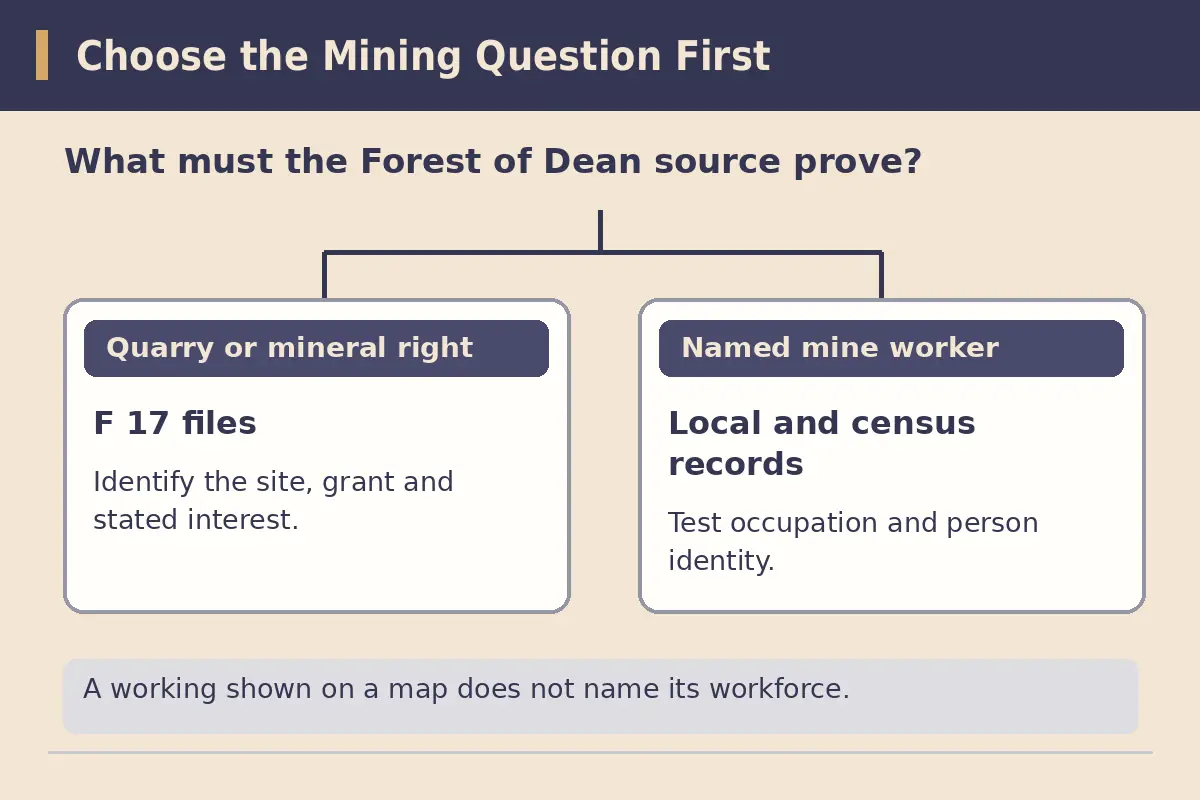
The Forest of Dean has a complicated history of minerals, forest administration, and locally specific rights. A broad family story that an ancestor “worked the Forest” does not identify an ironstone mine, a quarry, or a period of activity. The National Archives mines-and-mining guide explicitly points to F 17 for material on ironstone mining and stone quarrying in the Forest of Dean. That is a holding description, not a promise that every surviving piece contains a worker’s name. Begin with the locality and the exact research question: where was an extraction site, what rights were under discussion, or who was demonstrably employed?
Do not combine coal, ironstone, and stone extraction into a single undifferentiated mining category. A quarry and an underground working may have different legal arrangements, types of plan, and records of activity. Collect variant historical site names, nearby hamlets, parish boundaries, and known approximate dates. A family address close to a pit is useful geographical context but cannot establish an employer. A later trade directory that lists a mine owner can name an enterprise without confirming that the business operated every year or that a namesake worked for it.
Search F 17 Alongside the Custody History
Search the Discovery catalogue within F 17 with the locality, quarry name, and terms for ironstone or stone. Read the series-level description and each piece’s date span rather than trusting a search snippet. Materials may be arranged administratively and their catalogue titles may not include the particular place visible in an original file. Record the repository, complete reference, piece title, dates, and any access conditions before requesting an item. An apparent absence from the online index may reflect cataloguing depth or the fact that you have searched the wrong variant of a historic name.
The official mining guide states that related files once held in F 3, F 16, and F 26 were transferred to the Gloucestershire record office in 2002. This is a custody warning, not evidence that every file on the subject is at a single repository. Before reporting that a record does not survive, check whether the relevant collection migrated and whether a local finding aid describes it. Use independent notes for TNA-held and locally held material, preserving the original archive reference and any new repository identifier instead of inventing a single continuous record series.
For each candidate working create a site identifier based on a source reference, not a guessed modern address. Record historical name variants, approximate coordinates where justified, plan date, mineral type and independent operation dates. Never mix a proposed layout with a later physical survey without showing which is which. Differences between the two can signal change, but the difference itself does not date construction or extraction.
Distinguish Rights, Plans, and Production
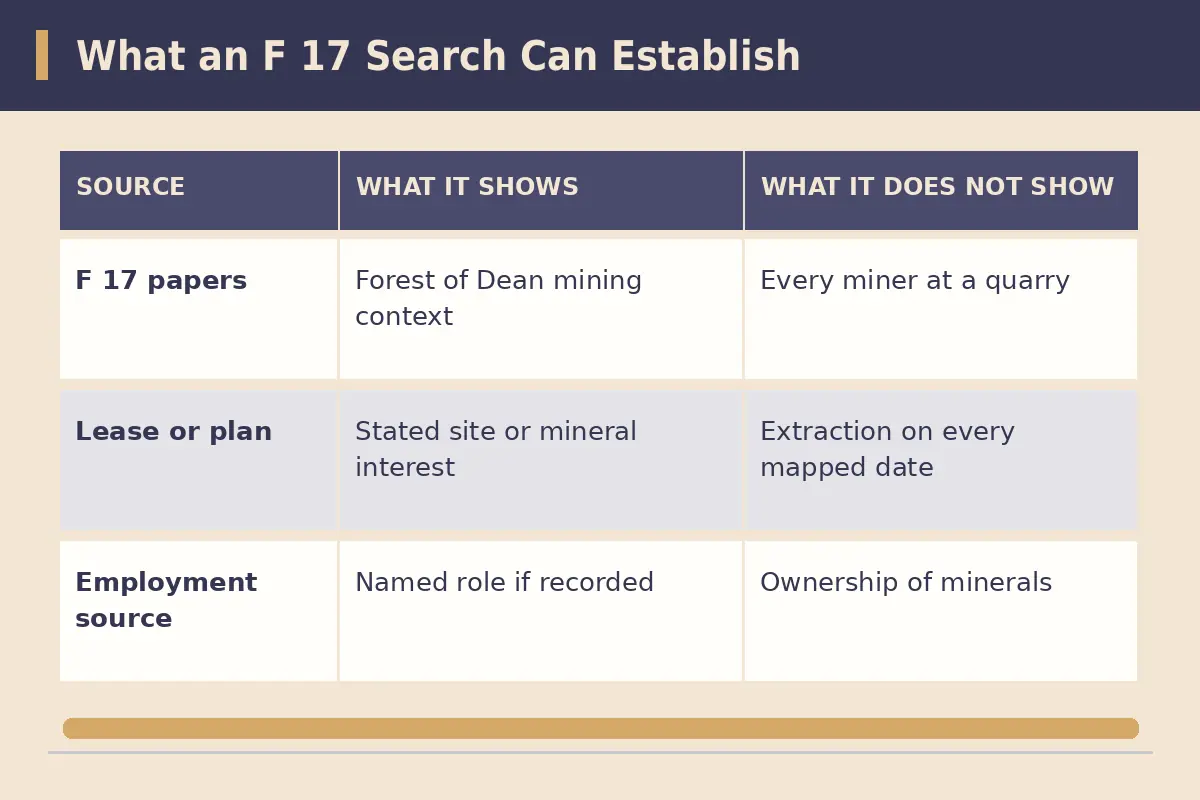
A lease may identify a landlord, lessee, term, payment, or permitted mineral, but such statements need to be read as legal terms in that particular instrument. Permission to dig does not show when excavation began or how much material left the site. A plan drawn for an application could depict an intended working rather than an operating pit. Likewise, a later survey may show a disused shaft without stating the date it was abandoned. Copy the legend, scale, north arrow, creator and date of each plan before drawing conclusions from a symbol.
To establish activity at a definite time, seek dated accounts, production returns, inspection material, correspondence about actual operations, or other contemporaneous evidence. A complaint that a quarry caused damage is evidence that someone made the complaint; it does not in itself settle cause or liability. Build a chronological grid with a row for each kind of document: right granted, surveyed feature, documented extraction, safety concern, and closing or redevelopment. Avoid turning a sequence of differently purposed papers into a narrative of uninterrupted production.
Find a Person Without Inventing a Miner Roll
Mining families often contain multiple people who share surnames and jobs. A site-level file about the Forest of Dean does not establish that an individual was present on a given shift. To test personal service, look for dated census occupations, local employment records where surviving, wage or compensation evidence, and contemporary newspapers. Record the workplace only when a source actually names it. “Iron miner” in a census is an occupation reported for that person, but the census may not name an employer; do not fill that blank with the nearest pit on a map.
A collision between a plausible employment date and the date of a lease is not proof of a link. Check age, address, spouse or household, and the historical spelling of any named working. If an account names a contractor, distinguish contractor, lessee, proprietor, and worker. One individual can hold multiple roles, but the documentation must show which role applies. Older accident or court records may identify witnesses and complainants rather than a comprehensive payroll. Treat each person as an independent identity problem, including all same-name candidates.

Write a Site History With Explicit Limits
A well-supported local history might report that a Forestry Commission file concerned ironstone extraction at a named place, followed by independent evidence that the site was working in a particular year. That does not establish the precise boundaries of a family holding or the identity of all workers. Quote period terminology and distinguish actual dates within a letter or plan from the catalogue’s inclusive date range. Where a historic map shows a mineral feature but no scale-based certainty, describe a location area rather than publishing an invented exact point.
Conclude by listing the unanswered questions that would materially change the story: which lease referred to this parcel, whether documented production occurred, whether a closure date survives, and whether a named ancestor has a verified personnel connection. Keep a full search log for TNA and local archives; document both positive and negative results with their date limits. This approach can make an industrial family narrative more specific without attributing an accident, employer, or mineral ownership to someone on conjecture alone.
If a cited record is now held locally, preserve both the historical departmental reference and the currently used repository identifier. Explain the transfer rather than presenting the National Archives catalogue as an all-inclusive online archive of Forest of Dean mining. A transparent custody trail can rescue a research project when one apparently missing piece exists under another archival arrangement.
More House and Local History Guides
How We Research This Archive Series
This guide starts with the official description in The National Archives’ research guidance, not a claim that we have inspected a particular person’s private file or a specific original piece. The archival statements here concern the series or research method. A hypothetical example is labelled as such; it is not a newly discovered historical event. We use the Discovery search guidance to distinguish keyword matches from archive holdings and document contents, because catalogue descriptions do not transcribe every word of an original.
For every real candidate, record its historical place or person’s name, the creator, document type, date, full F 17 piece or item reference, access restrictions, and the exact claim being tested. The official citation guide explains how to document those references so another researcher can retrace them. An unread document remains a catalogue lead, never proof of imagined details. If a record is missing, preserve the searched terms and dates and examine survival and alternate custodians before interpreting the gap.
Before sharing a conclusion, audit the difference between original source wording and your interpretation. Require independent evidence for any further claim about an individual, property owner, legal effect, or completed action. Respect archival access limits and living people’s privacy. This website also provides an affiliate disclosure; no paid partnership or commercial access is implied by these archival references.
The official mines guide identifies material on Forest of Dean ironstone mining and stone quarrying.
No. Related former F 3, F 16 and F 26 material was transferred to Gloucestershire in 2002.
Usually the plan establishes a mapped site or proposal, not a complete workforce.
No. Compare it with separately dated production, inspection, or accounts.
Connect an independently identified person to a specific employer or site using dated person-level evidence.