
Identify a Fishlake Grazing Question Before Looking for a Name
The National Archives guide for Record Group 95 specifically lists grazing and livestock-use permits for Fishlake National Forest, Utah, dated 1919–1945. These are records of the federal Forest Service’s management of use rights, not a county register of private landowners. Start by writing down the forest, approximate period, ranch locality and any known range or allotment designation. A family surname alone is a poor locator if the land-use records were organized administratively by place, permit or management unit.
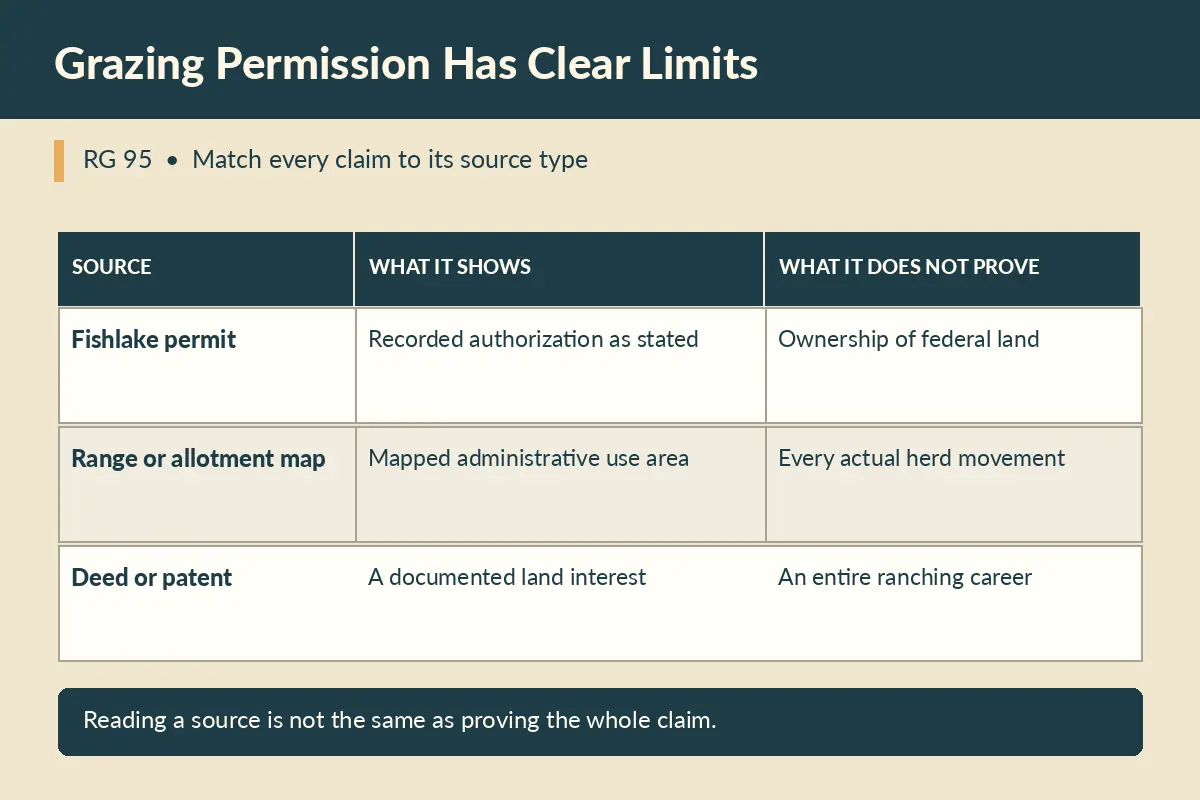
Clarify the claim. You may wish to know who received permission to graze cattle or sheep, which area the agency assigned, what terms governed use, or whether a family ranch was located nearby. Those questions are related but not the same. A permit may document an authorization for a stated term and holder; only the actual instrument reveals its precise conditions. It does not prove that every animal entered the area, that the holder lived on the allotment or that any federal land was privately owned.
The NARA inventory places the Fishlake material in section 95.11.6 under records of national forests rather than within a universal name-based ranching database. It specifies that the textual records are in Denver. Before assuming they can be viewed online, verify the catalog description and ask the custodian how the series is arranged. A general reference to “RG 95 grazing records” without the national forest, date range and record type is too broad for efficient retrieval.

Use the Permit’s Own Conditions Instead of Guessing Ranch Rights
When an item is obtained, transcribe the exact permit holder name or organization as written, identifying number if present, effective term, named forest or range, type and number of livestock if shown, and any restrictions. Do not presume the format or fields are identical across the entire 1919–1945 series. A renewal, amendment or temporary permission could carry different meaning from an original authorization. Record an action’s date rather than treating the document’s filing year as the start of the rancher’s entire use history.
The phrase “grazing permit” should be interpreted as a documented federal authorization under its stated terms, not as a conveyance of fee ownership. A named individual might be an applicant, correspondent, holder or representative, depending on the item examined. Do not convert a signature as a witness into a person’s permit-holder status. Likewise, an administrative complaint or requested adjustment is not evidence that a final change took effect. Look for a signed decision or matching renewed instrument when possible.
Create two ledger rows when a file describes both a requested and an approved area. The agency may have considered an adjustment that did not become binding. If an application includes a livestock total, distinguish the amount requested from the authorized head count and from actual animals present on a given day. An annual report may give aggregate use by forest; it should not be used to calculate one rancher’s individual herd without a direct documentary link.
Choose an Allotment Map Without Confusing It With Private Land
A range or administrative map can show a management area, topographic boundary or allotment designation. The NARA guide separately identifies range maps and records of regions and forest offices within RG 95, but the presence of a mapped area does not guarantee that it corresponds to the same individual Fishlake permit. Match the map’s producing office, date and named forest to the permit’s own descriptions. Include later boundary changes and renamed units in the comparison.
Unlike a county deed, a grazing allotment map normally answers where federal range management was delineated, not who held private title to every acre. For property claims, look for a separate land patent, deed, tract book or local recording appropriate to the parcel. NARA Record Group 49 concerns the General Land Office and land disposition records and is a different search route. The permit may connect an individual to a use privilege without connecting that person to fee ownership of the ground.
Map evidence has its own date and scale limitations. A boundary drawn on a published range map may be approximate, altered or created after the term of a particular permit. Do not plot an ancestor’s dwelling at the center of an allotment. A ranch headquarters could lie outside the federal range, and seasonal livestock movement might involve several different areas. Consult contemporary land records and residence sources before mapping the family’s home.
Match a Grazing Record to One Rancher, Not a Namesake
A surname on a permit is a lead, not proof of identity. Compare given name, initials, business or partnership name, county, livestock enterprise, nearby ranch location and relevant years with independent documents. Utah families may have repeated personal names across generations; a younger relative may have succeeded an older permittee. Treat a renewal as evidence of the named administrative holder on that instrument, not proof that it is the same human who appears in a census twenty years earlier.
Useful corroboration may come from county tax rolls, deeds to the ranch headquarters, probate files, directories or dated population and agricultural records. Identify what each source actually records. A tax assessment may concern livestock or property without proving that all animals grazed at Fishlake. A census household may establish a residence but not the precise dates of seasonal range use. A family account can preserve a valuable story, but verify the time and place before treating it as a reconstructed official permit history.
Make explicit distinctions between an individual, a ranch business and an inherited family name. If the permit belonged to a corporation or partnership, the identity of a named manager or signer needs a separate evidentiary connection. If the record was created by a government office but names a private livestock operator, describe both roles. This protects against a frequent historical error: describing a private ranch as owning a part of the national forest merely because animals were authorized to graze there.

Cite the Use Right and Keep the Search Reproducible
A full citation should give National Archives Record Group 95, Fishlake National Forest grazing and livestock-use permits, the document title and date, any file or allotment identifier actually recorded, and the Denver repository as appropriate. If an image is available, cite the image or page; if you have read only the archival guide, say it lists a series rather than pretending to know a particular person’s permit status. Do not create a filing number or range name to make the citation look more impressive.
Document negative searches with the specific forest name, the 1919–1945 span, variant spellings, possible ranch localities and any permit index inspected. The absence of a name in one folder cannot prove that a family never grazed livestock in Utah: a different national forest, private range or state land arrangement might have been involved. The source must be scoped to the land manager and place before it can support an absence argument.
The strongest result is an accurately qualified statement: a named permit authorized specified use of Fishlake land for a documented period, a separate administrative map helps identify the relevant range, and independent property or household evidence identifies the rancher. If only the permit class has been located, mark the person and allotment as unresolved. A precise land-use claim is both more useful and more defensible than a loosely asserted story of inherited national-forest ownership.
More House and Local History Guides
How We Research and Verify the Original Records
We reviewed the official National Archives RG 95 guide and checked section 95.11.6 for specific record classes, dates and custody. We compared the evidence limit with a second institutional source about the relevant historical context or research method. A published archival inventory supports the existence and stated scope of a class of records; it does not authenticate details of an individual item that we have not inspected.
Our recommended method separates three levels: the archive catalog or institutional guidance, the exact original document and an independent dated confirmation. Search failures are recorded with terms, jurisdiction, years and access method rather than represented as proof that an event did not happen. The site’s affiliate disclosure describes relationships; the official record links here are informational research sources, not statements of sponsorship.
Under RG 95 section 95.11.6, for 1919–1945, with textual records held in Denver.
No. Federal permission to use a range is different from legal title to the ground.
No. A permit records authorization as written; evidence of actual movement requires additional records.
Yes. Do not infer dwelling location from a grazing-use boundary.
Compare permit details with dated locality, livestock, tax, land and household evidence before merging identities.