
Find the 69 Negatives in RG 64 KE
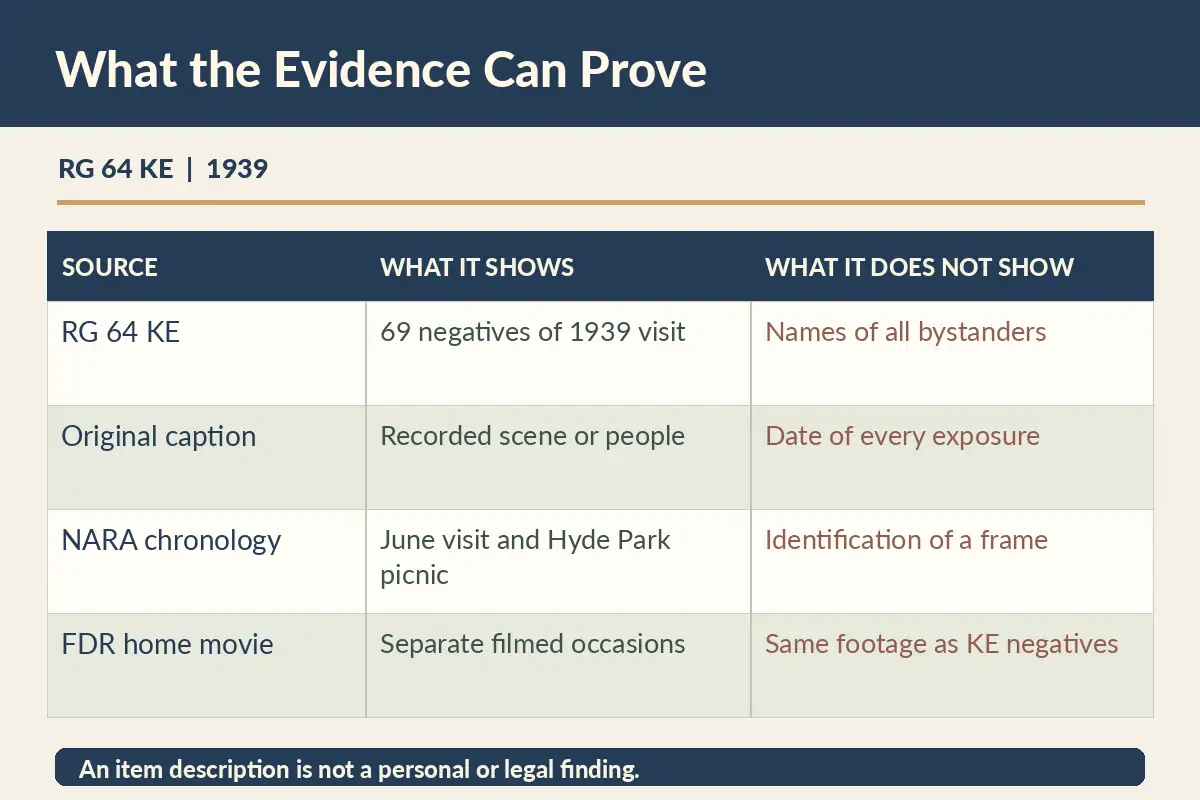
The National Archives lists 69 photographic negatives documenting the 1939 United States visit of King George VI and Queen Elizabeth in Record Group 64, series KE. This is a small, well-defined group, not a complete photographic history of every public appearance on the trip. Start with the specific negative and its original description. Preserve the archival identifier and ask which venue, date, and participants are actually named. Do not treat the series title as an identification of all people in each frame.
The visit took place in June 1939, before the outbreak of World War II in Europe. The National Archives notes the royal couple’s meetings with President Franklin D. Roosevelt in Washington and at Hyde Park. The event chronology can orient a photograph but does not automatically assign a particular exposure to a specific afternoon. Distinguish the date of a documented engagement, the exposure date of the negative, and the date an image was printed or circulated in newspapers.
Set up a scene inventory with the complete item reference, an exact transcription of the description, any confirmed venue, all directly named people, and the source of the dating. Mark uncertain guests as unknown. A crowd near a motorcade, a reception table, or a building entrance is not a complete guest register. A reader seeking a family member should not assume that attendance at a public parade places that relative in a particular published picture.

Identify Which 1939 Event the Frame Records
There are at least three different search routes. For an official meeting, compare known White House or Roosevelt-event descriptions; for the Hyde Park visit, check the dates and setting; for other appearances, seek a specific local caption or itinerary before naming a site. These are alternative scene types, not a linear reconstruction of every negative. Where the original caption gives only a general activity, do not replace it with a famous date just because that day appears in a timeline.
NARA’s historical account mentions a June 11, 1939, picnic at Hyde Park, remembered partly for its hot-dog menu. That is a firm contextual event, but not proof that any RG 64 KE frame depicts the picnic. The royal visit also had formal and informal settings, and photographs from different occasions can be visually similar. Test clothing, signage, architecture, the item title and a published itinerary before joining an image to a specific occasion.
The Franklin D. Roosevelt Presidential Library describes a separate silent color home movie of the royal visit, covering Mount Vernon and Hyde Park. The moving-image source may offer a sequence of visual clues or a different perspective. It does not mean a still in KE is a frame lifted from that movie. Cite film and photographic negatives under their own archival references. Use a matching scene as corroboration only when the venue and event can be shown to coincide.
Compare Still Photographs With the Royal Itinerary
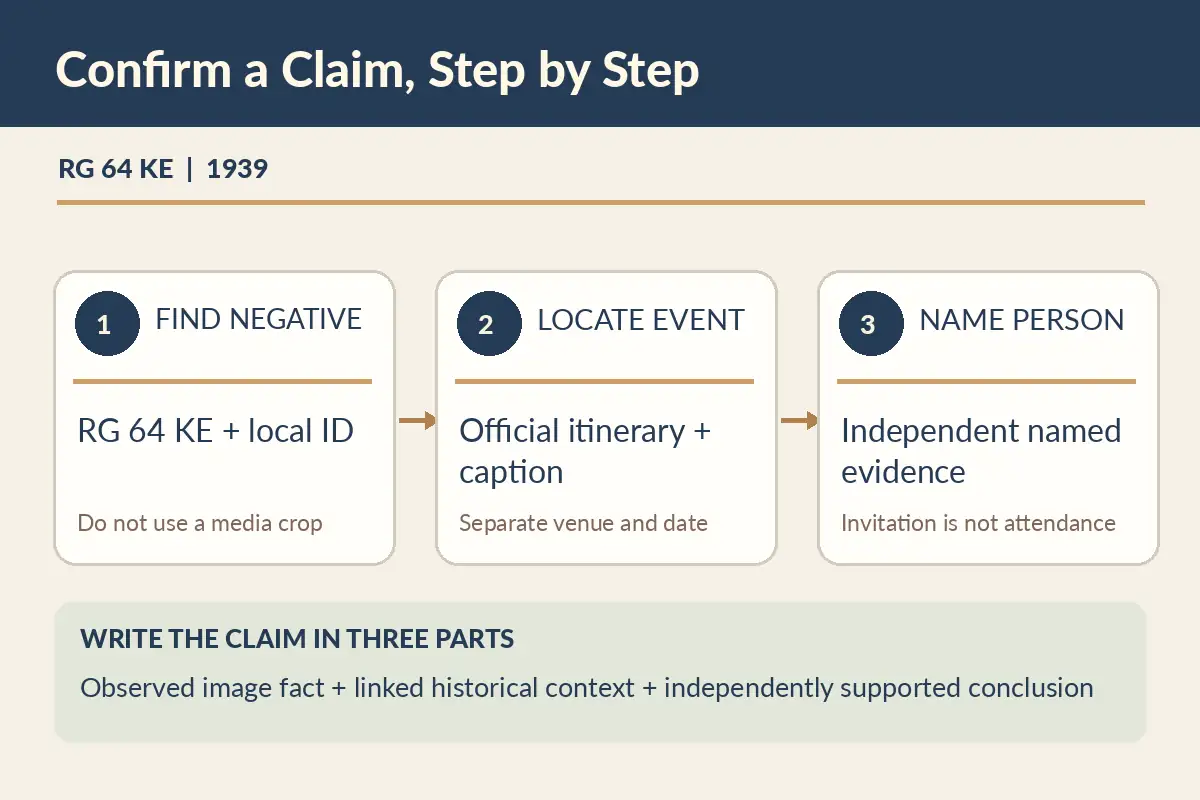
If a caption identifies Roosevelt, King George or Queen Elizabeth, keep that named attribution linked to its source. The presence of a recognizable public figure does not establish the identity of an aide, driver, attendant or spectator. Do not assign a name because a person looks like someone in a newspaper clipping. Compare a contemporaneous caption, an official list, and independent family records, and explain where each adds a distinct piece of evidence.
Researching a relative in a crowd requires stronger evidence than research into the event itself. Start from the relative’s independently established location and role, not from a face in a negative. Was the person an invited guest, an employee, a reporter, or a spectator? Each role implies a different possible record. Guest lists, employment rolls and press credentials should not be treated as interchangeable. Even a verified invitation does not prove that a person attended or appeared in the photograph.
Consider what a negative can and cannot show. It may capture people, clothing, vehicles and part of a setting; a catalog description may add location or a date. It rarely supplies the identity of every background person, the content of private conversations, or the significance of a handshake. A diplomatic interpretation belongs to correspondence and contemporary reporting. A family connection belongs to separate person-level evidence. Keep these levels in different paragraphs or evidence columns.
Separate Public Guests From Private Family Claims
The archival label KE is the series identifier within RG 64, not a license to invent a unique number for each picture. Record the local identifier exactly as the National Archives provides it. The National Archives explains that reference staff need record group, series and item details to locate still photographs. If an online reproduction omits its identifier, search the original catalog record before publishing it with an implied official caption.
Reproductions introduce their own problems. A newspaper crop may remove a car door, sign, or building corner that established a location. A hand-colored reproduction may alter clothing colors. Mirror reversals and captions reused from another agency can mislead the researcher. Compare a published picture to the full negative when available, and record whether the two are identical frames or merely similar moments in a public event.
For a scene-location argument, cite the RG 64 KE negative and then cite the contemporaneous itinerary or an official historical source that establishes the occasion. If a modern article interprets the diplomacy of 1939, identify it as interpretation rather than primary documentation. For a relative, add a named independent record and explain whether it proves presence at the event, presence in the frame, or only potential access to the site.
A responsible caption may read: “Royal visit to the United States, June 1939, RG 64 KE; exact event and unnamed attendees not verified.” If a negative explicitly identifies a White House arrival or a Hyde Park meeting, give that specific attribution with its item citation. A well-sourced royal chronology adds context, but the surviving photographic evidence must still be allowed to answer only the questions it genuinely documents.
More Research Method Guides
How We Research This Evidence
We started with the exact National Archives record-group guide and verified the series code, format, described quantity and date span. We compared its historical framing with an official contextual source and a second archival or institutional reference. NARA’s still-picture reference instructions explain why the complete local identifier matters. A general archival guide does not establish that every item is digitized, individually named or correctly dated in a third-party reproduction. For every claim, we separate observable content, original archival wording and independent documentation. The historical and source review was completed November 15, 2026. No sponsored route or unverified product recommendation is implied; see our affiliate disclosure.
A NARA series of 69 negatives of the 1939 U.S. visit of King George VI and Queen Elizabeth.
No. The visit included multiple venues; the picnic is a contextual event, not an identification for all frames.
It can offer comparative context, but the film and photographic negatives require separate item citations.
No. A crowd image is not an official attendance list.
An original image attribution, independent evidence of identity and role, and a documented link to that particular occasion.