
MH 60 can help locate a registered piece of late Victorian or early twentieth-century Poor Law correspondence when the original paper is difficult to find. The National Archives identifies the series as registers relating to miscellaneous correspondence for 1899–1920. A recorded subject does not prove that an individual received relief, lived in a workhouse or experienced the outcome mentioned. The first useful result is a traceable administrative reference, which must be followed through surviving records and, where necessary, a separately documented local history.
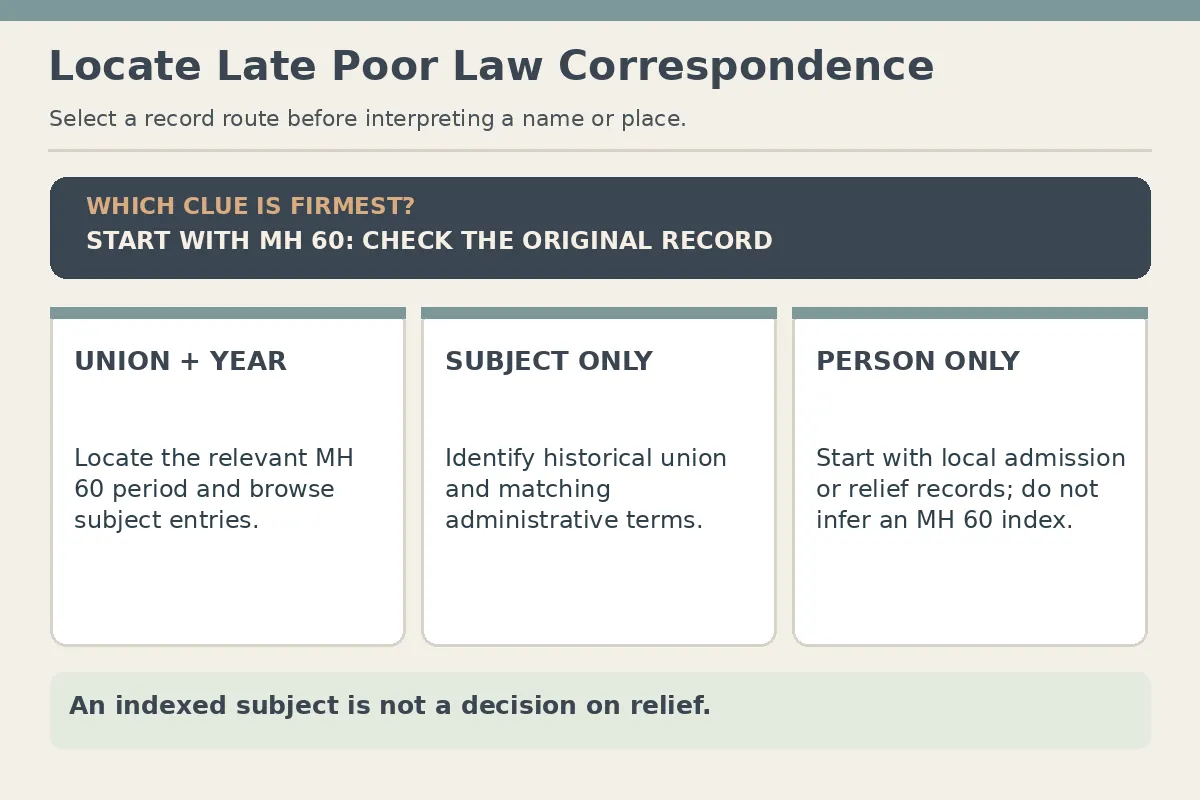
Start With the Union, Topic and Year
Record the exact Poor Law union or central administrative body named in your source, along with the date and the issue to be investigated. A union covered a group of parishes and its name need not match the locality of the workhouse building. Modern town names are therefore a weak substitute for a historically accurate union. The National Archives illustrates this problem with Slough, whose workhouse belonged to the Eton union. Use the union name that was current at the date in question.
If your clue concerns a staff complaint, building, transport of a pauper, medical question or financial request, state the claim without implying its resolution. Search MH 60 by any administrative term actually supported by the period documents. Keep alternative vocabulary, including phrases that might now seem unusual, in a search log. An index may classify a case under a broad subject rather than the surname of the person who triggered the correspondence.
Understand What a Correspondence Register Records
A correspondence register exists to track papers moving through an office. Its entry may identify a subject, date, register reference or filing relationship; the exact arrangement depends on the volume. Before using a reference number, copy the column headings and the entry in full. A note that a matter was referred or received is not evidence that relief was granted or refused. Even a reference to a named union does not necessarily identify a particular workhouse inmate.
MH 60 is not a universal alphabetic list of people receiving relief. Search strategy should follow the office arrangement and topic, then date, with personal names used when the original register supports them. Distinguish a later annotation from the date an earlier paper entered the system. If you encounter multiple entries for one dispute, note their chronology and office role; do not assume all entries represent separate events or people.
Bridge MH 60 to the Surviving Papers
The National Archives associates MH 60 with miscellaneous correspondence in MH 25 and places other kinds of Poor Law union correspondence in MH 12. These are related record systems, but not every entry in one can be guaranteed a surviving paper in the other. Capture the reference format precisely, including any date, subject and office number. Search the related series and catalogue descriptions, and note when an original has to be requested rather than downloaded.
A missing paper matters to the conclusion. The National Archives warns that much post-1900 Poor Law correspondence was destroyed by fire in the 1940s. A register entry may therefore be valuable evidence that a matter entered official correspondence even when the content is no longer recoverable. Do not invent the missing letter or describe its arguments as known. Report the distinction: a register proves an administrative trace, not what the lost enclosure said.
Separate Central Correspondence From Local Relief
A central office might receive a complaint about a workhouse or report on a proposed scheme without knowing the full facts of every household involved. To establish a particular person’s admission, discharge or relief, seek surviving union minute books, admission registers, relieving officer records and parish materials in the appropriate local repository. The national register and local records were created for different purposes; agreement across the two is more meaningful than a name appearing in only one.
When a case mentions a group of residents, avoid treating their names as if they were all inmates or recipients of relief. A correspondent might be a guardian, officer, journalist, complainant or witness. Copy the written role and compare it against independent material. A complaint, petition, instruction and recorded decision are distinct events. Mark each in the timeline so an administrative communication is not silently converted into a confirmed personal outcome.

Use MH 15 and MH 12 Without Confusing Periods
MH 15 contains subject indexes to Poor Law correspondence between 1836 and 1920, while MH 12 is a major body of union correspondence, especially for the nineteenth century. MH 60 specifically covers later miscellaneous registers. These references are not automatically interchangeable or mandatory steps for every subject. A researcher should start with the known date and type of letter, then identify the most likely office and series before testing cross-references.
Use the names of unions, dates and administrative subjects to compare entries, but record which repository or volume actually produced each clue. If a subject index supplies a code, preserve its original notation instead of replacing it with your own number. The National Archives explains that MH 15 uses historical paper and union number references, not a modern individual case-ID system. This is a useful reminder that old filing systems need to be read on their own terms.
Build a Timeline for a Missing-Letter Case
Consider a fictional situation in which a family account reports that a union asked central authorities for permission to change accommodation in 1907. A register entry for that year may record a request, but not its approval. Add one row for the family account, one for the MH 60 entry, a third for any surviving central reply and a fourth for a local union minute. Keep the date and evidence quality of every row visible.
If the original letter is lost, the timeline should say the entry records a subject or correspondence action; it should not fill in a response based on what usually happened elsewhere. The point of the fictional example is the limits of the register itself. Negative searches of surviving local documents may narrow the question, but only after the local records’ coverage has been established. Missing correspondence must never be treated as proof that no request was made.

Cite the Register and Describe the Gap
An audit-ready citation includes MH 60, the exact piece, register title or volume, entry date and any reference number actually present. Note whether you viewed the manuscript, a digital image, a transcript or only a catalogue description. These distinctions affect what can honestly be claimed. If a record is unavailable, check the archive’s stated access procedure, which may involve a visit to Kew or requesting a copy; do not promise that the complete series is name-searchable online.
Write the research conclusion in two parts: what the register directly says, and what separate sources show about the outcome. Use cautious language for missing material, especially during the post-1900 loss period. Keep the search terms, date ranges and repositories in your log so someone else can repeat the work. A well-documented unresolved question is more useful than a confident story built around a subject heading.
More Research Method Guides
How We Research This Archive Series and Verify Its Limits
We anchor the series description to The National Archives research guidance and use additional official guidance to test the difference between cataloguing, surviving documents and interpretation. The evidence trail follows the record creator, exact series and piece, original wording, historical jurisdiction, and a separate corroborating source for any person-level or outcome claim. We label illustrative scenarios as fictional and do not treat absences from poorly indexed collections as evidence of nonexistence.
An archival catalogue entry is not a substitute for reading a page. Availability, description detail and access conditions can differ by item and change over time; check the current record page before making travel, copying or subscription plans. We do not infer a paid relationship from archive references. Our affiliate disclosure explains site-level disclosure principles. The methods here are for reconstructing historical evidence, not for locating or revealing sensitive information about living people.
No. It contains registers of miscellaneous Poor Law correspondence, not a comprehensive name index of residents.
The National Archives identifies registers for 1899–1920 in its Poor Law research guidance.
Record the register entry accurately and investigate survival; many post-1900 Poor Law papers were lost in a twentieth-century fire.
No. A register may document incoming or outgoing correspondence without proving implementation.
The administering Poor Law union may have had a different name from the town containing the workhouse.