
MH 25 holds miscellaneous correspondence and papers connected with central administration of the English and Welsh Poor Laws. The National Archives guide distinguishes those papers from union-based correspondence in MH 12 and points to registers in MH 60 for 1899–1920. That relationship is an archive-search aid, not a promise that every subject has a surviving letter or that a named pauper appears in the file. Start with the administrative question and date, determine the relevant union or department, and only then consult the right register or piece. If the research goal is a named workhouse inmate, local admission books and other union records will usually be a more direct source.
Choose a Subject Before Choosing a Person
A family question often begins with someone said to have entered a workhouse. MH 25 is not an admission register. The National Archives describes it as miscellaneous central correspondence and papers. It is better suited to questions about a policy, an administrative dispute, a reported local problem or the route by which a subject reached government officials. Start with a dated issue and a place rather than expecting an alphabetical inmate list.
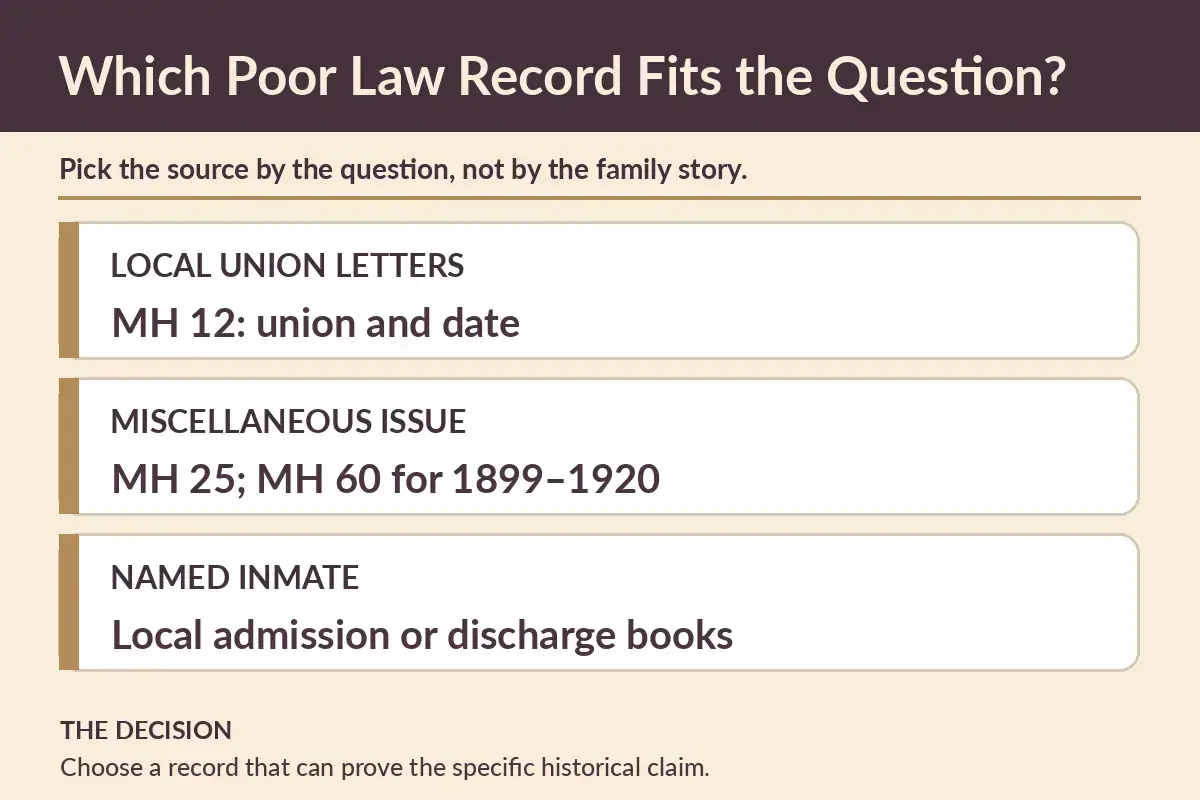
Write the query as a record problem: which authority received this complaint, when did it arise, and where might a reply be filed? The language used by officials could differ from family terminology. Try a subject term and its historical variants, then cross-check the central department responsible at that date. A modern social-service label can be unhelpful when searching a nineteenth-century paper series.
Keep MH 12, MH 19, and MH 25 Apart
The Poor Law research guide places routine union correspondence in MH 12, correspondence with other government departments in MH 19, and miscellaneous papers in MH 25. Those are not interchangeable search bins. A letter from a board of guardians is likely to follow a different administrative path from a Home Office inquiry or a general memorandum. If the relevant Poor Law Union is known, search it in MH 12 before concluding that MH 25 should contain every local matter.
The union name may differ from the town containing the workhouse. For example, the official guide gives Eton Union and a workhouse in Slough as a caution about place names. Make a jurisdiction card with the contemporary union, constituent parishes, county, central department, and dates of any boundary change. That helps prevent a failed town-name search from becoming a false claim of missing records.
Use MH 60 for the Period It Actually Covers
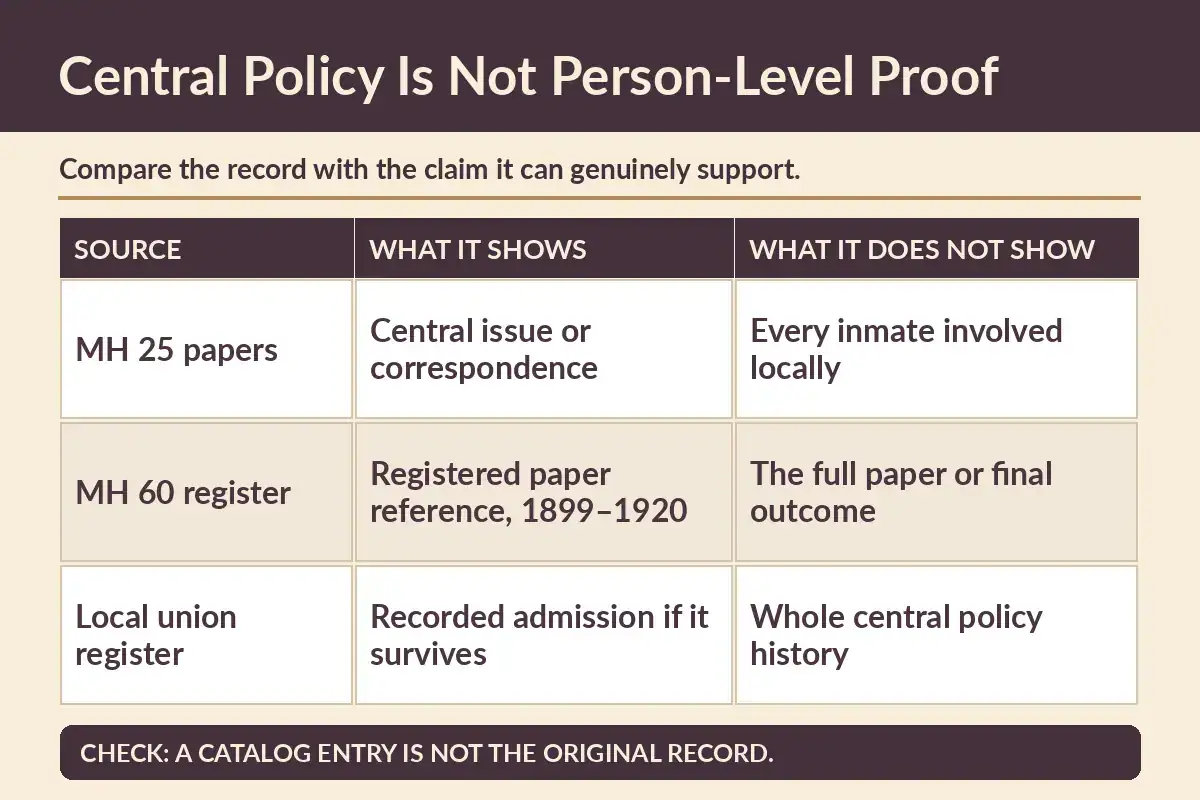
The National Archives identifies registers for MH 25 material in MH 60 for 1899–1920. A register can help recover a paper reference or administrative path, but its entry should not be paraphrased as the full letter. Check the exact years and arrangement of the register volume before searching for an earlier complaint. The guide’s 1899–1920 range does not establish complete coverage of all topics or surviving papers.
Build a reference chain: register entry, paper or file number, archival piece, and original item if found. Copy the wording of the register before interpreting it; an index title may collapse several communications into a short phrase. If the indicated file is missing, preserve the register entry as evidence that the matter was registered, not evidence of its outcome.
Interpret a Government Paper at the Right Level
A central instruction, inspector’s observation or draft response does not prove that a local board implemented the suggestion. Classify each document by its function: request, memorandum, reported observation, decision, or implementation record. Officials sometimes summarized statements made by others. Attribute those claims to the report’s informant rather than presenting every allegation as an independently established event.
If a named person appears in a complaint, determine why the person was mentioned. A complainant might be a guardian, official, witness, contractor, or individual receiving relief. None of those roles is automatically that of a workhouse inmate. Record the wording on the page and test family identity against a contemporary local register, census return, or another independently created document.
Locate Local Evidence of Attendance or Employment
The National Archives guide to workhouse inmates and staff explains that most routine local books are held by county or local archives. Surviving admission and discharge books, staff appointment records, births or deaths, and census returns can supply person-level information. Their survival varies by union. A centrally filed letter may describe an institutional policy without recording everyone who entered the workhouse during the same month.
For an alleged inmate, search the local admission register and compare name, age, date, parish of settlement, and household relationships where present. If the claim concerns a paid official, consult the appropriate workhouse or central staff records and check the office and appointment dates. A match in locality alone does not prove that the person in a general policy file is the subject of the family story.

Document Missing Records Without False Negatives
The guide warns that much post-1900 union correspondence was lost in a twentieth-century fire. An absent local letter or empty name result therefore cannot automatically be interpreted as proof that a complaint was never made. Log each search with the series, name or subject, date range, catalogue level, access status, and next step. Check whether an index entry, locally held copy, or later report survives independently.
A cautious case statement might say: ‘An MH 60 register entry describes a matter in the relevant year; the related MH 25 paper has not been seen.’ That is more useful than an invented resolution. The research question becomes whether local guardians’ minutes, contemporary notices, or surviving central letters can verify the substance. Keep that question open until the records support a stronger conclusion.
More Research Method Guides
How We Research This Record and Its Limits
The starting point for this guide was the official National Archives research guidance. We used it to confirm the relevant series, the documentary purpose of the records, the time ranges stated in the guide, and the important differences between a register or catalogue summary and a document that can be inspected. Where the archive supplies a range of years for a collection, we do not assume an individual record has the same date or that every anticipated item survives. Specific page-level conclusions require the complete original and its precise reference.
We checked a second, independent research route using this authoritative source and consulted additional archival guidance. Our illustrations are newly made explanatory drawings, not facsimiles of named archival documents; the decision routes are conditional and require the researcher to verify each intermediate item. The example reasoning in this article is methodological, not an assertion that the illustrative people, sites, records or events existed in the exact combinations shown.
We compared this topic with the supplied GenHis archive of existing article titles and WordPress listings, including the latest draft batches. The practical research output should preserve the original terminology, exact citation, date of document, repository and access status. If the intended piece is unavailable, record that limitation and use a separately created source to test the claim; never claim that an unseen record has established an outcome. Read the affiliate disclosure for site transparency. No archive listed here should be treated as a paid endorsement.
No. It comprises miscellaneous central Poor Law correspondence and papers, not a complete named admission list.
The official guide identifies registers for related material in MH 60 for 1899–1920.
Search MH 12 for union correspondence and relevant local archives for routine institutional records.
No. Record the reference, then verify whether the referenced paper is extant and accessible.
Seek an appropriate local admission book, census entry, or other person-level record and confirm identity.