
ED 132 can help locate official inspections of separate poor law schools and related institutions, but an inspection report is not a universal register of pupils. The National Archives places ED 132 inspection material in the 1904–1953 period, following a change in responsibility for examining the education and industrial training of children in separate schools. Begin with the institution, its locality and its administrative type. A school report may document staffing, lessons, premises or concerns, while leaving individual attendance entirely unrecorded.
The language of “poor law school” refers to historical systems of care and education, not to a single kind of classroom or a judgment about any child. Separate and district schools, workhouse schools and later converted elementary schools could sit under different administrative arrangements. A child might be transferred between institutions without the central inspection report naming them. Respect historical labels while recognizing their limits; do not infer hardship, disability or family circumstances for a particular pupil from general remarks about an institution.
Name the institution before searching children
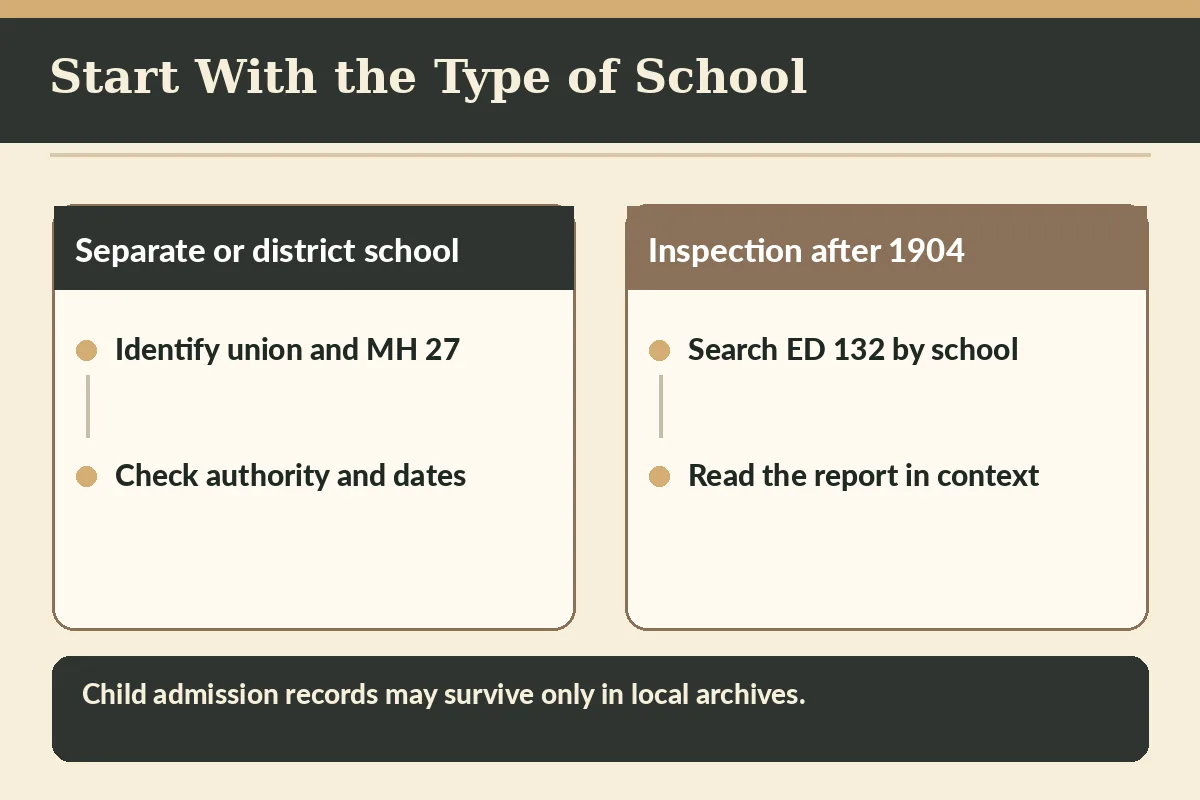
First verify the school’s exact historical name and the authority operating it at the date of interest. The National Archives lists MH 27 for administrative records of district or separate schools, and ED 132 for later inspections. A workhouse school attached to one poor law union may lead instead to union correspondence in MH 12. Avoid searching only a modern school name: mergers, institutional conversions and neighboring premises can produce deceptive results. Record every variant name, address and governing body as separate fields.
The transfer of inspection responsibilities in 1904 is a research signpost, not proof that all earlier school records were destroyed or that all reports suddenly entered ED 132. For a pre-1904 question, begin with poor law administrative sources appropriate to the institution. For post-1904 inspections, search ED 132 by school, locality and date where cataloguing allows, and examine the series description for arrangement and availability. School-based copies may survive in local repositories even when the central file is missing.
Read an inspection as an institutional snapshot
Read the inspection through four questions: what was observed, when, by whom and for what administrative purpose? A report may describe accommodation, curriculum, hygiene, teacher staffing or equipment, but its purpose is not to reconstruct one child’s life. Treat a recommendation to change practice as a recommendation, not evidence that change happened. Likewise, a favorable inspector’s judgment about attendance or conduct is a general observation, not confirmation of the presence or behavior of an otherwise unnamed pupil.
Extract a compact institutional ledger: exact title of school, inspection date, inspecting authority, classes or age groups if stated, named employees if stated, buildings and any specific follow-up action. Quote short wording only when the distinction is essential, and note uncertainty in the catalogue description. An annual or occasional inspection cannot be presumed to cover the whole time between visits. If a report provides statistics, state their date and denominators rather than converting them into individual biographies.

Test changes in authority and school purpose
A historical school might move from poor law administration to local education authority control, or change from a separate school to a public elementary school. The National Archives directs researchers to related elementary-school collections when conversion matters. Build a governance timeline with documented dates, rather than assigning the same school reference to every period. A report issued under a successor authority may discuss an older arrangement retrospectively; distinguish the described event date from the reporting date.
The Archives’ inspectorate guide notes that reports differ greatly in frequency and detail. Search results may identify a file without offering a digitized image, and many records require visiting Kew or ordering copies. Keep the “Held by” field in view: Discovery also includes collections from other repositories. If the central report names a teacher, seek staff appointment evidence separately. For children, search institution admission/discharge registers, guardians’ minutes and local education records, where permitted and where they survive.
Use separate registers to identify a pupil
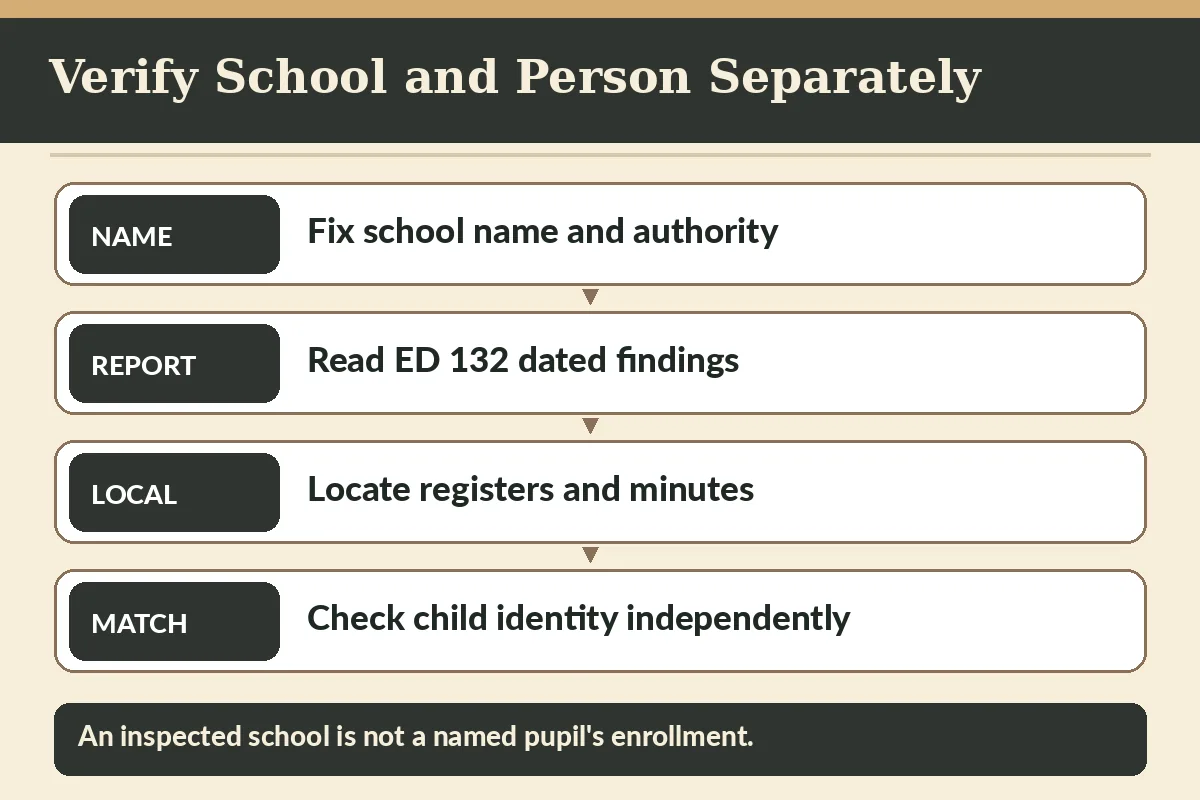
A specific child’s attendance requires person-level documentation. Local or county archives are generally the place to seek original admission, discharge and placement records for children’s institutions. A census may capture a resident at a particular date but will not prove the whole duration of schooling. Match names with age, birthplace, parents or guardians where available, and note that historical records may use abbreviated or changed names. Avoid equating an inspection date with a pupil’s admission or graduation date.
Use care with institutional records that expose vulnerable people or intimate family details. Respect archive access rules, restrictions and responsible quotation even for historical data. An inspector’s criticism of the administration should not be rewritten as a claim about a named child’s conduct. If the only surviving item is an administrative report with no child list, the most accurate genealogy conclusion is that the institution’s conditions can be studied, while the individual’s attendance remains unproved.
Imagine a family story that a grandmother learned needlework at a local school. An ED 132 report describing needlework instruction at that school supports the existence of that training at the report date. It does not demonstrate that she enrolled or attended the inspected class. A named admission register, or a contemporaneous individual record at an independent repository, would be the next test. When there is a conflict between a later memory and institutional dates, retain both claims until better evidence resolves the chronology.
Finish with two distinct summaries: one describing the school’s verified existence, authority and inspection findings; the other assessing the evidence for the named person. Give full catalogue references and identify which records were originals, indexes or secondary histories. A negative search in an undigitized institutional series is especially weak if the school was known by several names. Document the search limits before deciding an individual’s records are absent.
More Records and Archives Guides
How We Research Poor Law School Inspections
We checked The National Archives’ guide to children’s homes and institutions, elementary schools guide, and inspectorate records guide. Together they establish the ED 132 route, alternative administrative series and the uneven coverage of inspection reports. They do not establish attendance at any unexamined school.
Our method keeps the institutional inspection, the changing school authority and the child’s individual enrollment as separately sourced questions. We do not turn a policy finding or building description into an invented pupil record. The affiliate disclosure states the site’s editorial policy; the guide does not presume payment or access to a protected institutional file.
Inspection and related records of poor law schools and converted institutions, with the main period identified as 1904–1953.
No. Inspection files principally concern institutions and may contain no pupil names.
MH 27 can contain administrative material for district or separate poor law schools; check the institution and dates.
Surviving person-level records are often held by local or county archives, subject to their access rules.
No. Look for later inspection, authority minutes or documented implementation.