
Education records can help reconstruct the history of a school for blind or deaf children, an open-air school or a specialist residential establishment. The National Archives identifies ED 50 as a principal policy series covering 1872–1974, though few nineteenth-century files survive. The archive also points to separate institution records, including ED 32 in England and ED 224 in Wales. These files can document official decisions, buildings, inspection and provision. They are not complete lists of pupils, and the presence of a named school in a policy file does not prove an ancestor attended it.
Establish the School, Date and Historical Authority
Begin with a contemporary school name, a reported district and a plausible date. A later institution may have changed address, management or legal name. Historical terms for disability and special education can be offensive today; reproduce them only where necessary to identify a record, with clear context and respectful modern language elsewhere. Ask whether the institution was a local authority school, residential home, voluntary establishment or training institution. Those categories lead to different administrative files.
In England and Wales the relevant education structures and legislation changed throughout the period. The archive notes school-board arrangements for blind and deaf children before the Elementary Education (Blind and Deaf Children) Act 1893, followed by further provision in 1899, 1914, 1918 and 1921. Do not apply a 1945 regulatory term to a school in 1880. Record the language used in the period and the body responsible for decisions, without treating an administrative classification as a diagnosis of an individual child.
Use ED 50 for Policy, Not Student Names
The National Archives identifies ED 50 as an important series for special educational treatment from 1872 to 1974, although few nineteenth-century papers survive. The specific piece ED 50/9 contains material from 1872–1893 about provision for blind and deaf children and arrangements in London. Search ED 50 using a school name or service type, then narrow by dates. These files may discuss policy, funding or overall capacity rather than individual students.
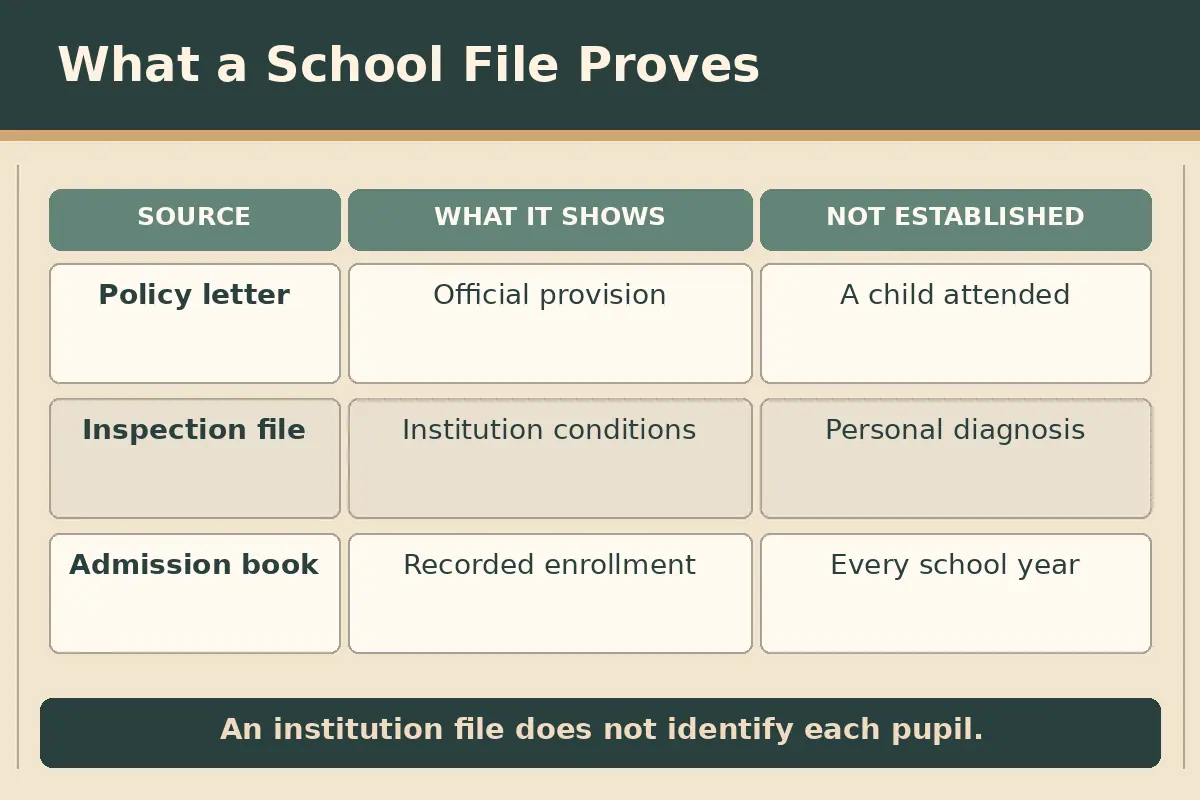
A report saying a school had a particular enrollment or purpose is evidence of institutional administration, not a list of every child present. Distinguish a proposal for extra classrooms from proof they were built. If you find an official letter about admission rules, do not infer that an ancestor met those rules. Retain the document’s author, date and recipient. National-level correspondence is a different evidentiary voice from a local admission register or a firsthand report of schooling.

Route Institution Files to the Right Series
For individual special schools in England, the TNA guide recommends ED 32; for Wales it identifies ED 224. ED 62 covers some training establishments and ED 195 includes reports of HM Inspectorate after 1948. ED 122 includes certain boarding-home records and has a 75-year closure condition. Do not search these collections as though one replaced another in a continuous student file. Choose each by the institution’s historical location, category and administrative function.
Search both current and former school names with town or county. If a piece is organized by institution, inspect its exact date coverage before assuming an ancestor’s school years are represented. An inspection report could describe teaching conditions without providing any names. Administrative boundaries and the distinction between education and welfare provision can complicate searches. Where responsibilities shifted, look for local education authority, county archive and school record holdings in addition to central files.
Separate Institutional History from Individual Attendance
A family recollection that someone attended a named school needs a person-specific record. Possible sources include surviving admission registers, school log books, annual reports, local authority files, census entries and letters. None is guaranteed to survive, and access can depend on privacy restrictions. A central ED 32 file can be useful for confirming that a school existed at the right time, but this cannot by itself establish who studied there or why a pupil was placed in that setting.
If a school changed its name, build a timeline including addresses, management and date of change. Link the historical institution to a person only with evidence identifying the individual and a date. Be especially careful with diagnoses, family circumstances or behavioural claims in older administrative records. The context may reflect period practices and prejudices. Do not publish details about living or potentially living individuals without an appropriate legal and ethical basis.
Handle Missing Files and Restrictions
An unsuccessful ED 50 query is particularly weak negative evidence for early periods because very few nineteenth-century files survive. Try school types such as “open air” as well as names and geographic terms. The archive identifies ED 133 as local-authority special-school provision with very few pre-1936 files, another survival limitation. A closed ED 122 record is not an absent record; respect its stated restriction and consider lawful access or less sensitive institutional sources.
When ordering records, capture the full reference, historical dates and current access status. Keep a list of collections not searched because access required an onsite visit. A catalogue title may not contain all individual names in a file, and a search snippet can omit the context of a sensitive label. Read original passages and quote sparingly with explanations. If an original cannot be consulted, describe its contents only to the extent supported by the archive catalogue.

More Records and Archives Guides
How We Research a Historic School
We choose the historical authority, school type and date before identifying ED 50 policy or ED 32, ED 224 and related institution sources. We then build separate columns for the institution’s existence, physical location, rules and a named person’s enrollment. We cite the documents supporting each claim and retain changes in school name as dated events. Where personal records are restricted or missing, we do not infer attendance or a medical condition.
The National Archives special services guide explains ED 50, ED 32, ED 224 and privacy conditions, while the Discovery catalogue guidance explains what catalogue descriptions can and cannot retrieve. These are collection descriptions, not evidence that any one child attended an institution. Sensitive historical language is contextualized rather than reused as a modern diagnosis. See the GenHis affiliate disclosure for the site’s policy.
No. ED 50 primarily concerns policy and administration, not comprehensive student registration.
Try ED 32 and verify school name, locality and dates; other series may also apply.
The TNA guide identifies ED 224 for special schools in Wales.
No. Individual evidence and historical terminology must be interpreted cautiously.
Very few nineteenth-century ED 50 files survive, and school names or authorities may have changed.