
ED 55 is a route to central-government files on the administration of secondary school special places. The National Archives explains that a 1932 economy campaign replaced earlier free-place arrangements with special places based on means-tested fees. These policy records are useful for interpreting a family story about a scholarship, school costs or a place at a grammar school, but they are not themselves a pupil admission register.
The research task is to identify the policy that applied to the school in the relevant year and then locate evidence for the particular child. Historical terms such as “free place,” “special place,” “scholarship” and “fee remission” must not be treated as interchangeable across decades. Begin with a dated school and local authority, not merely the surname.
Separate the 1907, 1932 and 1944 policy periods
The Education (Administrative Provisions) Act 1907 introduced a free-place scholarship scheme for pupils moving from elementary to grant-aided secondary schools. The National Archives guide explains that such schools had to admit qualifying free-place scholars and received a grant per scholar. That background makes a pre-1932 family recollection of a free place plausible, but it does not identify an individual recipient.
In 1932 the special-place system replaced the earlier free-place arrangement with a means-tested scale of fees, for which ED 55 contains administrative files. Fees were later abolished in secondary schools under the 1944 Education Act. Record the exact year of admission and the type of school before applying one label. A child who attended in 1930 and one who entered in 1936 faced different administrative systems.
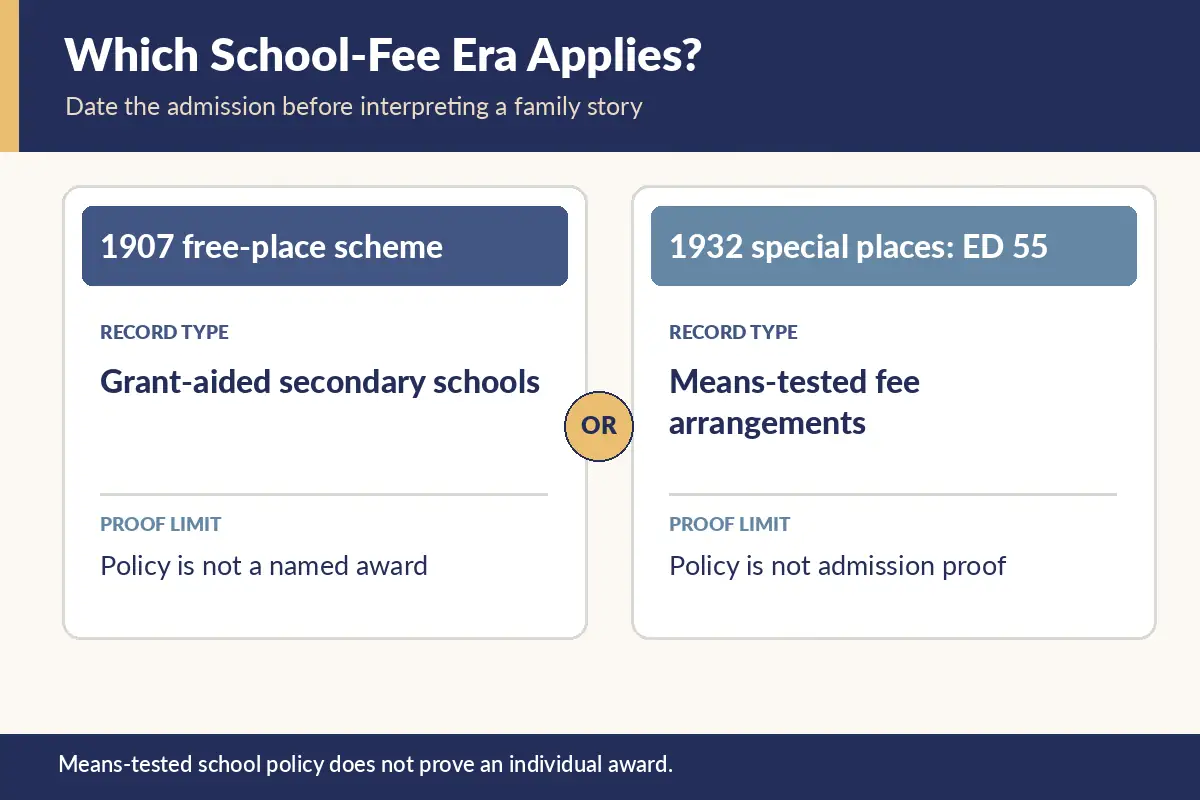
Use ED 55 for the policy question, not a name search
Start with the local education authority, school, date and question about fee categories or selection. Search the ED 55 catalogue descriptions and associated files for scheme administration, terms and local references. The archive guide directs researchers to central government series for policy and local archives for records of individual pupils. Do not expect every ED 55 file to name children or to provide a national list of scholarship winners.
Distinguish a policy circular, a local return, a draft interpretation and a final approved rule. A circular may indicate what authorities were expected to do, but only school or local authority records can establish how a particular applicant was treated. If the catalogue uses a later title for an older policy file, still note the original document date and exact scope.
Test the meaning of scholarship in a family story
Interview or transcribe the surviving family account with the speaker, date and precise term preserved. “Won a scholarship” may refer to an entrance examination, reduced fees, a free place, a charitable award or a family interpretation formed years later. Write competing hypotheses rather than immediately converting the story into an ED 55 case. A contemporary letter of acceptance, school report or newspaper notice can clarify what the family actually meant.
If a school changed its name, governing status or locality, establish a dated name-and-status chain. Grant-aided grammar schools, private schools and municipal schools did not necessarily have identical admissions or fee systems. A pupil’s age and residence help target a likely school, but neither proves enrollment. Do not infer financial hardship simply because a special-place rule was means-tested.

Find the individual pupil record locally
The National Archives school research guide says its central records are not a collection of individual pupil files. Seek surviving admission registers, school logbooks, scholarship examination returns, governing body minutes or local education authority files with the school or local archive. Some records have been destroyed, transferred or restricted. Ask what is held and what access rules apply, rather than assuming personal details are publicly searchable.
Once a named admission record is located, compare full name, age or birth date, parent or guardian, previous school and address if those details appear. A shared name and age alone may still fit more than one child. Enrollment, attendance and successful completion are different events: a school roll might confirm entry but not that the pupil stayed through final examinations.
Read payments and educational awards carefully
A statement that a school qualified for a grant or administered special places does not show the award given to a particular family. Where a local record documents a fee, check whether it is the amount due, amount remitted, amount actually paid or a later balance. Avoid treating a policy figure as the fee every family incurred. Historical money amounts should be labeled by their contemporary unit and year.
For a named child, seek a letter, register or scholarship award record with an explicit link. An exam result may demonstrate performance without proving that the child accepted the place. A governors’ meeting might approve funding without proving the award was used. In a narrative, say “eligible for consideration,” “offered a place,” or “enrolled,” whichever the documents truly support.

Make a family research timeline with honest gaps
Prepare a chronology with the policy period, school identity, application event, fee decision, admission and attendance evidence in separate columns. Cite ED 55 for the applicable scheme; cite the local original for a named child. Add a field for data restrictions and a note about records searched but not located. This avoids a common mistake: using a convincing administrative history to fill in an individual biography.
A school certificate, class photograph or newspaper report may help test the identity but should be described according to its source and context. If the school archive is closed or a pupil register missing, give the documented policy background and stop before claiming admission. That is a useful family-history result even without a complete school career.
More Records and Archives Guides
How We Research and Verify These Records
Our archive-first review began by identifying the holding repository, creator and series rather than searching a family name in isolation. We compared the series description with subject-specific guidance, separated original documents from catalog descriptions and compiled indexes, and checked how dates, jurisdictions, omissions and access conditions affect each conclusion. The examples in these diagrams are editorial illustrations of evidence logic, not reproductions of documents or identified historical people.
We consulted this archive research resource on 2026-11-03. The National Archives states that the 1932 campaign replaced free places with special places on a means-tested fee scale and identifies ED 55 policy files. The next step for a real family claim is to examine the identified source item and test that one finding with independently created evidence.
We consulted this archive research resource on 2026-11-03. The National Archives distinguishes central school administrative files from individual pupil and attendance records, generally held locally. The next step for a real family claim is to examine the identified source item and test that one finding with independently created evidence.
Our record descriptions and illustrated methods are informational, not advice that a specific commercial provider owns every relevant document. Some archival copies require a fee or a visit, and access restrictions must be respected. We have not assumed any paid relationship. Read the affiliate disclosure before following any recommendations.
ED 55 contains files on administration of the secondary school special-place system following the 1932 policy change.
No. The 1907 free-place scheme and 1932 means-tested special-place system belong to different policy periods.
No. These are central policy records; individual enrollment is usually researched in school or local authority archives.
Not by itself. It may document assessment, while admission and attendance require their own evidence.
The Education Act 1944 abolished secondary school fees; the relevant date should be checked against the pupil’s school timeline.