
A Union Certificate Records an Organization
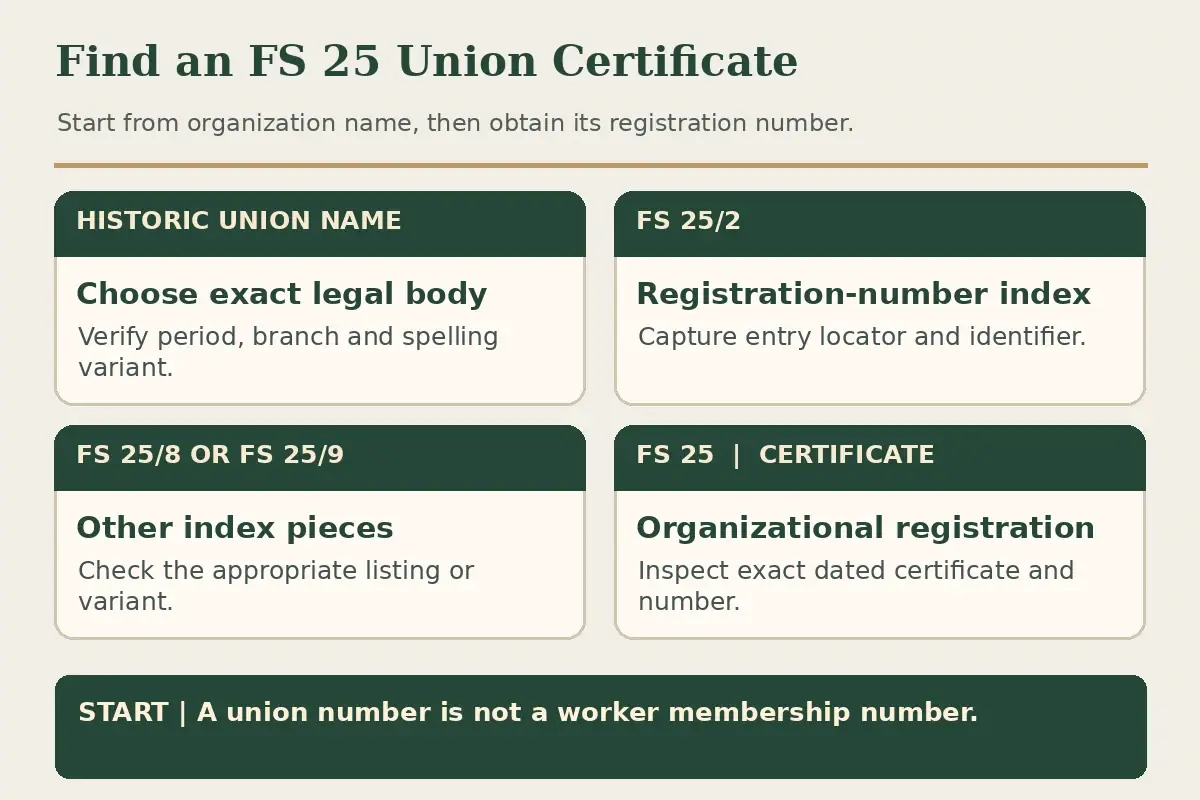
FS 25 includes certificates of registration for trade unions, according to The National Archives. The key search is often a registration number, not a worker’s surname. Use the indexes in FS 25/2, FS 25/8 and FS 25/9 to identify the number before looking for the certificate. Such a certificate can document an organization’s recorded legal registration; it is not a universal list of members, officers, dues payers or employees. Begin with a historical union name and the question you want to prove.
Organizational history and personal labor history are different fields of evidence. A grandfather’s trade, workplace and county do not establish that he joined the union active in that industry. A union may have multiple branches, regional bodies, amalgamations and later names. A certificate issued to the national body does not show that each worker in its territory enrolled or paid dues. Document the exact legal entity, date and certificate number before looking for any personal link.
The National Archives guide to companies and businesses lists FS series under mutual societies and specifies the FS 25 index pieces. That is a precise research route rather than a guess based on a union name appearing in a web index. Check whether you are researching a trade union, friendly society, benefit association, cooperative or company, because these may be registered under different FS or BT series.
Resolve the Index Number Before Ordering a File
Write the union’s name exactly as it appears in dated sources and include likely historical abbreviations or successor names in a separate column. Search the FS 25 index resources by relevant name and capture the registration number with the index volume and page or entry locator. Numbers are identifiers for the registered body, not membership IDs for individual workers. The National Archives warns that browsing archival references can be necessary when item descriptions do not include every name.
Keep a two-column authority file for ORGANIZATION NAME AT DATE and REGISTRATION NUMBER. A spelling change or merger might change the relevant entity and may require its own certificate or record. Do not assume that modern unions with similar titles are unbroken successors of older organizations. Check the document’s stated amendment, replacement or cancellation context if preserved, and record which office created the certificate.
The National Archives provides three index references—FS 25/2, FS 25/8 and FS 25/9—but it does not promise a full searchable surname database. If an index page is unavailable digitally, identify the piece and current consultation route through Discovery. A no-result keyword query must be logged as a finding-aid limitation, not a verdict that the union never registered or did not exist in another form.
Do Not Turn Registration Into Membership Evidence
An organizational certificate might give a registered name, authority or administrative date, depending on the particular document. Inspect the actual fields before quoting them. A union’s registered office and an individual member’s residence are distinct. A branch secretary’s signature is a role performed for a specific document and not proof the signer represented every local worker. Avoid writing “all miners in the district belonged to this union” from a single FS 25 entry.
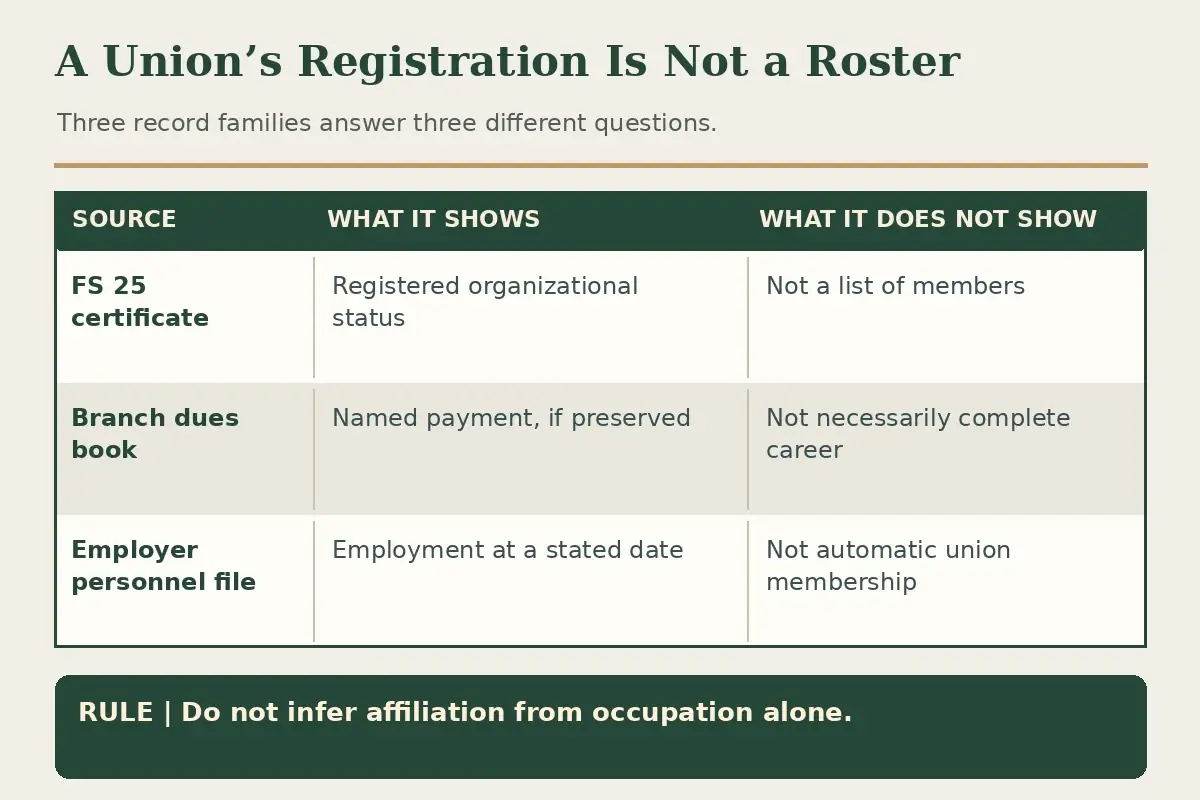
Build three columns in the evidence ledger: FS 25 CERTIFICATE, BRANCH OR MEMBERSHIP SOURCE, and EMPLOYMENT OR RESIDENCE SOURCE. The certificate supports a corporate or association-level statement. A dated membership card, dues book or branch minute might support an individual affiliation if available. A workplace pay or personnel record establishes employment context but cannot automatically fill a missing membership entry.
When a person claims membership, ask whether the record actually names the person, which branch it describes, the time range and the role of the informant. A newspaper reporting a strike, for example, does not prove every worker was a registered union member. A political stance cannot safely be inferred from a trade or surname. Keep personal and organizational claims on separate dated timelines, and corroborate them only where sources actually overlap.
Look Beyond FS 25 for a Worker’s History
Trade unions sometimes deposited historical archives with local record offices, universities or labor-history repositories; survival varies widely. The National Archives FS 25 certificate points to organizational identity, after which local branch minutes, membership registers, contributions books and officers’ correspondence may provide named-person evidence if access permits. Not every union or branch preserved such papers, and a surviving branch ledger may cover only particular years.
Use the Discovery search help to browse archives by series, subject and repository as well as keyword. If the institution is another custodian, consult its original catalogue and access terms. Note the exact organizational name used in each repository; some historical organizations were amalgamated, split or renamed, and a name match may conceal legal discontinuity. Do not treat the current union’s website as sufficient evidence for a specific nineteenth-century member.
If evidence exists only for an occupational community, frame the result as context. A registered union in a town demonstrates that a named body existed in its own legal record, not that a particular family participated. Independent census occupations and workplace records can help narrow a search, but must not be converted into membership by proximity. Missing registers are a gap in surviving evidence, not proof of non-affiliation or a reason to assign membership speculatively.

More Research Method Guides
How We Research FS 25 Organizational Proof
Our workflow begins with historical organization identity, follows FS 25/2, 8 or 9 to its registration number and then checks the FS 25 certificate itself. We record what the item directly says about the organization; we do not extrapolate members from an address or signatory. The diagrams distinguish index route, evidentiary reach and the independent documents that would be needed to confirm a named worker’s participation.
We cite the exact certificate piece, index locator, date and repository and state whether the original document or only its description was inspected. For a branch claim we add a separate record, date range and name-identity test. If no membership source is available, our conclusion remains about registration, not ancestry or politics. Preserve variants of union names to make an unsuccessful search reproducible.
Check Discovery for current availability and closure rules, and do not claim all organizational documents can be downloaded. The affiliate disclosure explains commercial transparency. The safest statement is frequently the narrowest: a specific historical body had a registered identity in a cited FS 25 record. Whether an individual relative joined requires other proof.
Certificates of trade union registration; the series concerns registered bodies rather than comprehensive worker rosters.
The National Archives names FS 25/2, FS 25/8 and FS 25/9 for identifying registration numbers.
No. Consult independent branch or member records if the question is about an individual.
No. Check amalgamations, renamings, dates and legal continuity using separate records.
Local or institutional archives may hold branch minutes, membership registers or contribution books, depending on survival and access.