
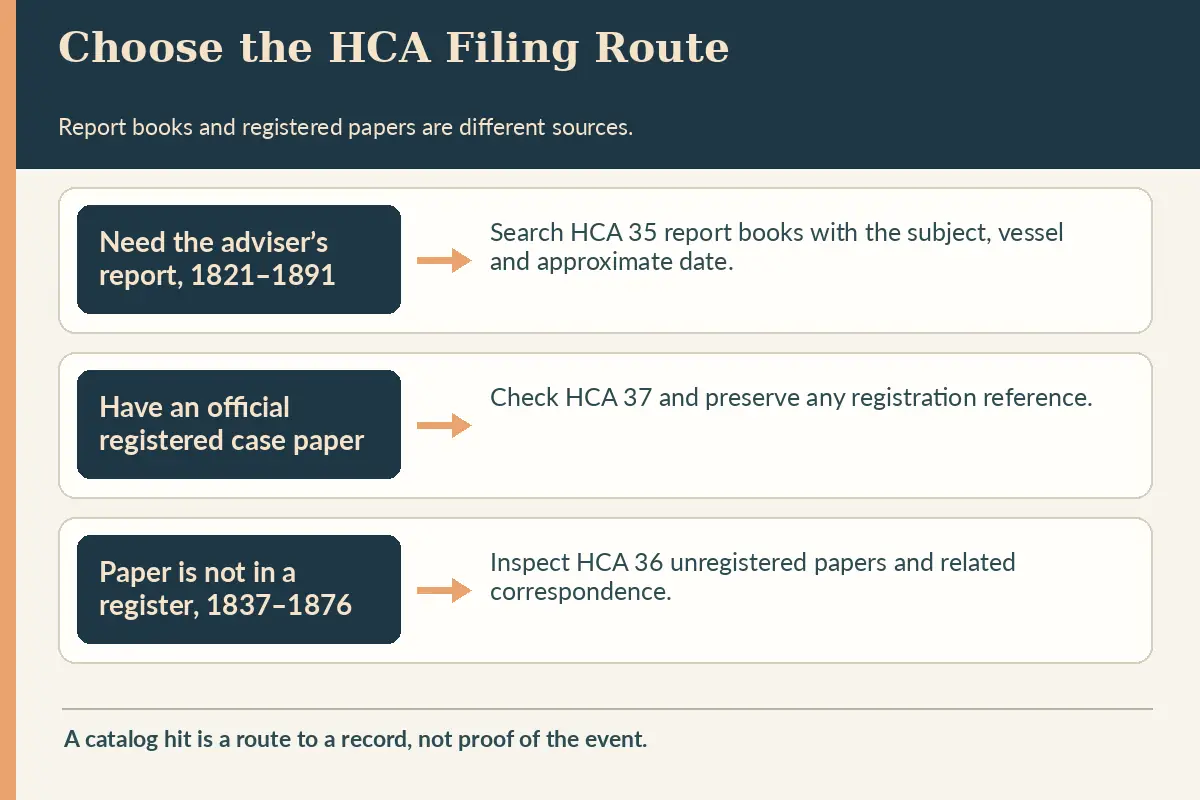
The National Archives identifies HCA 35, HCA 36 and HCA 37 as important surviving papers of the Slave Trade Adviser to the Treasury concerning cases of illegal slave trading. The three series are not interchangeable: HCA 35 contains report books from 1821–1891, HCA 36 unregistered papers from 1837–1876, and HCA 37 registered papers from 1821–1897. Those different functions help researchers choose a starting record. They do not establish that every allegation led to a court finding or that every person affected is named in surviving records.
The National Archives guide to slavery and the British transatlantic slave trade places the papers within wider records of suppression, including Mixed Commission Courts, vice-Admiralty proceedings, naval logs and Colonial Office correspondence. These records often reflect the perspective of officials and enslavers rather than the people who suffered the trade. A responsible research account must make that imbalance explicit.
Choose the right series for a report or case paper
HCA 35 contains report books and is the sensible route when a reference concerns the adviser’s analysis. HCA 37 concerns registered papers and may preserve a case identifier or filing sequence; HCA 36 holds unregistered papers. The overlap in date ranges is significant. They represent record forms and administrative handling, not three consecutive phases every case had to pass through. A missing registered file may have another explanation and cannot be “replaced” by assuming the existence of a matching unregistered document.
Build a filing ledger with vessel name as written, alternative names, year, port or coast, document type and original reference. Keep a separate column for facts taken from catalog descriptions versus facts personally read in original papers. Do not treat a modern catalog summary as the court’s own wording.
Separate allegation, opinion, seizure and court finding
A vessel may be suspected of unlawful trading, stopped by a ship, reported to advisers or brought before a court. Those acts are not identical. A Treasury adviser’s opinion might discuss jurisdiction or evidence without becoming a judicial decree. To state that a vessel was condemned, find the appropriate court’s order or a reliable source specifically identifying that outcome. To state that its cargo, crew or occupants were transferred, use a source documenting the transfer.
Create an evidence matrix of allegation, intervention, advice, proceeding, decision and aftermath. Some cases have few surviving stages. If a report describes an accusation in harsh official terminology, paraphrase carefully and attribute who asserted it. Do not promote a reported suspicion into an established fact merely because it appears in a government series.
Keep vessels, owners and people distinct
Ship names, flags, masters and claimed owners can change during a vessel’s career. A similar ship name in two ports is not proof of identity. Cross-check vessel dimensions, known voyages, masters, dates and any renaming before joining records. A master mentioned in a report is not necessarily the legal owner; the owner is not automatically the same as the charterer or beneficiary. Each assertion should have its own citation.
Most importantly, the records may name very few of the Africans captured, transported or declared “liberated” by colonial authorities. A total of people aboard must not become a fabricated roster. Colonial records can impose labels that obscure coercion and subsequent forced labor. Use historically accurate attributed terms where needed while explaining their administrative origin and limits.

Look beyond the central adviser papers
TNA points to naval logs in ADM 51 and ADM 53 for sightings and captures, and to the records of Mixed Commission Courts and vice-Admiralty courts for some proceedings. Treasury T 1, Colonial Office correspondence and customs sources can contain related or duplicated material. The relevant territory’s national or local archives may hold court files absent from UK central collections. Such connections require vessel names and dates, not just a generic keyword search.
Compare each document’s purpose. An operational log reports what officers saw or believed; a letter can forward allegations; a court record documents proceedings and decisions within its jurisdiction. Similar text repeated in several administrative copies may derive from one original witness account and should not be counted as independent corroboration. Record the chain of copying when the file makes it visible.
Report the outcome and archival silence ethically
For a particular incident, list the exact HCA reference, item date, document author, vessel identity evidence, action described and unresolved gaps. Quote historical language sparingly and attribute it, especially where people were treated as property or described through colonial categories. Explain whether you found evidence of a tribunal judgment, a seizure, a release, or simply official correspondence about a possible case. If the affected individuals were not named, state this limitation plainly.
A missing HCA case is not proof that a voyage did not take place, and an official declaration of freedom may not indicate what happened to someone afterward. TNA notes that some people labeled liberated were compelled into military service or apprenticeship. Avoid romanticizing suppression as a straightforward endpoint. Ground any later life claim in individual-level evidence rather than turning an institutional record into an imagined biography.

More Research Method Guides
How We Research and Verify These Records
We first review the National Archives research guidance for the collection’s official purpose, record ranges and known omissions. We then review Discovery search methods, which distinguish an indexed name from a piece description and an item actually examined. For a difficult claim we ask what an original document could establish directly and which different source would be needed to prove residence, identity, a decision or subsequent action.
Our diagrams are original editorial explanations, not reproductions of historical manuscripts. Dates are kept as stated by the archival custodian; uncertainty, gaps, and alternative searches are visible rather than hidden. Our affiliate disclosure explains the site policy. None of these archival routes depends on a paid endorsement.
HCA 35 holds report books, HCA 36 unregistered papers, and HCA 37 registered case papers.
No. Seek the proper court judgment or another reliable document stating the outcome.
No. Many individual names were not recorded or do not survive in central official papers.
No: HCA 35 is 1821–1891, HCA 36 is 1837–1876, and HCA 37 is 1821–1897.
Relevant naval logs, Mixed Commission or vice-Admiralty proceedings, and independently cited Treasury or Colonial Office documents.