
Choose the Papers, Not a Famous-Name Anecdote
The National Archives lists MINT 19/4–6 as papers of Sir Isaac Newton in his Royal Mint roles, dating 1700–1726; MINT 19/6 serves as a calendar to the series. The research task is not simply to locate Newton’s name. It is to move from a summarized entry to the relevant document and establish who wrote, received, approved or copied its contents.
Newton entered the Mint as Warden in 1696 and became Master at the end of 1699, remaining in office until his death in 1727, according to The Royal Mint. The distinction matters: when reading papers dated 1700–1726, do not label him Warden merely because that title features in his earlier biography. Describe the role shown by the document or established date.
The collection can illuminate coinage policy, Mint administration and the handling of problems. It is not a payroll list of every person who worked at the Mint. A named informant or supplier in a letter may merit further research, but being mentioned does not establish permanent employment, guilt of an offense, or a connection to a modern family.
Use MINT 19/6 as a Finding Aid
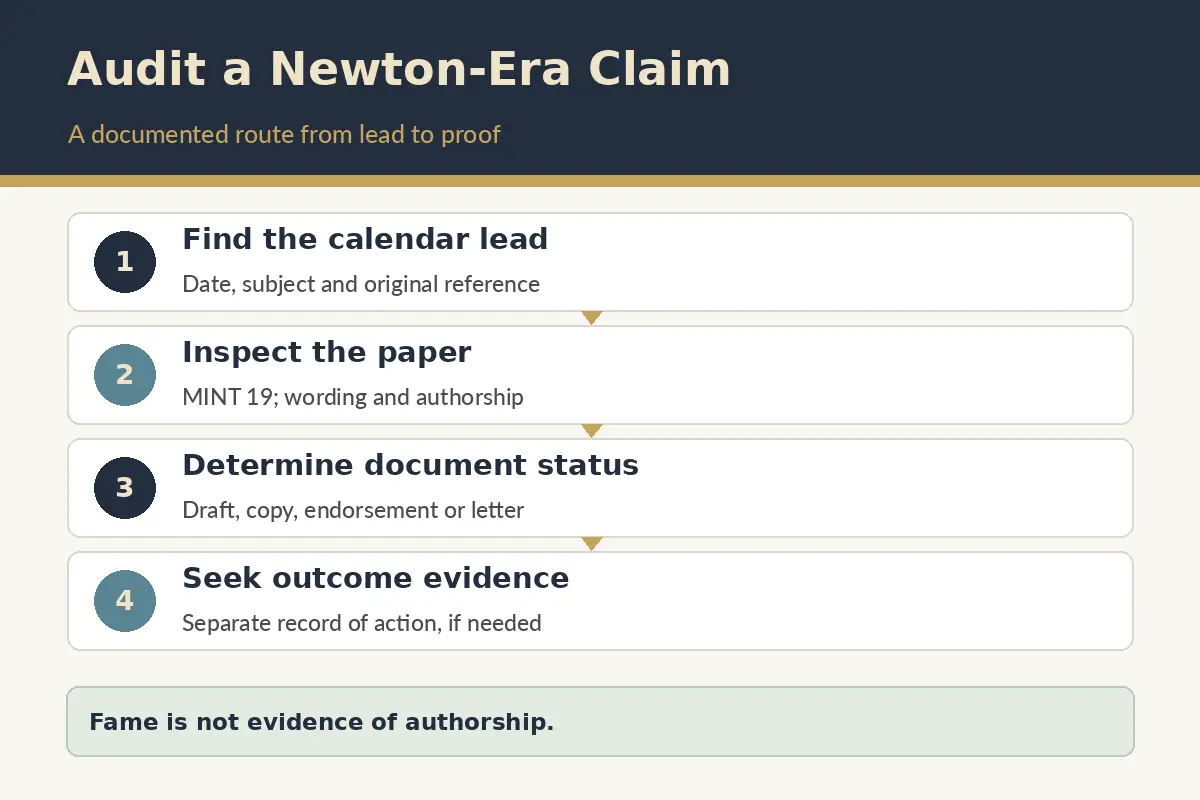
A calendar is an organized summary or guide to underlying papers. The archive’s digital-microfilm guide specifically identifies MINT 19/6 as a calendar to the entire series. Begin by noting the calendar entry’s date, subject, personal names and original reference. The entry is a lead, not an exact transcription of the full paper unless the source explicitly says so.
Digital microfilm from The National Archives may be available as large downloadable PDFs that cannot be searched internally by personal name. The guide recommends locating the correct piece first and then scrolling. Keep page or image numbers as navigation notes and cite the formal record reference when one is available; a PDF page count is not a historical folio citation.
If a calendar paraphrases a letter about coins failing a test, its wording may omit a qualification, marginal note or later amendment. Open the original paper and copy the phrases important to your question. Mark unclear handwriting rather than forcing the document to agree with the abbreviated calendar description.

Distinguish Draft, Copy, Letter and Recorded Action
The Royal Mint’s institutional account emphasizes the numerous draft reports and letters in Newton’s hand. A handwritten draft can document his thinking or proposed advice without proving that the draft was sent, accepted or implemented. A fair archival ledger must therefore identify a document’s physical or administrative status before making a statement about policy.
Sort each piece into a cautious category supported by its actual features: draft report, outgoing copy, incoming correspondence, memorandum, signed instruction or later summary. Dates at the top of a document may differ from filing, copying or response dates. Record addressee, endorsement, sign-off and enclosures only where clearly present.
An archival calendar entry and its source draft are not independent corroborations of an event. A signed response or a separate administrative order may establish what happened next. Avoid transforming “Newton considered a remedy” into “Newton ordered the remedy” merely because a famous name makes the stronger version more appealing.

Read the 1717 Guinea Issue With Source Discipline
The Royal Mint highlights Newton’s report dated 21 September 1717, which helped lead to a reduced value for the guinea. This offers a useful illustration of how a report, later public policy and retrospective institutional description represent different kinds of evidence. Do not assume a topic mentioned in the Mint’s history corresponds to a particular MINT 19 sheet until the reference is confirmed.
For a research note, separate what the original paper actually recommends, what a later authority decided, and what later historians conclude about consequences. A policy recommendation may offer evidence of an adviser’s reasoning without proving how every shopkeeper, local mint worker or trader immediately responded.
The same discipline applies to Newton’s work on counterfeiting, assay and administrative matters. Interviews with informers can contain allegations and their own interests; a financial schedule can reflect calculations rather than disbursement. Evaluate the genre and chain of copying before adding a colorful detail to a family or local-history narrative.
Preserve Exact References and Honest Limits
A reproducible search log includes the full MINT 19 reference, original paper or calendar location, date as written, source type, participants, a short quotation or careful paraphrase, and unresolved handwriting. If a surname appears, first check its role and spelling, then look for an unrelated administrative or parish source before claiming a biographical identity.
A file’s presence in a famous official’s papers reflects archival association, not necessarily personal authorship. Drafts can be revised by clerks, copied into other registers or later summarized. Look for signatures and documentary context. If the evidence does not identify an author, use “among Newton-era Mint papers” rather than asserting that Newton wrote it.
Keep an audit trail from the calendar to the original item and then to an independent outcome document when the question requires one. A well-bounded finding such as “the calendar describes a proposal and the surviving draft uses these words” is preferable to an attractive but unsupported claim about a decision or someone’s family occupation.
More Research Method Guides
How We Research Royal Mint Correspondence
Our archival route is from The National Archives digital-microfilm guide; Newton’s offices and the context of his work are checked against The Royal Mint’s institutional history. We follow the archive’s record-citation guidance for precise pieces and items.
We have not asserted that any particular ancestor appears in MINT 19, or that a calendar alone proves an administrative outcome. See our affiliate disclosure before paid assistance. Start with one dated calendar entry, inspect its actual source, and clearly label what that paper can establish.
The National Archives identifies it as a calendar to the MINT 19 series.
The digital-microfilm guide gives 1700–1726.
The Royal Mint says he became Master in late 1699 and served until 1727.
No. Check the underlying paper and independent decision or implementation evidence.
Not without additional documentation establishing the person’s role.