
MINT 15/17 is a specific Royal Mint record associated with Isaac Newton’s pursuit of suspected clipping and counterfeiting in the years around 1698–1706. Its depositions can identify what witnesses and suspects said. A sworn allegation is not a conviction, and appearing in the papers is not proof that the named person was guilty.
Identify the Record Before Naming a Suspect
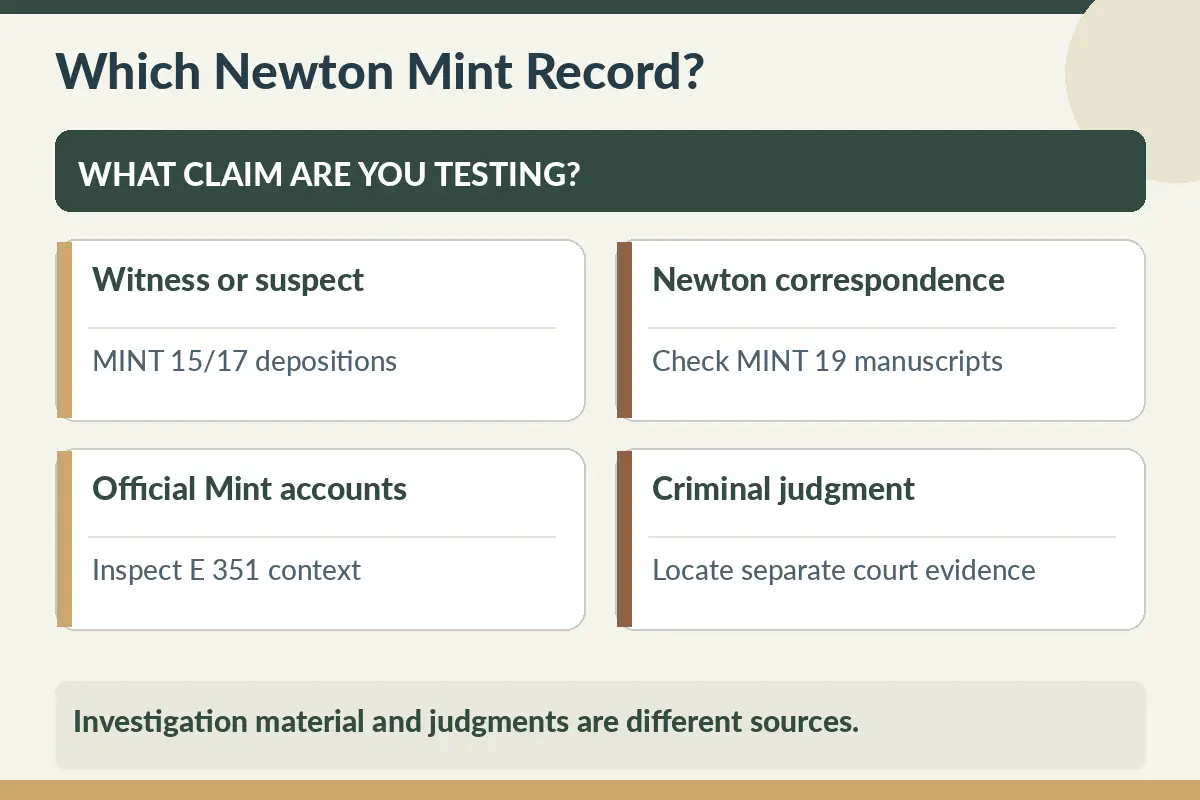
Newton served in the Royal Mint as Warden and later Master, but not every document in the Mint archive originated in his own hand or reached a courtroom. The Oxford research project Newton and the Mint identifies MINT 15/17 as a substantial body of witness depositions linked to his anti-counterfeiting work. It separately locates Newton’s personal papers in MINT 19/1–2 and official accounts as Warden and Master in Exchequer E 351. That division is essential: a witness deposition, private note and financial account answer different questions.
Start with an exact name, the alternative spelling used in the manuscript, an approximate date and a possible London or provincial connection. Then identify who gave the testimony and whether that person was an accuser, witness, suspect or an official taking a statement. Do not give the entire collection a single invented roster of convicted counterfeiters. For family history, the strongest defensible starting claim may simply be that a named person was mentioned in an inquiry on a particular date.
Date the Testimony, Not the Alleged Incident
Scholarly work using MINT 15/17 dates the depositions associated with Newton’s Mint investigations to the closing years of the seventeenth century and the beginning of the eighteenth, particularly 1698–1706. That provides a research window, not a fixed incident date for every reported event. A deponent may recount activities weeks or years earlier, copy another person’s account or provide details that were later disputed. Record the sworn or written date separately from the alleged conduct and any later court event.
Design a four-date timeline: alleged conduct, statement or examination, proceeding if documented, and subsequent known outcome. Use blank cells rather than estimate unsupported dates. Namesakes are especially hazardous in densely populated areas and occupations involved with money, metalworking or trade. A repeated first name and surname across statements could describe different people. Confirm occupation, address, associates or physical context only if the source actually supplies those details; do not insert them for narrative smoothness.
Classify the Information in a Deposition
A deposition is a historical statement made within an official investigation. Its evidentiary value depends on what the speaker personally observed, what they claimed to have heard, and whether the manuscript is an original, copy or later digest. Distinguish direct quotation from a summary by the clerk. If a person reports that another passed counterfeit coin, that is an accusation made by that speaker; the testimony does not by itself determine whether the coin was counterfeit or whether the accused knew it.
Make a claim-level ledger: speaker, exact words or careful paraphrase, firsthand versus reported knowledge, date and place as given, and a question for independent testing. Preserve contradictory statements. A deponent who changed an account should not be silently rewritten into one coherent story. If evidence was motivated by possible reward, pressure or fear, discuss that as a source-critical possibility only when supported by the context, rather than asserting a particular witness’s motive without evidence.

Separate Mint Investigation from Criminal Trial
The Oxford project emphasizes that many letters and documents related to Newton’s prosecutions remain unpublished and that the witness depositions are a distinct source group. A note about a suspect, a signed examination or a witness narrative does not show that an indictment was preferred. Still less does it prove a verdict or the enforcement of a punishment. The researcher needs an independent court or legal record for each later stage of proceedings.
A simple status scale prevents overclaiming: mentioned in deposition; identified as a witness or suspect; associated with a documented charge; linked to a surviving verdict; linked to an independently evidenced sentence or execution. Do not move a name up this scale by inference. In particular, the fact that Newton or his assistants pursued an allegation is not a substitute for a court decision. A claim about forgery, clipping or coining should remain attributed to its original speaker until a corroborating record supports a firmer statement.
Cross-Reference Newton Papers Without Merging Them
For a deeper study, compare MINT 15/17 statements with Newton-related MINT 19 papers and contemporary legal material. The Oxford project points readers to the Treasury calendars and official Mint accounts as further sources, while distinguishing their archival purposes. These comparisons can reconstruct the administrative path of an inquiry. But a later historian’s edition or summary is not the same artifact as the underlying manuscript; note editorial omissions, transcription conventions and uncertain readings.
Keep a source crosswalk that records reference, creator or recorder, document type, date and specific claim. A person who appears in a deposition and also in correspondence might have been discussed rather than participating in both events. Similar-sounding neighborhoods, trades and aliases should not be collapsed without independent identifying detail. If you cannot link a witness to a known ancestor with secure facts, state that identity remains unresolved instead of converting an intriguing incident into a family anecdote.

Write History at the Correct Level of Certainty
For a defensible narrative, cite the specific MINT 15/17 folio, image or item and quote only what is needed to establish who spoke and what they reported. Describe a deponent as “stated,” a clerk as “recorded,” and a court as “found” only when the corresponding evidence survives. Include the editor or transcription used, if any, so readers can distinguish the archival witness from modern interpretation. Retain uncertainty in historical spellings and dates.
The next research action should resolve a specific gap: whether the described person can be independently identified, whether a criminal case followed, or whether the alleged practice appears in other contemporary evidence. A failed search for a trial is not itself acquittal, nor does it prove that no trial ever occurred. The useful outcome is a carefully attributed source story in which a notable official’s involvement does not overwhelm the testimony’s limits.
More Records and Archives Guides
How We Research, Cite Evidence, and Handle Uncertainty
Research for this article used official archive series guidance and source explanations: Oxford Newton and the Mint project; Oxford Newton and the Mint project; The National Archives research guidance. The record titles, series categories and retrieval steps are supported by those pages. We have not asserted that an uninspected piece contains a specific named ancestor or that a historical allegation was true. The figures and schematic routes here are explanatory drawings, not facsimile archival originals.
When a claim matters, record the precise series, piece, item and folio where possible; the source creator, record date and historical place; the literal observation; and any independent evidence for your interpretation. A failed catalogue search can be a cataloguing or survival limitation rather than evidence of absence. Our affiliate disclosure explains the site’s policy; these research paths do not require an undisclosed paid referral.
It is a Royal Mint record containing witness depositions associated with Newton’s inquiries into suspected coining offenses.
No. A person may be a witness, informant, recorder, associate or someone merely mentioned in a statement.
No. It records testimony. Criminal charges, judgments and punishment require separate evidence.
No. Oxford’s Newton and the Mint project distinguishes depositions in MINT 15/17 from Newton-related personal papers in MINT 19.
Cite the exact MINT 15/17 item or folio and the original wording, with any modern transcription identified separately.