
Home Office HO 52 is a set of historical county correspondence, not a register of completed government decisions. To find a letter, choose the search method for its year before trying a modern place name: 1820s volumes, 1830s county ranges and later alphabetical place ranges are arranged differently.
Choose the Date Before Searching a County
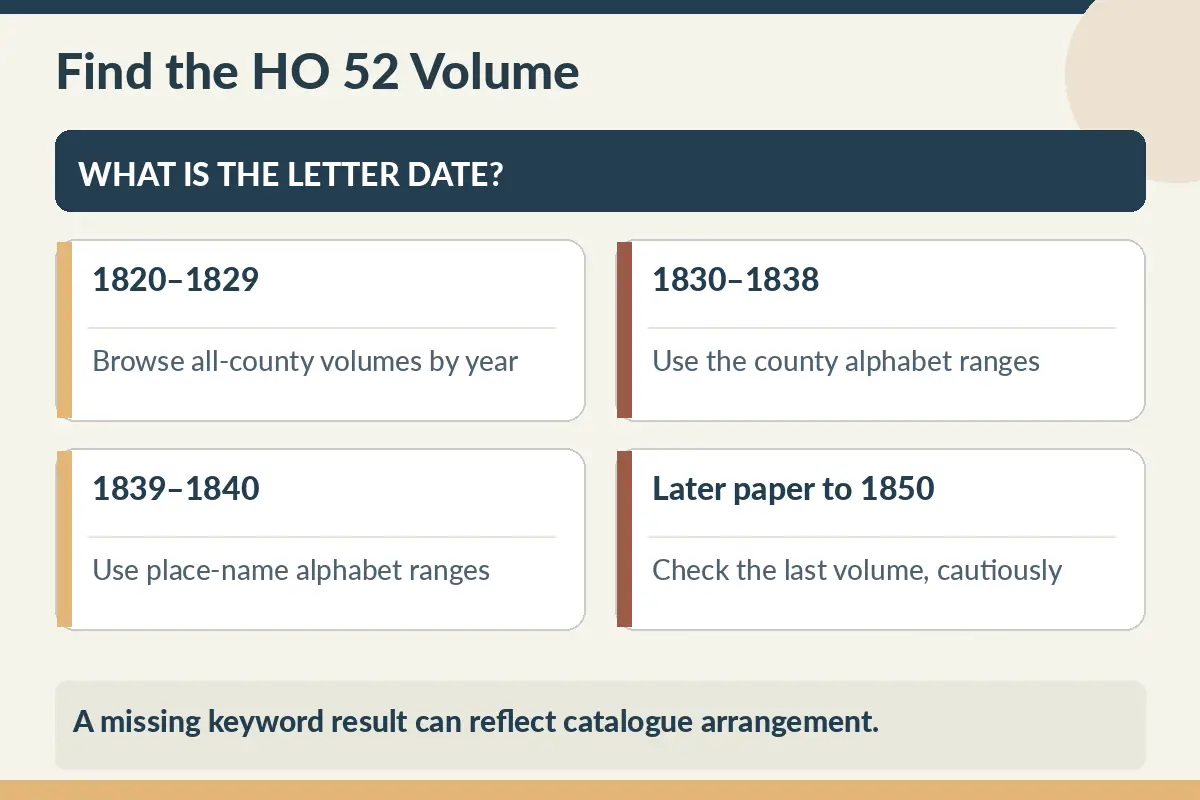
The National Archives identifies HO 52 as Home Office counties correspondence, covering 1820 to 1850. Its catalogue is not uniformly item-indexed. Between 1820 and 1829, only five pieces are listed, broadly as “all counties”; the sensible first move is to browse the year range. From 1830 into 1838, some records are grouped by alphabetical ranges of counties. For 1839–1840 the arrangement shifts to alphabetical ranges of place names. A keyword-only search that succeeds in one period may fail in another without suggesting the relevant letter never existed.
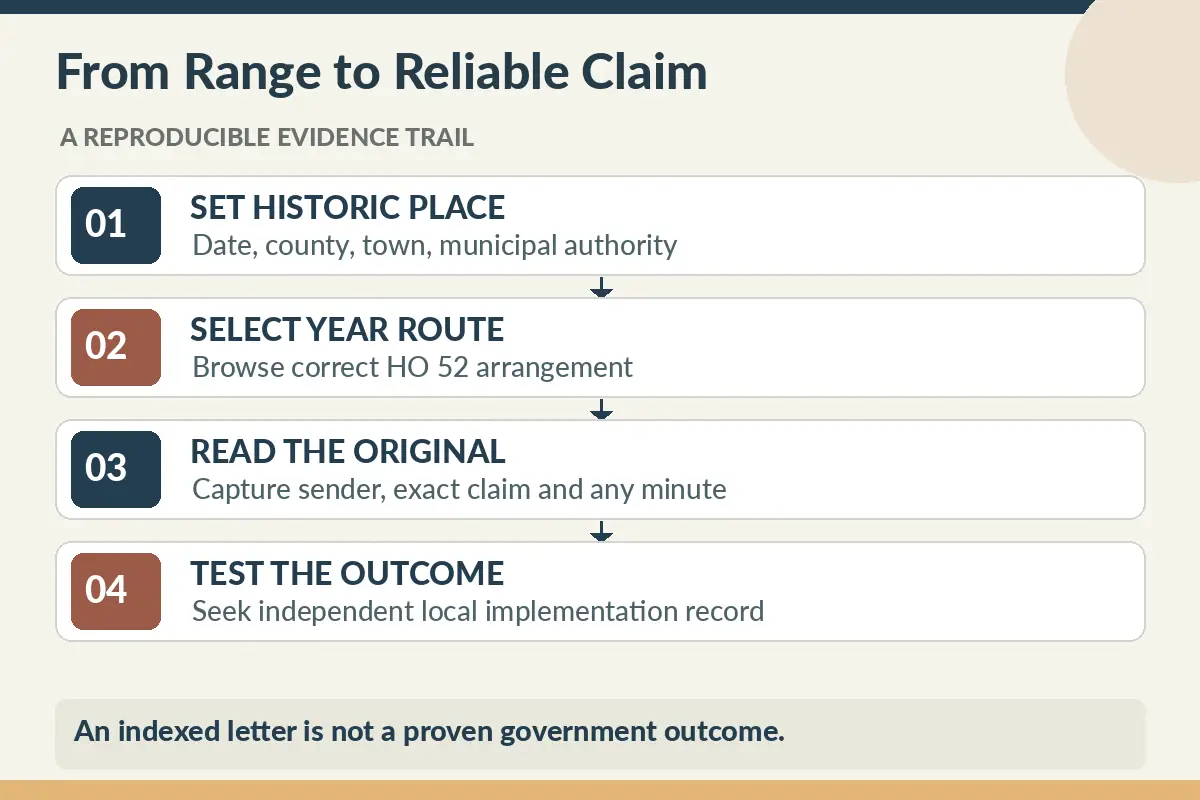
Begin a locator with event date, historical county, town or municipal corporation, who might have written the letter, and the issue under discussion. Keep these fields independent. A modern county council boundary is not a substitute for the administrative geography in use when the correspondence was filed. When the event date is approximate, search adjacent years and preserve why each was checked. Search both a personal name and a county, but do not let the absence of a person-level catalogue hit override evidence from an unindexed piece.
Distinguish County, Place, and Subject Entries
The National Archives says that most of 1830 and some of 1832 and 1837 have more detailed descriptions searchable by keyword. That is a limited exception, not a promise that every 1830s letter has an individual summary. In 1830–1838 use the alphabetical county spans when a name search fails. For 1839–1840, find the place-name span instead; a letter about a particular town may be listed under its initial rather than the first letter of the county. The last HO 52 volume also includes a small number of later papers up to 1850.
A practical test is to write two catalogue queries before opening a result: a broad date-plus-range query and an exact town or surname query. Record which one located the piece. When a catalogue description says only “counties” or “letters,” that description gives an arrangement, not an absence of detail inside the manuscript. If a district was renamed or had alternative spellings, note both. Municipal, county and magistrates’ correspondence may refer to the same incident from different institutional viewpoints.
Read a Petition as an Assertion, Not an Outcome
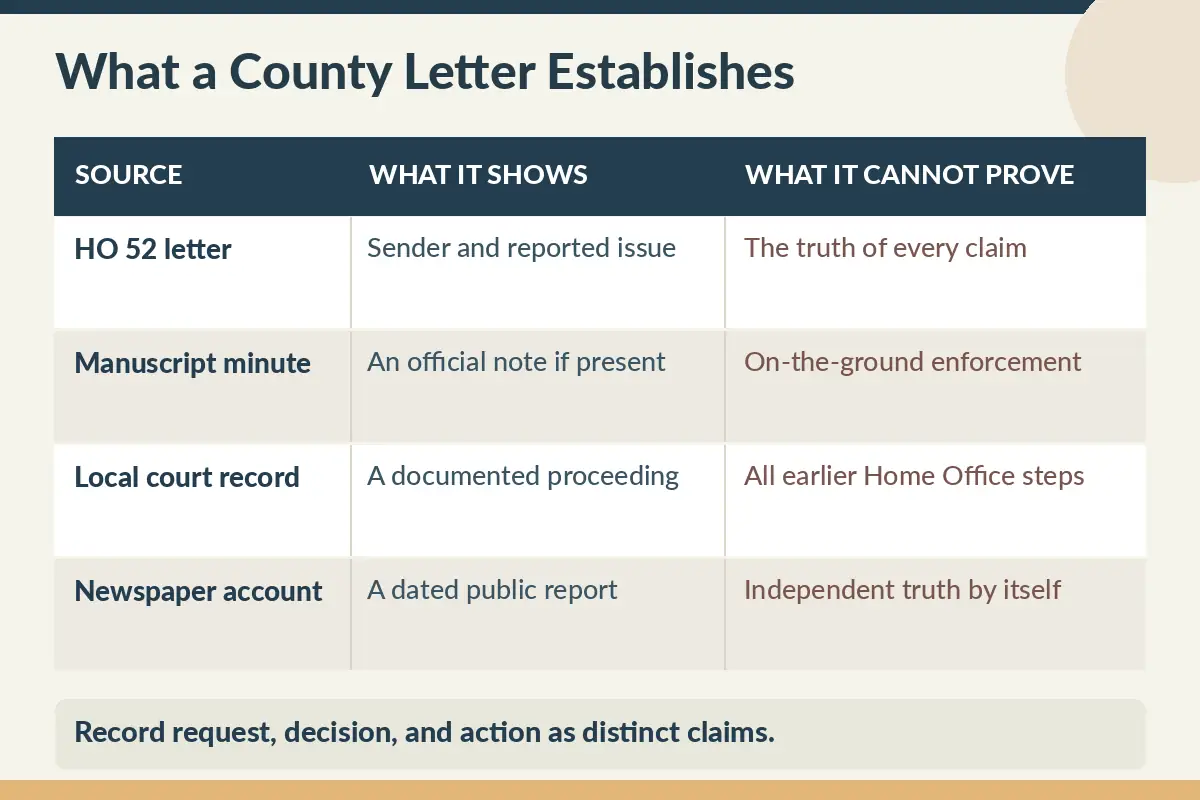
Home Office correspondence may preserve statements made by magistrates, officers and local authorities. A complainant’s description of unrest, crime, costs or local need is testimony within a particular administrative exchange. It is not automatically a verified finding. Even where a letter requests an appointment, reward or intervention, the request is distinct from a reply and a reply is distinct from enforcement on the ground. Ask whether any endorsement, minute or enclosed report is actually present in the document you read.
Use a claim table with a column for the sender, the writing date, the exact allegation or request, and the observed subsequent step. Mark later actions “not shown” until independent records support them. A second letter from a different office may be another report derived from the same first complaint, not independent corroboration. The most useful family-history result may be that a named official was acting in a documented capacity on a date; it does not prove kinship to a local namesake.
Browse Digital Microfilm Without Assuming an Index
The National Archives includes HO 52 among its digital-microfilm holdings. Such files may be freely downloadable after signing in and following the archives’ conditions, but the images are not equivalent to a complete modern full-text search. The digital-microfilm guide warns that documents can be very large PDFs and that users generally need to scroll through them. If a volume is described only by year and county span, browse through the dated pages and note the folio or position of the letter.
Before downloading, save the Discovery piece reference and verify the relevant range. During inspection, record the manuscript date, the sender’s actual signature if present, any enclosure and any later pencil or ink notation. Preserve uncertainty over damaged or abbreviated words; do not silently supply a modern spelling as a transcription. If access differs by piece, follow the current catalogue instructions rather than asserting every HO 52 page is individually viewable from search results.
Cross-Check the Administrative Trail
HO 52 is one of several overlapping early Home Office correspondence series. The official guide points researchers toward HO 44, HO 42 and HO 40 where period and subject fit, especially disturbances. Those are alternative possible routes, not required sequential stages. A county magistrate’s letter might also be followed in quarter sessions records held locally, contemporary newspapers or court files. Which one matters depends on whether the claim concerns an event, a decision, a named official or local implementation.
Try a two-tier evidence test. Tier one is the original letter with its author, date and archival reference. Tier two is an independent record created for another purpose: minutes recording expenditure, a court order or a dated municipal ledger. Do not equate identical wording copied across administrative offices with two independent observations. Where no second source survives, state the reported action as reported, rather than confidently narrating its result.
Cite a County Letter So the Search Can Be Repeated
A useful citation includes The National Archives, the full HO 52 piece/item, the writer and addressee where legible, the manuscript date and folio or image position if available. A citation to HO 52 alone cannot take the reader back to one letter. Retain the precise catalogued county/place span and your search date in the research log. If a digital copy is used, distinguish the current delivery format from the historic record’s date.
End with a statement proportional to the evidence: “A dated Home Office letter reports the magistrates’ request” is defensible when the original says so; “the Home Office approved and enforced it” needs an explicit decision and separate implementation evidence. That rule applies even when the letter concerns a relative’s workplace, a town’s unrest or a famous local dispute. The fact that a historical letter exists does not certify every assertion written in it.
More Research Method Guides
How We Research, Cite Evidence, and Handle Uncertainty
Research for this article used official archive series guidance and source explanations: The National Archives research guidance; The National Archives research guidance; The National Archives research guidance. The record titles, series categories and retrieval steps are supported by those pages. We have not asserted that an uninspected piece contains a specific named ancestor or that a historical allegation was true. The figures and schematic routes here are explanatory drawings, not facsimile archival originals.
When a claim matters, record the precise series, piece, item and folio where possible; the source creator, record date and historical place; the literal observation; and any independent evidence for your interpretation. A failed catalogue search can be a cataloguing or survival limitation rather than evidence of absence. Our affiliate disclosure explains the site’s policy; these research paths do not require an undisclosed paid referral.
No. Catalogue detail and the arrangement change with the period. Many pieces require year and county or place-range browsing.
The five early pieces are broadly catalogued as all-county correspondence, so the year range is often the better starting point.
No. A petition or request is evidence that someone made a claim, not that an official accepted or implemented it.
The National Archives lists HO 52 as digital microfilm, but the images still require browsing and may be delivered as large PDFs.
Use historical jurisdiction and the catalogue arrangement for the letter’s date, then check local administrative sources.