
Begin With the Ship, Date, and Nature of the Death
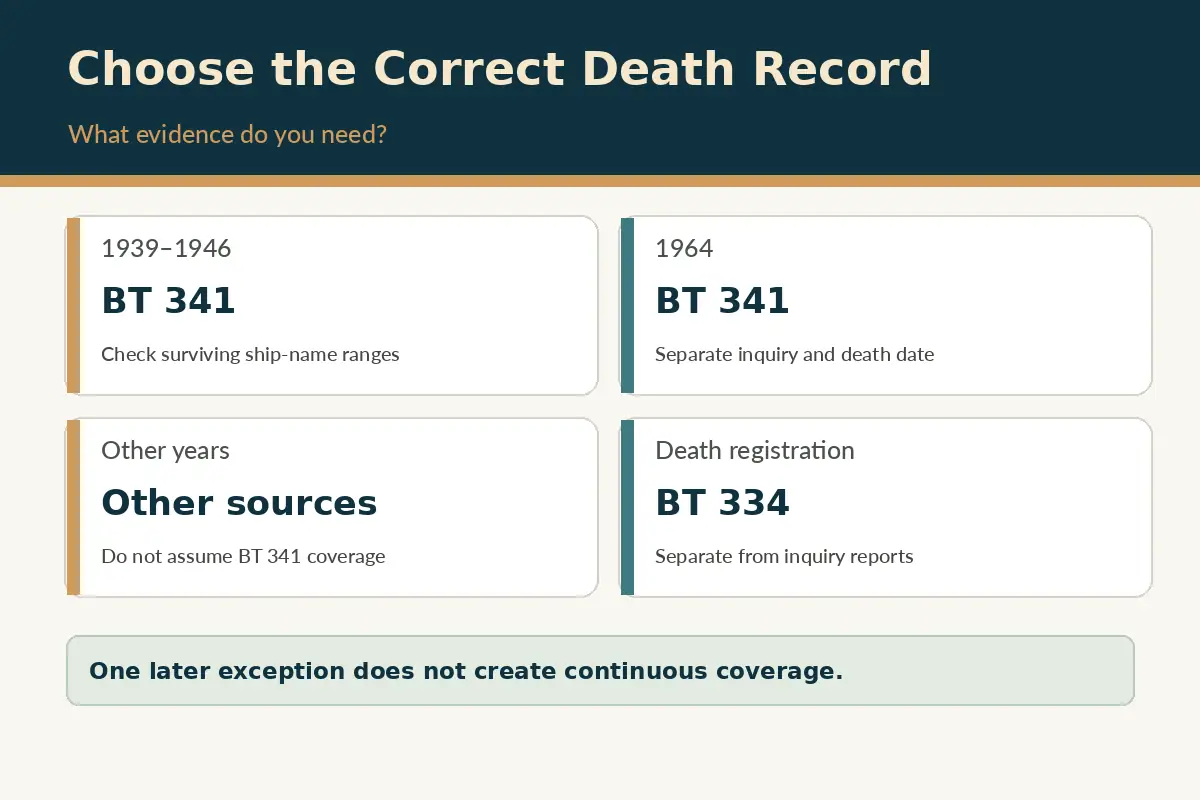
BT 341 is a targeted route to papers and reports of inquiries into deaths on merchant ships. It is not a comprehensive register of everyone who died at sea. The surviving inquiry files described by The National Archives cover 1939–1946 and 1964, with one later exceptional file. Start with a ship name and the likely year of death rather than assuming an alphabetical name search will find a person.
Record the deceased person’s name as supplied by a reliable family source, but maintain an independent vessel-identification line: ship name, registration or identifying particulars if known, date and location of incident, and whether the person was a crew member or passenger. The inquiries can concern passengers of different nationalities, so British citizenship is not a safe filter.
A family account may say that somebody was “lost on the voyage.” That phrase could describe a death, disappearance, injury, sinking or a story repeated decades later. Treat it as a question. A defensible search asks whether an inquiry was preserved for a named vessel in the limited date window, not whether the story has already been proven.
Apply the Survival Window Before Browsing BT 341
The National Archives names the main surviving inquiry periods as 1939–1946 and 1964. A 1952 death may be documented elsewhere but does not belong to the normal BT 341 inquiry survival range. Conversely, an incident within the permitted years is only a candidate for an inquiry: not every death necessarily produced a file that now survives.
Use the Discovery catalogue to browse the BT 341 series and the ship-name ranges indicated in record descriptions. Check variant spellings and the possibility of several ships sharing a name. A piece containing a range of vessels is not itself proof that a particular person or ship has an inquiry inside it until the papers are inspected.
The archive guide also mentions an exceptional file concerning a death in 1991. Do not silently extend the whole series to continuous coverage through that year. Keep the principal period rule, then handle a catalogued exception on its own stated terms. Date-of-death, date-of-inquiry and later filing or indexing dates belong in separate columns.
Read Statements, Logs, and Medical Material Separately
Official merchant-shipping guidance describes inquiry files as potentially containing statements, logbook entries, medical reports and other case papers. These are distinct types of evidence. A statement may reflect memory, perspective or disputed circumstances; a contemporary logbook entry records what was written aboard; and a medical note may address a narrower clinical issue.
Create a short source ledger for each allegation: exact wording, author or speaker if identified, date of the claimed event, document date, and its location within the archive piece. Where two accounts conflict, preserve both. An inquiry may investigate conduct or causes without automatically proving negligence, a criminal act, or every circumstance described by a witness.
A report’s narrative may name a shipmate who helped during the incident. That mention does not alone identify the shipmate as a particular ancestor with the same name. Test the role, ship and date against independent crew agreements or a shipping record. Treat a person appearing in an inquiry as a participant in a document, not a complete service record.
Compare the Investigation With Registration Records
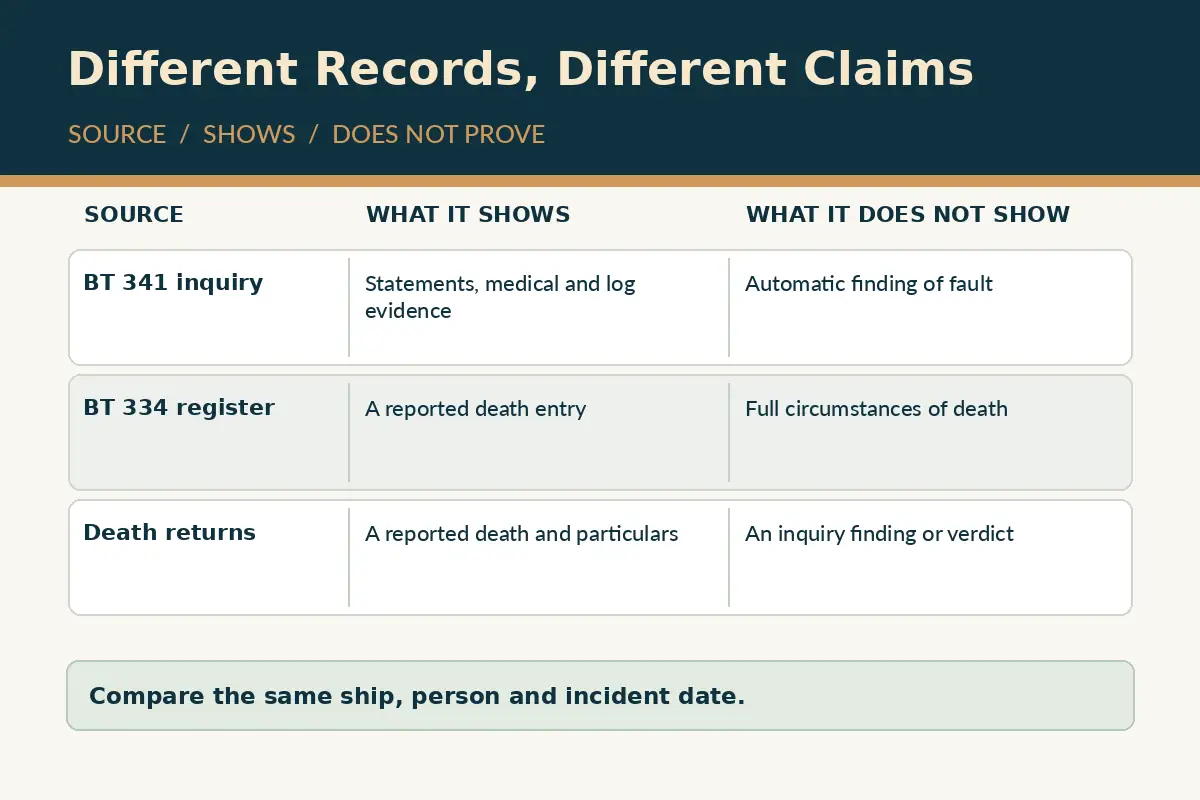
BT 334 holds shipping-death registration material and plays a different role from an inquiry file. The registration identifies a reported death, while BT 341 is the route to surviving investigation papers for its specific periods. The two may share a death but are not duplicate record types. Do not cite an inquiry as the legal registration merely because both name the same individual.
The government’s historical-records guidance says returns of death for the relevant periods are held at the National Maritime Museum, separate from the National Archives inquiry papers. The reports may correspond to death registers in BT 334. Therefore write the archive and the document type for every finding; a missing inquiry is not evidence that a death was never registered.
Suppose a fictional engineer named Daniel Reed appears in a family diary as having died aboard a ship in 1942. Search the ship-name BT 341 route, then compare the exact incident date and personal particulars with a register or death return. If two engineers shared that name, the vessel and other details are needed before merging the records.
Document a Negative Search and an Unfinished Explanation
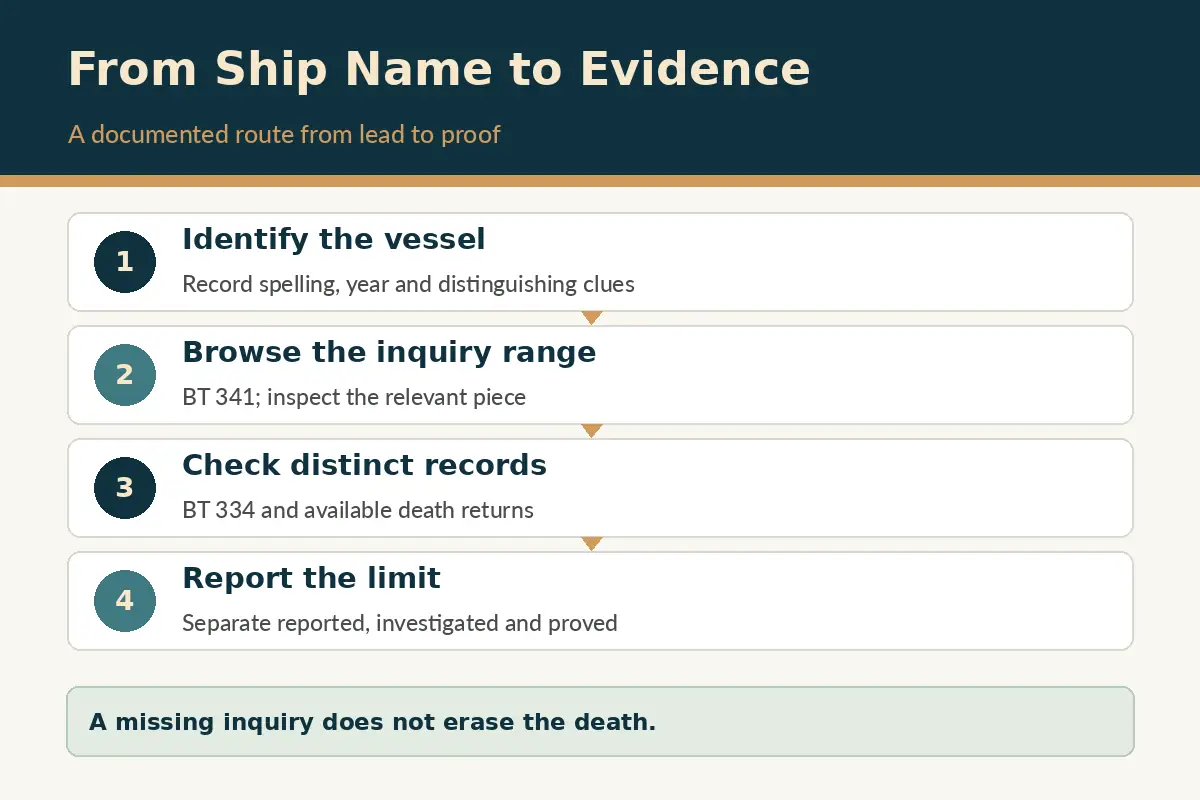
A complete search record lists the vessel spellings, year ranges, relevant BT 341 piece descriptions and any material actually consulted. If the catalogued range was not viewed, label the result “catalogue searched,” not “no inquiry exists.” If the archive papers are restricted or unavailable in the requested format, record that practical limit instead of treating it as an evidential absence.
Do not substitute the well-known shipwreck investigation series MT 9 for BT 341 by default. A marine casualty investigation about a lost vessel and an inquiry into a particular death can have different purposes and provenance. Search across collections only when the specific incident suggests the extra route, and keep the resulting citations distinct.
A useful final conclusion distinguishes three questions: Was a death registered? What did any surviving inquiry record about its circumstances? Which findings, if any, are independently supported? If there is no BT 341 file for the tested ship and year, the conclusion should be limited to those searched descriptions and surviving records.
More Records and Archives Guides
How We Research Merchant-Ship Death Inquiries
Our date and filing guidance follows The National Archives guide to deaths at sea and abroad. We compare it with the UK government historical merchant-seamen records guidance for the separation of inquiries, registers, and returns of death.
The example engineer is fictional and not a discovered case. We do not infer causes of death from a single witness account, and we do not assume continuous BT 341 coverage. Before purchasing copies or hiring a researcher, see our affiliate disclosure. Keep the vessel/date question narrow and record each original reference before drawing conclusions.
No. It contains surviving inquiry papers for specified periods, not a universal death register.
The National Archives identifies 1939–1946 and 1964, plus one exceptional later file.
Start by the ship-name ranges in the series and verify vessel identity and year.
No. The first holds investigation papers; BT 334 is a separate registration source.
Not automatically. Identify the statement’s author, limits, and any independent documentary support.