
British merchant-ship births and deaths may appear in BT 158, BT 159 and BT 160. Learn what a ship log, returned register and GRO copy each establishes. Start by distinguishing the original document from an index or later copy. The custodian’s official research guidance defines the relevant records and access limits; our affiliate disclosure explains site policies.
Start With the Event and the British Vessel
A birth or death aboard a British registered merchant vessel could be entered into the ship’s log and then reported ashore. That does not mean every passenger’s foreign vital event appears in these registers. Establish whether the vessel was British registered, its name if known, a port or voyage, the person’s name and an approximate event date. A transatlantic arrival index may provide the ship and a timetable but is not itself a birth or death record.
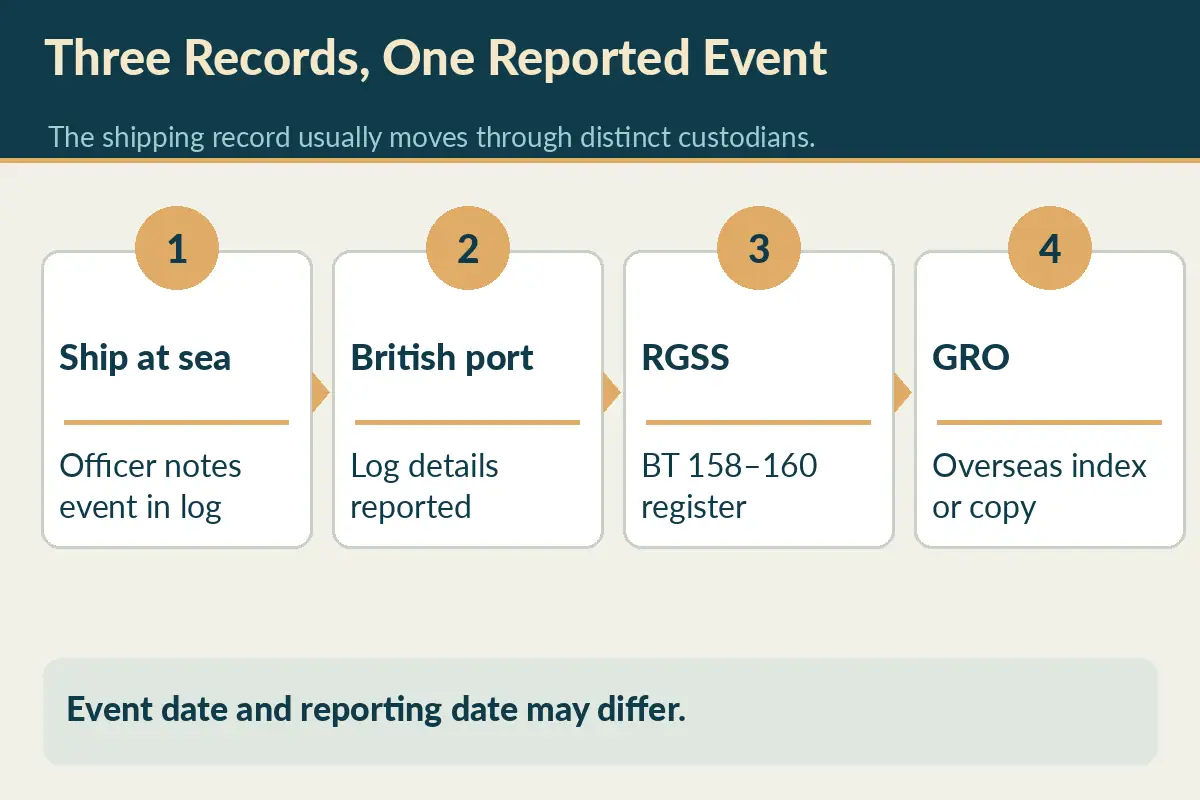
The National Archives guide identifies the ship’s log as the earliest report in the post-1854 system. When the vessel next reached a British port, information was entered into Registrar General of Shipping and Seamen registers; copies went periodically to the General Register Office. Put each creation date on a timeline. A birth reported in July but recorded in a register later need not have happened on the date of docking. Exact locality at sea may be limited to a route or position if noted.
Choose BT 158, BT 159 or BT 160 Correctly
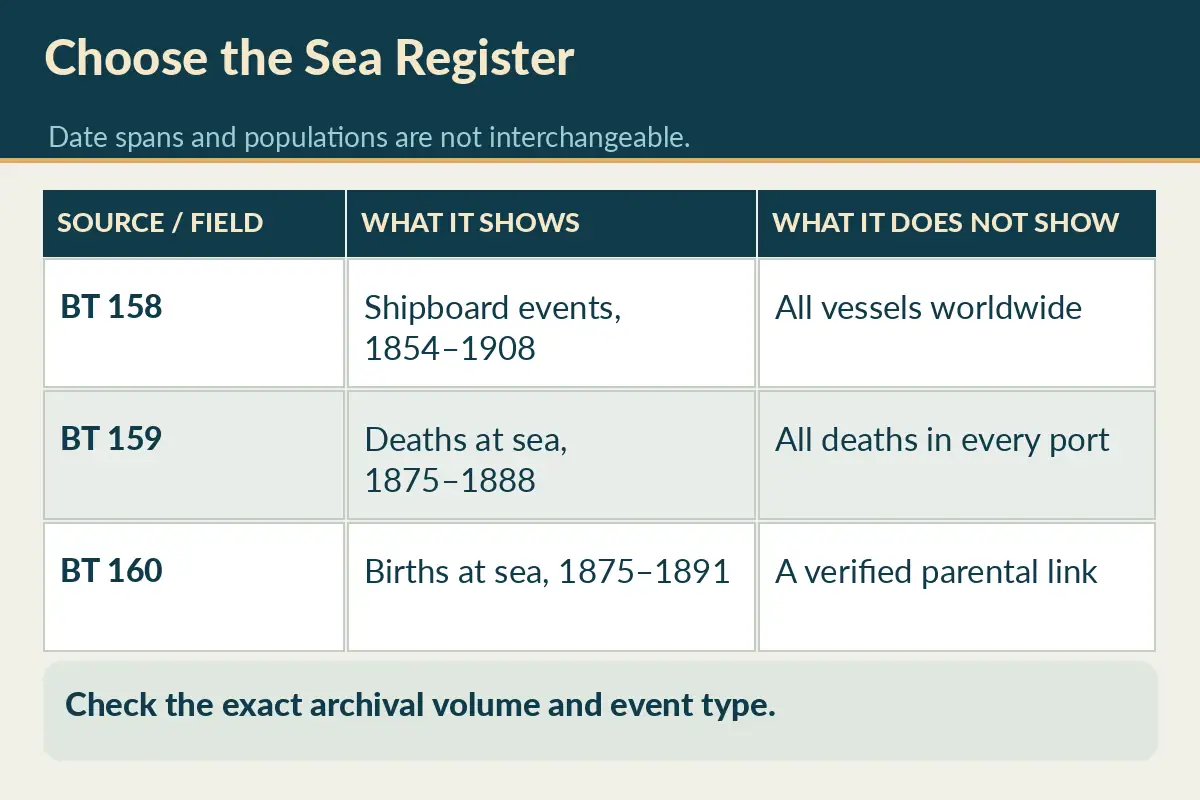
The Archives describes registers for merchant-shipping births, marriages and deaths at sea in BT 158, beginning in 1854. Related BT 159 material covers deaths of British nationals at sea in the later nineteenth century, and BT 160 covers births of British nationals in that period. The official non-parish guide gives BT 158 to 1908, BT 159 roughly 1875–1888 and BT 160 roughly 1875–1891. These ranges describe particular holdings, not a guarantee for every voyage.
If you have a ship name but not a person-level index, first search the overseas General Register Office indexes and then determine which archival register could contain the return. Commercial providers may hold images, with charges and different search coverage. Note exactly whether the result displays a GRO index line, an RGSS register image or a ship’s log. A match in two databases may reflect the same transmitted information rather than two independent witnesses to the event.
Read Ships’ Logs and Register Copies as Separate Sources
The ship’s officer recorded an event onboard; a later registrar wrote or copied a return in a port register. Transcription errors, inconsistent spelling and incomplete ages can arise between these stages. When images are available, copy the vessel name, voyage clues, event date, age or status, and record heading exactly. If a location at sea is imprecise, label it as the record states rather than converting it to a modern town. Crew and passenger references may be recorded differently.
A log may record shipboard circumstance while the register emphasizes the vital occurrence for administrative reporting. An overseas index may then summarize the register. None of these alone necessarily proves the individual is your ancestor: compare an independent census, passenger list, family correspondence or civil certificate. If a child is born at sea, the birth place field in a later census might be reported as an ocean, a port or a country; keep that discrepancy visible instead of forcing a single geographic label.
Do Not Treat an Onboard Marriage as Legally Valid
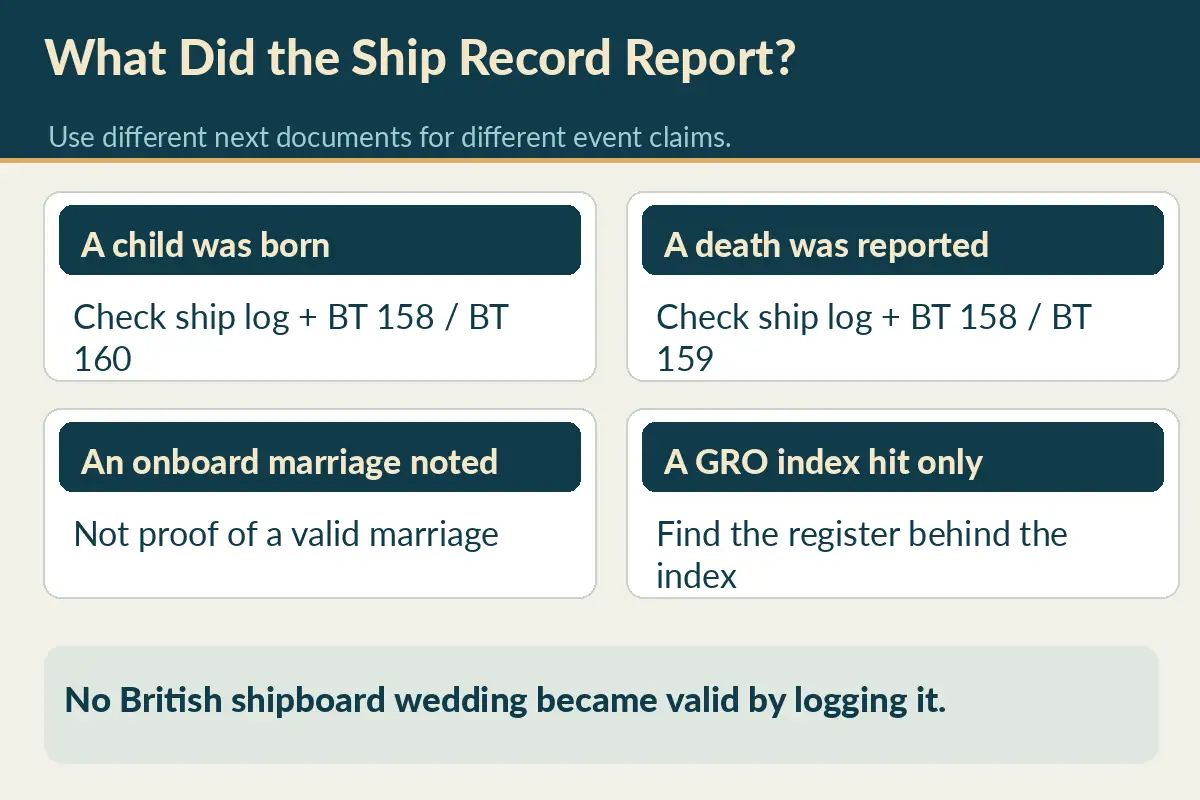
The National Archives states that no British registered ship was approved as a venue for valid marriages; from 1854, any marriage that took place aboard still had to be reported in the ship’s log. Such an entry documents a purported ceremony or occurrence, not a legally valid marriage under the stated British system. This is a crucial difference from the births and deaths recorded for return. A couple later married in a port might generate a separate, valid local entry.
When you encounter the word marriage on a ship record, read the document’s exact wording and the applicable jurisdiction before assigning a marital status in your family tree. Do not infer that a captain solemnized a lawful wedding. Search a local civil register or religious register at the relevant port for an independently valid event. Use a three-column ledger headed reported shipboard event, subsequent formal registration and remaining uncertainty to make the legal and evidentiary distinctions explicit.
Understand Events That These Holdings Miss
There was no obligation to maintain sea-event registers before civil registration began in England and Wales in 1837, and specific shipping-reporting requirements developed afterward. Ships under other flags may be represented under other legal and archival systems. Even after 1854, an incident might not have been reported or its copy might not survive. The GRO’s overseas series is not exhaustive; the Archives says some documents never reached the GRO or have been lost.
Search by the ship’s historical registration and actual itinerary, not merely the departure country of a passenger. If the expected index is empty, try spelling variants, a different event year, an original log, a foreign port register or a colonial repository where appropriate. Note that the absence of a British record cannot demonstrate that no birth or death occurred at sea. It can at most limit the search to specified surviving British reports and years.
Build an Event-to-Record Citation Chain
Cite each observed layer separately: original ship’s log if seen, BT 158/159/160 piece with page or entry, and GRO overseas registration reference. Note whether the evidence was an image, a transcription or a catalogue description. Dates should include the event date, next port reporting date when given and registration or copy date. Use the person’s identity details from outside the vessel record to distinguish similarly named passengers or seamen.
The goal is not merely a searchable name hit but a defensible account of what happened aboard a particular ship and what was later registered. One entry might support only a reported birth or death; citizenship, parentage, kinship or place of future residence needs corroboration. Start with The National Archives’ sea and abroad guide before paying for a commercial index search.
How We Research Events at Sea
We begin with the vessel flag and an event date, follow the ship-log to port-register to GRO-copy route, and distinguish original images from indexes. We keep British births, deaths and reported shipboard marriages in different legal categories, and verify the person with another independently made source.
More Records and Archives Guides
Official Archive Descriptions and Reading Access
We checked the original custodians’ descriptions rather than assuming a database provides complete coverage. Primary official guide documents the National Archives describes BT 158–160, the ship-log reporting sequence, GRO overseas indexes, and the legal status of onboard marriages. Supporting archival series description documents the National Archives distinguishes BT 158 registers through 1908, BT 159 deaths and BT 160 births with their different date limits.
No. It concerns surviving merchant-shipping reports under a particular British system and does not cover every ship or voyage.
The onboard event, port report and later register or index could be created on different dates.
They contain narrower later-nineteenth-century registers of deaths and births of British nationals, respectively.
The National Archives says no British-registered ship was approved for valid marriages; reported onboard ceremonies are not proof of legal marriage.
No. It is a later indexed registration layer; identify the underlying ship and register when possible.