
WO 96 contains militia attestation papers from 1806–1915. Learn how to identify a recruit by county, regiment and service details without assuming every militiaman joined the regular army. Start by distinguishing the original document from an index or later copy. The custodian’s official research guidance defines the relevant records and access limits; our affiliate disclosure explains site policies.
Identify the County Militia Before Searching a Name
The British militia was a county-organized, part-time force rather than simply another name for regular army service. Its institutions and recruitment changed over time. The National Archives describes county militia as a voluntary part-time force and notes that the modern system dates from the mid-eighteenth century. If a household census calls an ancestor a soldier, establish the date and place of the record before choosing between militia and regular army series. A matching surname in an attestation index is a lead, not a completed military biography.
Begin with a research card containing name variants, county of probable residence, birth-place estimate, known occupation and the earliest reliable military date. Add any regimental title exactly as it appears in a family document. Do not assume that a recruit stayed in that county, that his militia unit served abroad, or that enlistment implies combat. A person might have periods of absence, later transfer or no surviving attestation in the searched pieces. Record the limits of the name index as carefully as its hits.
Cross the 1881 Regimental Naming Boundary
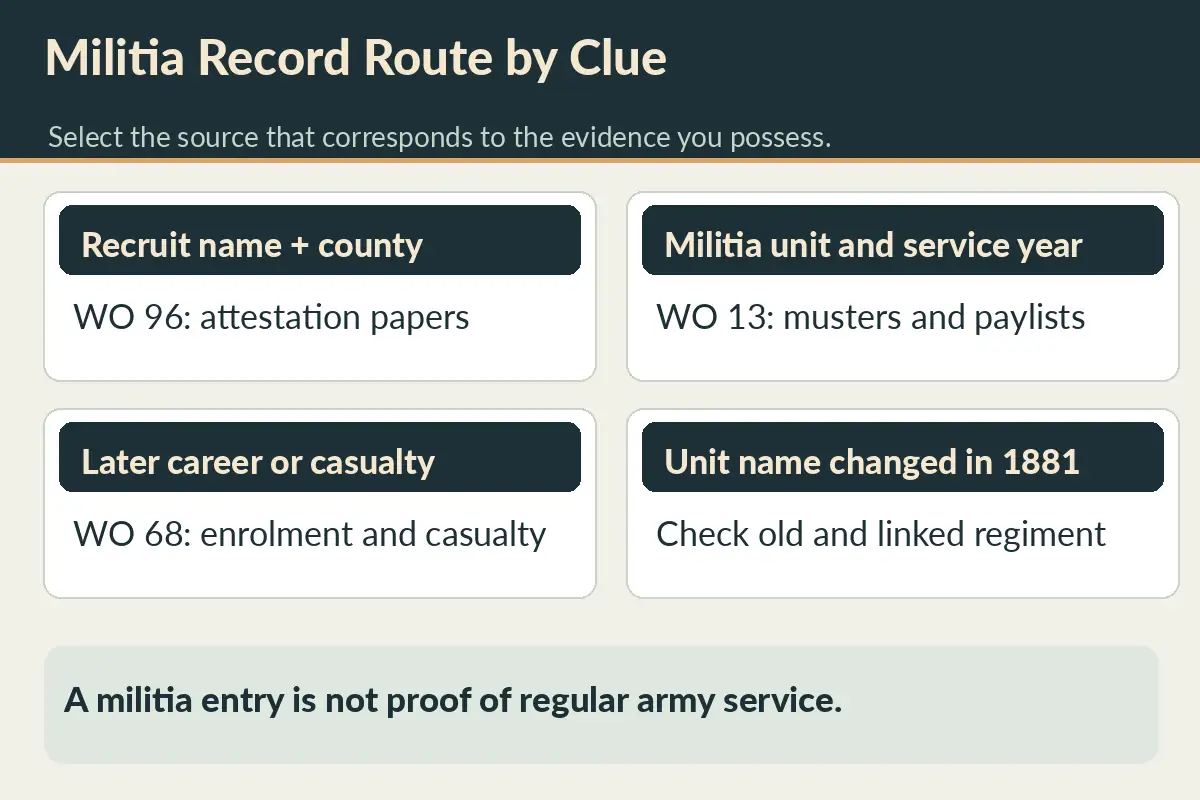
Militia regiments became linked to regular army units in the 1881 reorganization; a unit could appear under an older county name in one source and under the parent regiment in a later one. The Archives militia guide recommends using Army Lists from 1881 onward to identify those relationships. Write both names and the date of the naming change in separate fields. Searching the modern designation alone may miss an older roll, while merging every similarly titled battalion can create a fictitious continuous career.
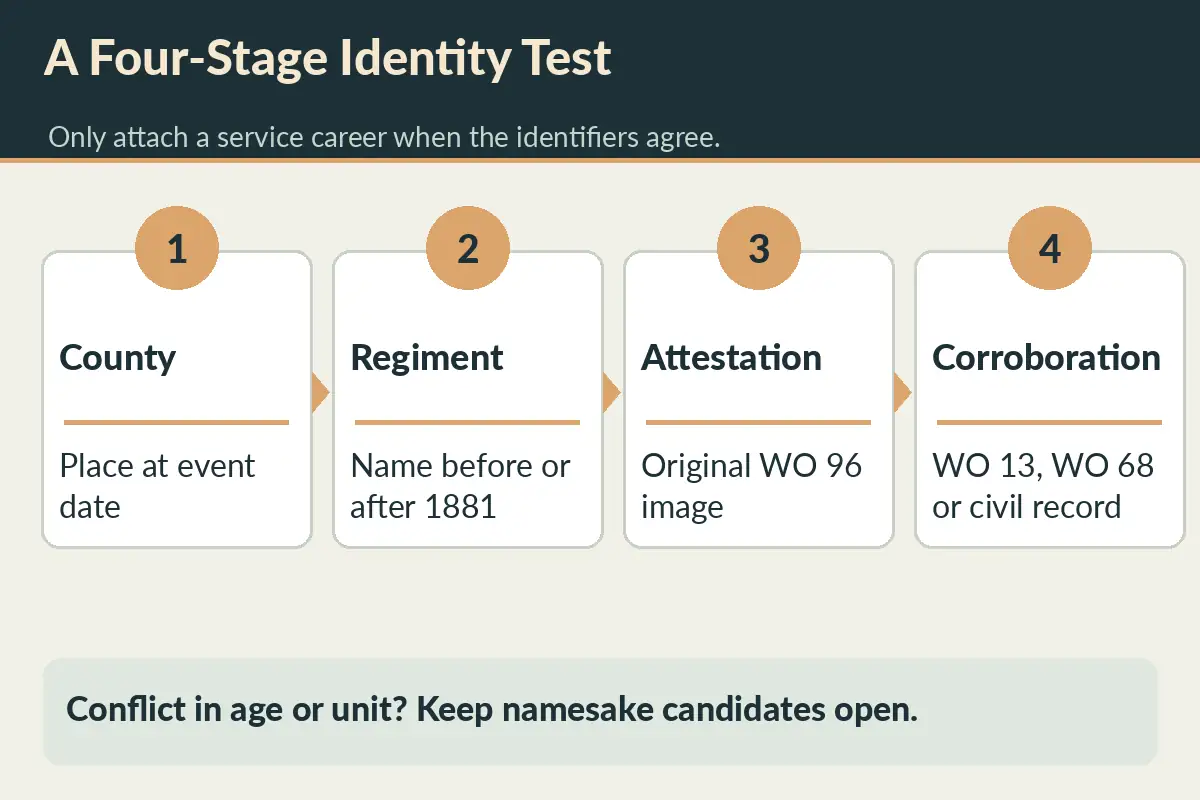
Search WO 96 by name, then compare the candidate paper with the county and the historical regiment. Capture all written service numbers and dates, not just the database summary. An attestation might bear later annotations extending toward discharge; those marks may have been written long after the signature. Distinguish when an enlistment happened, when an amendment was made and when the indexed digital object was published. A signature or witness proves the form was executed as recorded, not everything subsequently asserted in an online family tree.
Read the Attestation as a Specific Event
The WO 96 document is an attestation, sometimes with additional papers attached. It may contain a recruit’s identity description, reported age, birthplace, occupation, regiment, service particulars, signature and witness; do not promise every field on every item. Transcribe the printed questions alongside the answers. Age and birthplace were supplied for an administrative purpose and must be checked against independently created civil, census or parish records before being regarded as precise birth facts.
When interpreting signatures, do not confuse the witness with a relative. Likewise a later note about discharge is an event in a service file, not proof of permanent settlement at the named place. Preserve blank answers and overwritten figures. Keep any named next of kin as a reported relationship, then test it against a marriage certificate, census or probate record. An attested military identity may provide strong distinguishing evidence, but namesake soldiers with similar birth years remain possible within a large county.
Compare WO 96 With the Correct Other Militia Series
WO 68 holds militia enrolment and casualty books, with coverage described for 1759–1925. WO 13 contains militia muster rolls and paylists for 1780–1878. The National Archives advises searching these by county or historical regiment. These are distinct record types: an enlistment form may document recruitment, a muster or paylist may document an appearance in a particular period, and a casualty book may record a later administrative change. None automatically substitutes for another.
Do not jump from a WO 96 index hit to WO 12 regular army musters unless other evidence supports regular service. Some men may have regular-army connections, but separate recruiting and service records must establish them. The 1881 unit naming shift also affects how a regiment appears in later descriptions. Compare the dates of candidate entries and record the unit’s full designation; a familiar county name by itself is inadequate to reconcile two people across several decades.

Handle Missing Files and False Identifications
Not every militiaman left a surviving WO 96 file, and the known collection is not a roster of every person eligible for militia duty. Earlier local militia lists and ballot or enrolment lists may survive in county archives; those records are not interchangeable with attestations. The Archives notes that local list survival is incomplete. Search relevant county record offices by parish and year when WO 96 yields no credible result, distinguishing a listed eligible man from a selected or serving man.
To reject a tempting namesake, compare age in the form with dated civilian records, regiment location, occupation changes and whether known children were born in the relevant places. Contradictions deserve their own research-log column. An empty search result should say whether you searched the name index, a specific WO 96 piece or an alternative county holding. Absence of a hit in one commercial index is not evidence that the family story about militia service is false.
Create a Defensible Service Summary
Prepare a chronology with one row for attestation, one for any annotated service change, one for a dated muster and one for discharge if documented. For each row supply repository, full piece reference, page or image number, transcription of the original label and date of observation. Use separate columns for stated fact, inference and independent verification. That makes it possible to revisit a disputed service number without relying on an index screenshot.
A sound conclusion can be modest: this named person signed a militia attestation associated with a given county regiment on a particular date. A stronger claim, such as continuous service or later regular army enlistment, needs additional records with matching identifiers. The reader should leave with a specific unsearched source, not a manufactured certainty. Consult The National Archives militia guide for the exact series routes.
How We Research Militia Attestation
We choose the historical militia unit and county before searching a surname, check the 1881 naming transition, and read the WO 96 image in full. We test attestation against dated WO 68 or WO 13 evidence where appropriate; we do not treat a militia form as proof of regular army combat service or family relationships.
More Records and Archives Guides
Official Archive Descriptions and Reading Access
We checked the original custodians’ descriptions rather than assuming a database provides complete coverage. Primary official guide documents the National Archives describes WO 96 attestation papers, 1881 regimental name changes, and WO 68/WO 13 alternatives. Supporting archival series description documents the National Archives identifies WO 96 among digitized militia attestation sources and notes access arrangements.
No. It concerns militia attestation; a separate record is needed to establish regular army service.
The 1881 reorganization linked militia units to regular regiments. Search the name used at the date of the record.
No. Survival and coverage are incomplete; try county militia lists, WO 68 and WO 13 where appropriate.
No. The witness role alone does not establish a family relationship.
Yes. Start with county and period, then compare each candidate’s regiment, age and original documents.