
WO 344 questionnaires record statements by some liberated British and Commonwealth prisoners of war. Separate eyewitness testimony, camp chronology and later corroboration. Start by distinguishing the original document from an index or later copy. The custodian’s official research guidance defines the relevant records and access limits; our affiliate disclosure explains site policies.
Understand Who Created the Questionnaire
WO 344 consists of questionnaires completed by some liberated British and Commonwealth prisoners of war after the Second World War. The forms record accounts and identifying particulars, not a complete government-verified narrative of each captivity. The National Archives describes two broad archival groups, Germany and Japan, with surname-range catalogue arrangement. Begin with the full name, service number if known and likely captivity theatre, and make sure the conflict is the Second World War rather than the First.
Questionnaires can include camp and hospital names, dates and places of capture, illnesses, work camps, escape attempts and reports about treatment. Some boxes ask about suspected misconduct by other people. These are testimony and official collection questions; accusations recorded on a questionnaire are not findings by a court or an independent investigation. Avoid repeating stigmatizing allegations about identifiable individuals without context, and limit publication of potentially sensitive or living-person details.
Choose Germany or Japan and the Surname Range
The official guide says the original WO 344 volumes are arranged by alphabetical surname ranges, separately for prisoners captured by Germany and by Japan. In the catalogue, browse the corresponding theatre rather than treating a name index as complete. Record the exact piece and surname bracket. A broad name search may return a digitized image on a commercial site, but the availability and indexing of images differ from what can be requested or viewed at Kew.
Namesakes require more than a shared surname: compare service number, unit, rank, capture context and home address where safely available. A soldier might have been moved among camps, so one known camp is not always the final location on the form. If the individual is not found under a guessed theatre, reassess the service and capture documentation before inventing an alternative captivity history. The absence of a questionnaire does not prove that a person was never taken prisoner.
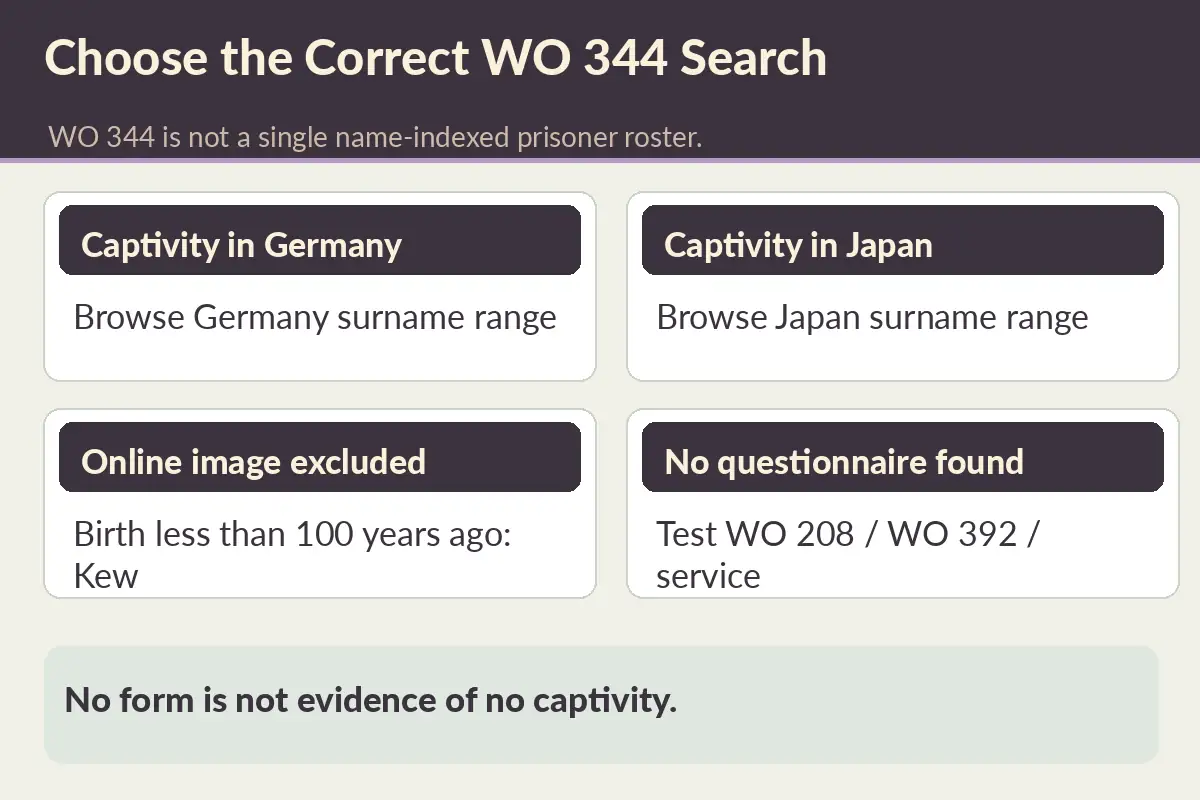
Apply the One-Hundred-Year Online Access Gate
The National Archives explains that online WO 344 images and indexes at Ancestry exclude people born less than one hundred years ago. Those excluded items can be consulted as originals at the Archives in Kew using the surname-range catalogue organization. That distinction is about the digital provider’s visible collection, not permission to publish private health or accusations. Respect the current custodian and provider rules whenever a living person may be involved.
Do not try to bypass a closed search result or identify a living person from indirect medical or detention details. A form that is viewable in a reading room still deserves careful handling if it names third parties. Record access conditions at the time of consultation and cite the exact item. Where public evidence is insufficient, state the archival limitation. An incomplete online index is not a negative conclusion about wartime service or captivity.
Separate Prisoner Report From Official Finding
Make a worksheet separating fields such as rank and service number from narrative responses about events in a camp. A name and service number can support matching an individual to service records; a reported capture location is a recollection that deserves a second source. Camp conditions and illnesses may be described with vivid language or approximated dates. Preserve that testimony with attribution instead of modernizing it into an absolute medical or legal conclusion.
If someone describes another prisoner’s conduct, label it as the speaker’s report. Do not report “a named soldier collaborated” when all you have is a questionnaire response suggesting suspicion. A postwar investigation, independent witness or court record would be different evidence. Sensitive information about treatment or medical care also requires restraint when linking to families or living relatives. Readers should be able to see exactly which statements are firsthand, secondhand or unverified.
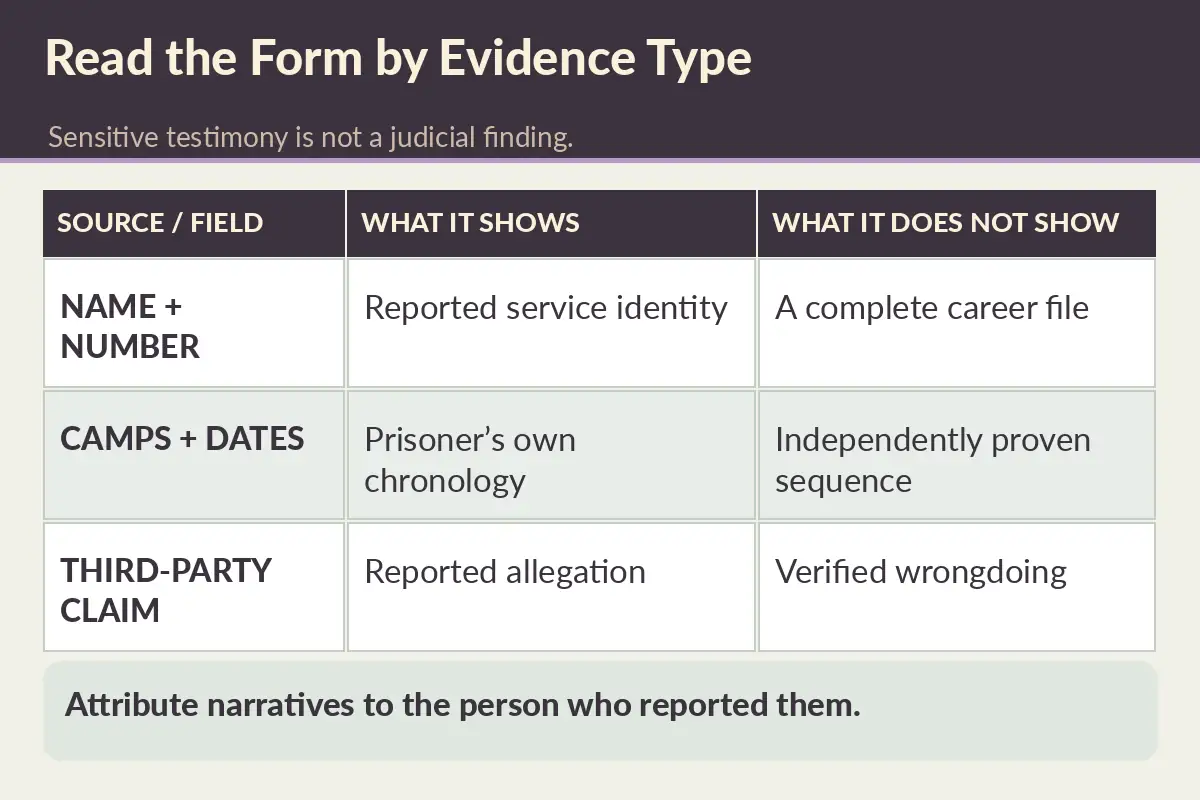
Use WO 208 and Service Files for Independent Checks
The Archives identifies WO 208 reports of liberation, escape and evasion as separate documents that may add information about events. WO 392 contains prisoner lists; WO 347 may supply hospital material for Far East captivity. These series are not sections of a single person’s WO 344 file and need independent search routes. Wartime service files may also record dates of missing status, capture or repatriation, but coverage varies.
Do not construct an uninterrupted camp itinerary from one questionnaire’s partial list. Compare independent dated entries and note differences in place spellings, transfers and capture dates. Some reports are indexed differently, and an absent catalogue name may simply mean the file is not described at item level. Cite each separate custody series. If testimony refers to an event outside the surviving records, say it remains reported, not independently established.
Produce a Respectful Captivity Evidence Timeline
The final research product should have distinct rows for service identity, reported capture, reported camp sequence, liberation statement and any independently documented return. For each claim, identify whether it comes directly from a WO 344 response, a separate military record or a later family account. Record the questionnaire piece and the date or period written on the form. Quote only the minimum needed to explain the evidentiary issue, with sensitivity to people still living.
A responsible summary might say that a particular liberated prisoner reported imprisonment at named camps; it should not silently convert those reports into an officially verified camp itinerary. The official POW guide also emphasizes that there is no single definitive POW record. The next research step is a specific additional source, not a generalized assumption that all missing forms were destroyed.
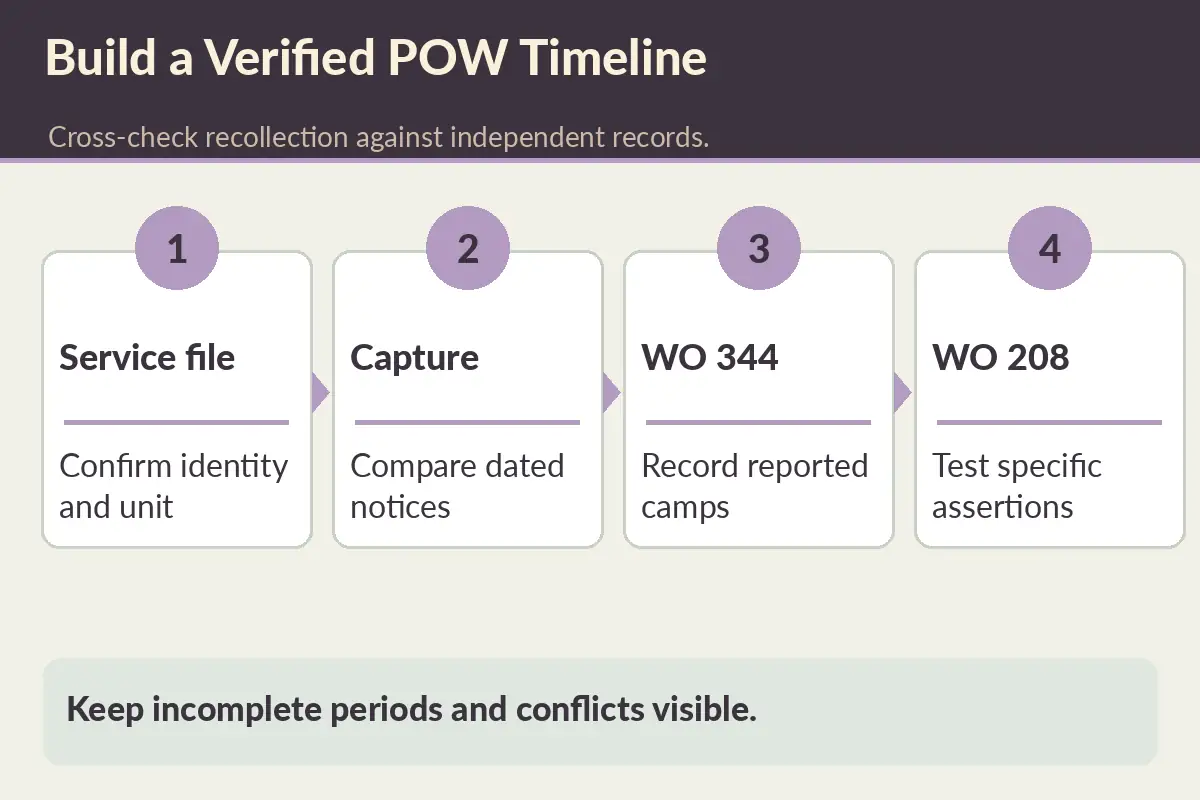
How We Research Liberation Testimony
We first identify theatre and surname-range WO 344 references, then test prisoner identity by service number and independent dates. We distinguish statements in a liberated prisoner’s form from conclusions established by other records, and we respect the published 100-year online availability rule and third-party privacy.
More Records and Archives Guides
Official Archive Descriptions and Reading Access
We checked the original custodians’ descriptions rather than assuming a database provides complete coverage. Primary official guide documents the National Archives describes WO 344 Germany and Japan questionnaire ranges, privacy exclusions, testimony topics and WO 208 alternatives. Supporting archival series description documents the National Archives explains service records, War Office record series and catalogue access for Second World War research.
No. The surviving questionnaires are not a definitive roll of all prisoners.
No. The Archives describes separately arranged groups by surname range.
The cited online Ancestry collection excludes those individuals; consult the Archives’ lawful original-access guidance.
No. They are reported claims and require independent evidence before being characterized as facts.
Consider WO 208 reports, POW lists, unit records and other independent documents, with their own coverage limits.