
The Freedmen’s Bureau and Union Army preserved marriage certificates, licenses and returns from 1861–1869. Use M1875 by state and groom name, then check independent family records. Start by distinguishing the original document from an index or later copy. The custodian’s official research guidance defines the relevant records and access limits; our affiliate disclosure explains site policies.
Understand Why the Marriage Record Was Made
During the Civil War and Reconstruction, Union Army authorities and the Freedmen’s Bureau helped formerly enslaved people document and legalize marital unions denied legal recognition under slavery. The M1875 collection is cataloged as 1861–1869, although the descriptive pamphlet notes an exceptional earlier-dated certificate. A certificate dated in 1866 may document a couple who had lived together earlier; do not assume the legal recognition date was necessarily the start of the relationship. The record’s statements about the past may be based on the couple’s declarations and should be attributed accurately.
These records deserve respectful, person-first interpretation. A document may identify children or past relationships, but it is not a universal registry of everyone emancipated or a guarantee that every detail was recorded firsthand by a modern vital registrar. Search by the couple’s names, locality and approximate date. Be careful about surnames adopted or used at different times; an apparent mismatch can reflect historic choices or clerical practice, not a reason to impose an enslaver’s surname as a family identity.
Use the M1875 State-and-Groom Search Order
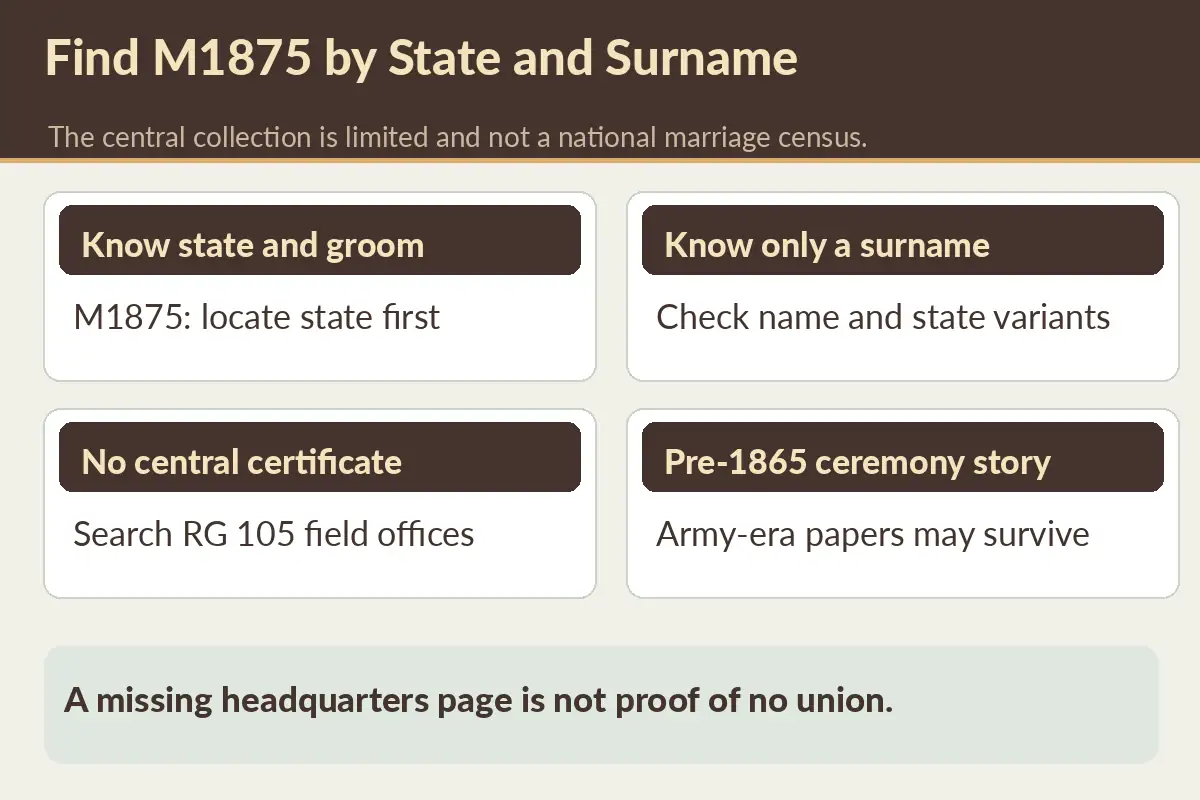
NARA describes M1875, Marriage Records of the Office of the Commissioner, Washington Headquarters, 1861–1869, as five microfilm rolls. The records are arranged for the most part alphabetically by state, then by the initial letter of the bridegroom’s surname. Coverage differs sharply: some states have hundreds of certificates, others only small groups or monthly reports. Search the NARA M1875 descriptive pamphlet before assuming every state is similarly represented.
Transcribe the exact roll, state, surname section, date and page or image. Initial-only grouping means names inside a segment may not behave like a simple modern alphabetical index. Try variant spellings and the bride’s name where collections allow, but record which method produced the hit. A search engine showing no result under one surname is not a sufficient search of the state’s images. If the relevant central office pages do not exist, check separate field office series rather than deciding the marriage was never recognized.
Distinguish Certificates, Licenses and Monthly Reports
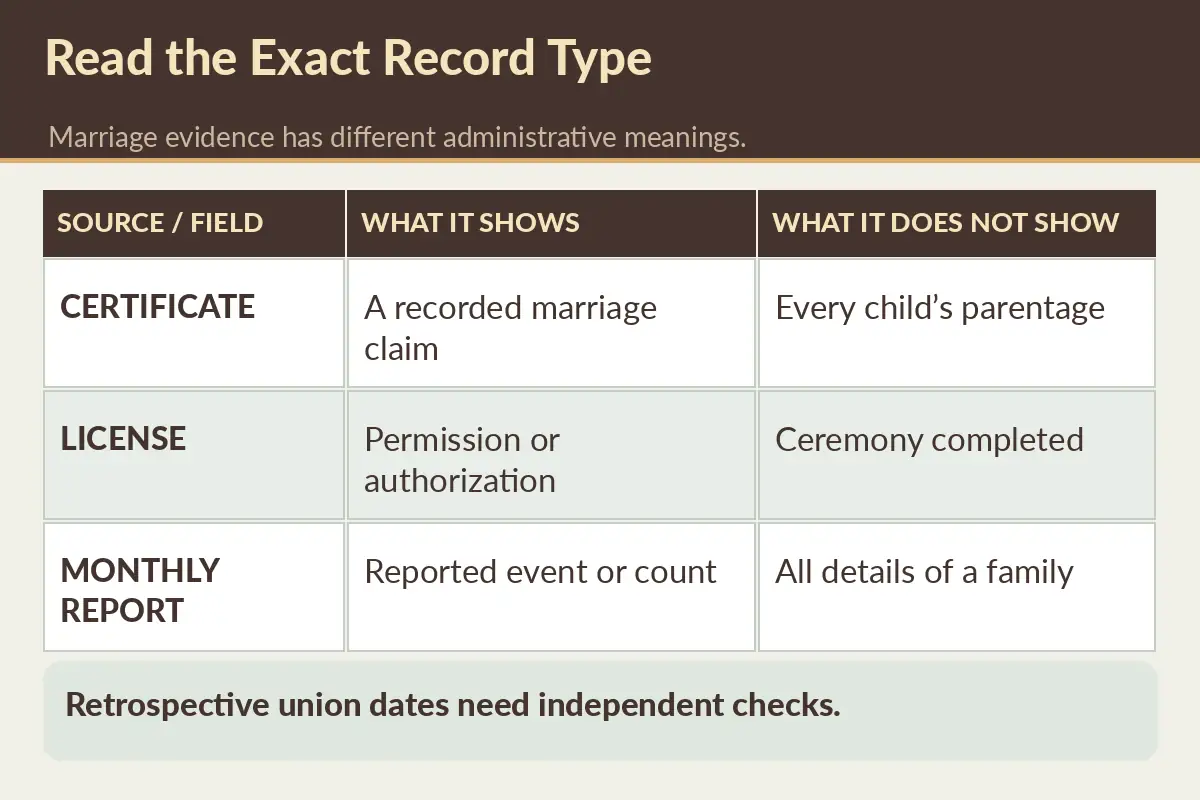
M1875 does not contain one uniform national form. The official finding aid identifies marriage certificates, licenses, monthly reports and other proofs. A certificate might document a recognized union; a license concerns permission or authorization; a monthly report can summarize marriages with less detail. Inspect the heading and date on the original and state exactly what that record claims. A license by itself is not automatic proof of a completed ceremony, and a summary count cannot prove the identity of an unnamed couple.
Some documents describe previous years together or children already born to the couple. Such statements can provide unusually valuable clues to families separated by slavery, but their evidentiary status remains a recorded account. Do not transform a duration such as “together for fifteen years” into a certified exact wedding day. Keep original names, dates and witness labels intact. Seek a later census, church record, family correspondence or county record to confirm the identities and household connections.
Check Field Office Holdings When M1875 Is Silent
NARA explains that the Washington headquarters collection was formed from submitted documents and does not represent everything recorded locally. RG 105 field offices maintained correspondence, registers, certificates, agreements and other materials; their microfilm publications vary by state. A marriage item might survive only within local field office files and never appear in M1875. Search the correct state and office descriptions, not all RG 105 material as if one nationwide surname index existed.
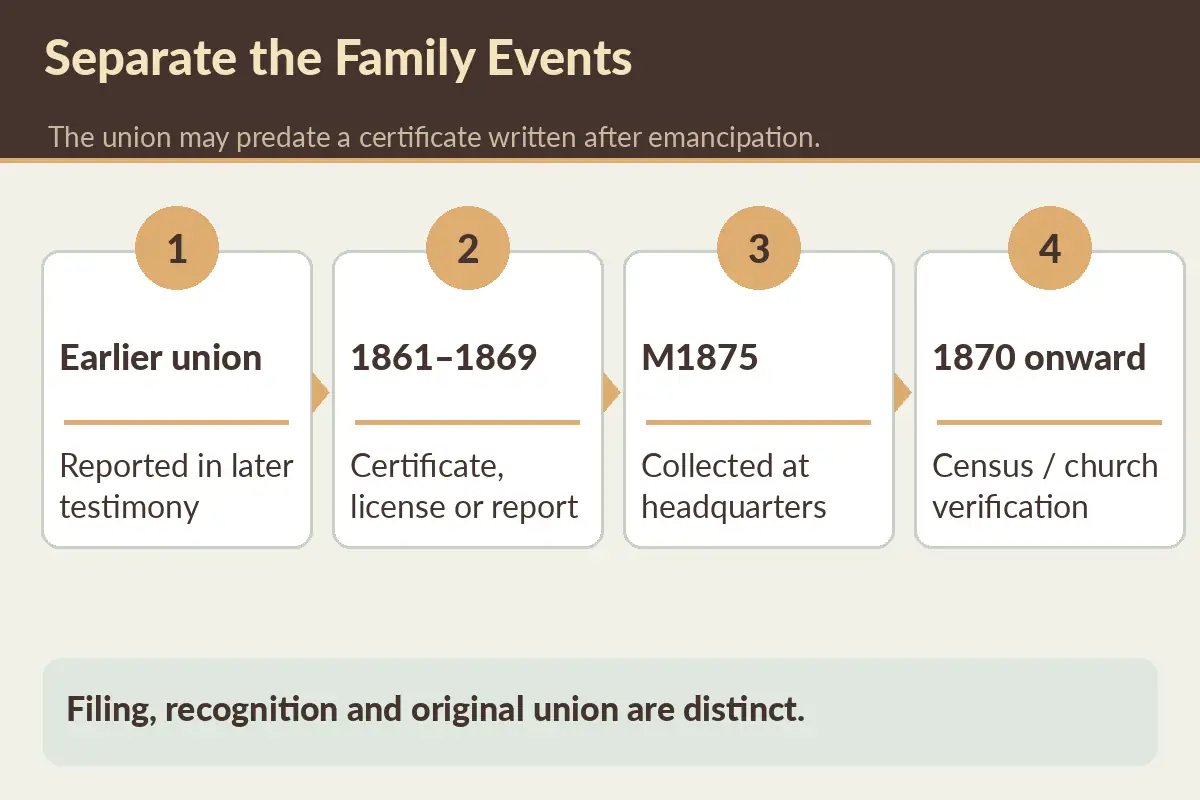
If the couple lived in more than one county, identify the jurisdiction at the date the marriage was documented. A field agent’s office location is not necessarily where the couple first entered the union or had all their children. The 1861–1869 range includes some Army-origin records made before the Bureau began operating in 1865. Keep record creation, central collection and earlier family events distinct. This prevents a headquarters filing date from becoming an invented family milestone.
Connect Children and Former Names With Care
A marriage document may list a spouse’s prior name, children’s names or the length of an earlier union, depending on the form. The writer and the informant may differ, and clerical spellings are not always consistent across records. Create a roster of every named person with the exact relationship phrase from the document. Do not assume all children named were biological children of both spouses unless the record states so and independent evidence supports the claim.
Compare age distributions, residences and household groupings in the 1870 census and any surviving earlier records. A similar surname in the same county is not sufficient to prove a parent-child link across emancipation. If you encounter references to people enslaved by a named individual, distinguish documented record relationships from hypotheses about ancestry. Use respectful terminology and avoid converting reported ownership into proof of parentage. Preserve uncertainty where documents disagree.
State What the Original Marriage Evidence Shows
For each claim, give the original document type, M1875 roll or RG 105 field-office reference, the date it was made, names exactly as written, who appears to have reported the facts, and image or page citation. Separate the union described, the authority’s later recognition and a possible earlier informal marriage ceremony. Also document whether you viewed the image or only a name index. These are not necessarily the same administrative event.
A good conclusion is bounded: the federal record documents the couple’s stated relationship or an officially recorded marriage in a particular place and time. Further claims about all their children, ancestral surnames or exact beginnings of the union require additional documents. Start with NARA’s RG 105 guide, then follow the specific roll and state coverage rather than importing a family legend into the original text.
How We Research Reconstruction Marriages
We start with NARA’s five-roll M1875 arrangement and check the appropriate state and bridegroom-initial section. We identify the source type and who supplied retrospective information, then search separate RG 105 field-office collections for missing local papers. We treat children, former names and union duration as evidence to verify, not automatic proof.
More Records and Archives Guides
Official Archive Descriptions and Reading Access
We checked the original custodians’ descriptions rather than assuming a database provides complete coverage. Primary official guide documents nARA identifies the RG 105 marriage holdings and M1875 central office collection of licenses, reports and other marriage proofs. Supporting archival series description documents nARA’s M1875 pamphlet gives the arrangement by state and bridegroom initial, limited coverage, and diverse record types. Additional historical context documents nARA provides context for retrospective legal recognition, variation among states and central versus field office holdings.
No. Its Washington headquarters holdings vary by state; field-office materials may survive separately.
For the most part by state and then by the initial letter of the bridegroom’s surname.
No. M1875 is cataloged as 1861–1869, but some entries discuss older unions and one unusual certificate has an earlier date.
Not necessarily. It may record later legal recognition of a preexisting relationship.
Only claims actually recorded can be evaluated; corroborate the identity and relationships with independent sources.