
A marriage recorded after emancipation may document a relationship formed many years earlier. During and after the Civil War, federal officers and the Freedmen’s Bureau helped formerly enslaved couples obtain legal recognition for unions that enslavement-era laws had not protected. Surviving certificates and registers can name spouses, children, residences and prior relationships—but forms and coverage differ greatly by office and state. The National Archives warns that these records are fragmentary. This guide shows how to search the relevant series, distinguish a reported earlier union from its later registration, and use sensitive historical testimony without inventing lineage or treating people as merely entries in a database.
Understand why a later certificate can describe an earlier union
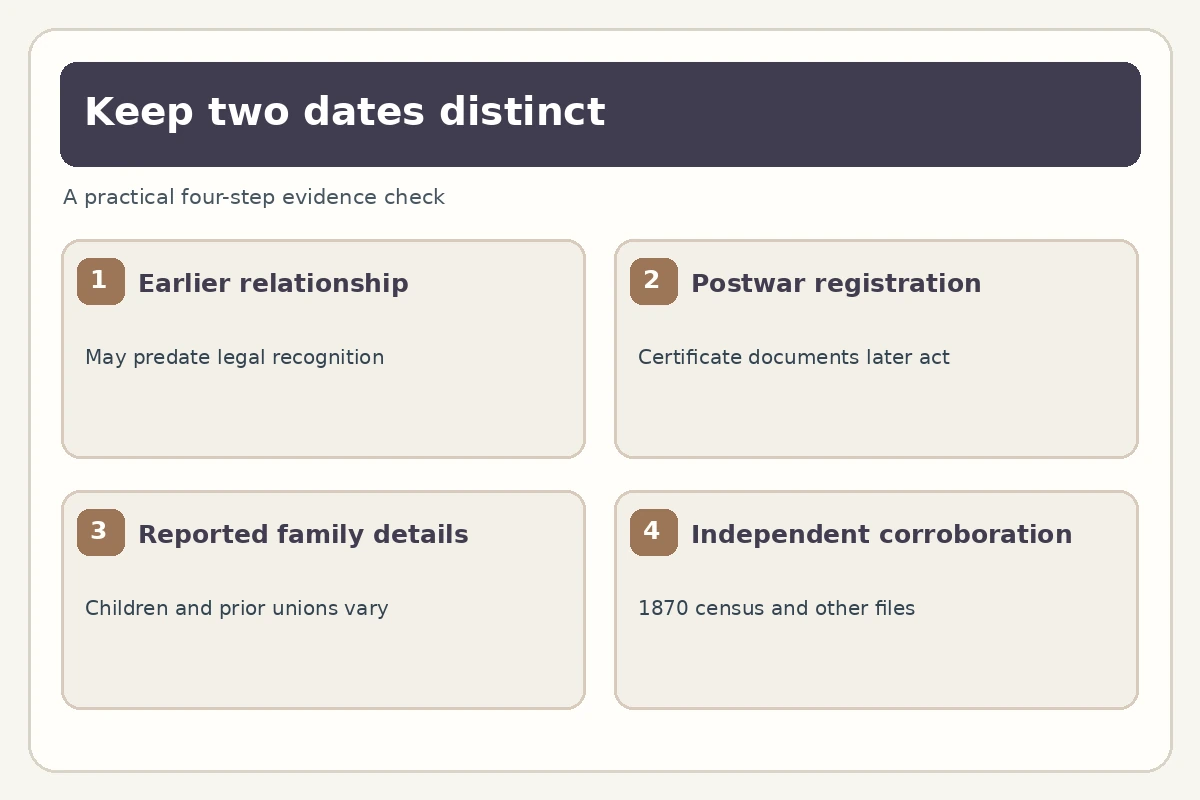
The Bureau of Refugees, Freedmen, and Abandoned Lands was created in 1865 amid the transition from enslavement to freedom. Couples who had regarded themselves as married could previously have been denied legal recognition and could have been forcibly separated. Federal officers and civil or religious authorities sometimes recorded or solemnized marriages to regularize those relationships. A certificate dated 1866 may therefore include a statement that the couple had lived together for years before that date. Record the ceremony, registration and reported relationship dates separately. Do not assume the earliest mentioned date is a modern legal marriage date, and do not describe pre-emancipation partnerships in terms that erase the agency of the people whose relationships were at stake.
Find the right Bureau office and surviving series
NARA describes records created by wartime Union officers and subsequently by field offices and the Bureau’s Washington headquarters. Its marriage series includes certificates, licenses, monthly returns, and other proofs of marriage, but record quantity varies substantially by location. Begin with a couple’s documented postwar residence and nearby county or field office. A marriage may have been recorded in a military camp or another jurisdiction. Examine the NARA series descriptions and FamilySearch collection waypoints to learn what was digitized. An online search hit is a useful index lead, not a guarantee that every county or every marriage appears. Record the state, office, date span and whether you reviewed indexed text or the original images.

Read the whole form before extracting names
Inspect all sides or pages of the certificate or register, including notes in the margins and follow-on entries. Forms may contain current spouses, duration of the relationship, previous partnerships, reasons for separation, or children. But these are not uniform fields across all records. NARA’s historical examples show how some certificates explicitly discuss separation through sale or identify children. Transcribe sensitive language accurately for private analysis while describing the context in respectful modern prose. Do not interpret a reported “former companion” as evidence of divorce, nor use a name in a clerk’s list to invent a parent-child link. State who made each claim and whether a witness, officiant or clerk recorded it. Our guide “Missouri Death Certificates, 1910–1975” covers a related question.
Distinguish household statements from corroborated parentage
A couple’s testimony about living together and raising children is important first-person family evidence, yet a record might not specify biological relationships, exact birth dates or the circumstances of every separation. Make one row per named person with the exact phrase that connects them to others. If a certificate reports children by a previous partner, preserve that distinction instead of placing all children under the current couple in a family-tree program. Where the document is ambiguous, mark the link as unknown. Compare to the 1870 census, later marriage certificates, military files, probate records, and surviving Bureau employment or assistance records. A match in the next census may strengthen identity but does not retroactively make every earlier relationship certain.
Account for fragmented survival without erasing a family
NARA notes that different states kept marriage records in different ways, and its overview emphasizes their fragmentary survival. Historical legal differences, office practices, displacement and later preservation all influence what can now be found. The absence of a couple’s names from a digitized marriage collection does not mean they were unmarried, had no family, or did not attempt to register a union. Search with variants, identify adjacent offices or alternate jurisdictions, and look for records created by wartime chaplains, local courts or county clerks. Explicitly document which series and time period were searched. When describing an unsuccessful search, use “not located in this surviving series” rather than turning an archival gap into a claim about the couple’s lived relationship.
Evaluate names and movement during Reconstruction
Formerly enslaved people might be represented under changing name spellings or differing surname choices. Do not presume a surname identifies a former enslaver or a specific lineage. Search for combinations of spouses’ given names, children, place and an approximate year, then corroborate any candidate using another record. People could have moved after the war to reunite with relatives, pursue work or escape violence, and a single residence field is evidence for one moment rather than a lifelong location. A dated map of county boundaries may help locate the responsible field office. Do not display potentially sensitive personal narratives without considering their historical context and the dignity of individuals named in the documents.
Build a two-date and two-source research worksheet
For each record, write the date of the recorded marriage event or registration beside any earlier union date reported in testimony. Add the office, officiant, named spouses, precisely stated children, past relationships if described, and the exact document identifier. In a second column list an independent source that supports or questions each statement. A family-history narrative should distinguish “the certificate reports a union since 1848” from “the union began in 1848 as established by contemporaneous evidence.” Where only the certificate survives, the reported statement remains valuable and should be attributed, not erased. This worksheet allows a descendant to interpret the file in historical context rather than flattening complex experiences into one undifferentiated marriage date.
Cite the archival record and preserve the human story
A reliable citation includes NARA’s Record Group 105 or the specific cited series, field office or collection, names and date as written, image or document number, and the online provider consulted. If using a FamilySearch transcription, cite the database and, separately, the original image or NARA series description where possible. In the narrative, foreground the individuals, their actions and the record’s actual language. Do not copy sensational details into public profiles when they add nothing to the research question, and do not assume all named descendants are deceased. A careful account can acknowledge forced separation, legal exclusion and subsequent recognition without suggesting that a bureaucratic certificate created the family’s relationship for the first time.

How We Research These Historical Materials
We used NARA’s records overview and two historical studies to distinguish wartime marriage testimony from certificates prepared under postwar legal processes. We also checked the collection description for the types of records that survived and their uneven office-by-office coverage. Descriptions of forced separation reflect the archival historical context, not invented private biographies. The central evidence chart deliberately leaves parentage unknown unless the individual record states the relationship and another source supports it.
More Records and Archives Guides
Official Sources and Collection Descriptions
www.archives.gov source guidance: NARA describes Freedmen’s Bureau and predecessor marriage-record series, record types, and their varied geographic survival.
NARA documents variation by locality in marriage records and the legal context of recognition after emancipation.
www.archives.gov source guidance: NARA illustrates how marriage certificates can include earlier unions, children, and declarations with different dates.
www.familysearch.org source guidance: FamilySearch identifies the digitized marriage-record collection, its constituent series and possible recorded fields.
The artwork is a general historical-research illustration, not a likeness of a formerly enslaved person, a specific union or an archival certificate. We do not use private descendant information and do not claim any federal archive or community organization endorses this guide. The records deserve careful contextual handling beyond a database transcription. Relevant site policies are explained in the GenHis affiliate disclosure.
The relevant wartime and Bureau series span portions of the Civil War and postwar period; coverage differs by office and record type.
Not necessarily. A postwar certificate may legally recognize an earlier relationship that the couple reported had already existed.
Some forms do name or count children, including from previous partnerships, but you must read each original rather than assume uniform fields.
No. Surviving registers are fragmentary and record-keeping varied by state and office.
Include the particular document and date, field office or series, NARA record group or identifier, image location, and provider consulted.