
A date written in a family Bible is a lead whose creation date must be investigated. A family register can preserve a birth that predates the start of official civil registration, and a handwritten margin may connect several generations. Yet a person might have entered all the names many years after the events, possibly from memory or an earlier missing register. The Maryland State Archives recommends checking the Bible’s publication date before treating a line as contemporary. This guide explains how to protect the original, identify layers of handwriting, and move from an intriguing family note to a verifiable genealogical conclusion.
Start with a complete photograph of the original
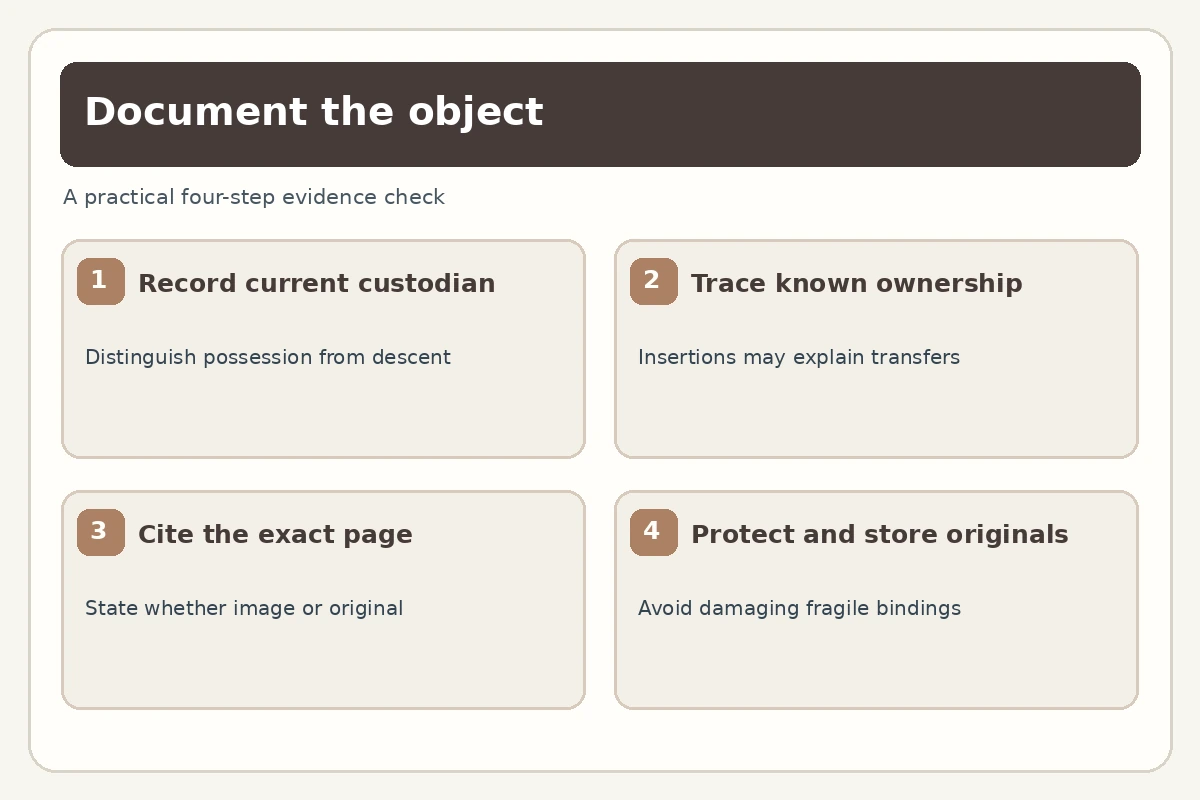
Ask the lawful custodian for photographs of the front and back covers, the publisher’s title page, relevant family-register pages, inserts, and any ownership inscriptions. Do not detach fragile pages or scrub away stains to improve legibility. Photograph a page straight on in diffuse light, then take close details of difficult lines; preserve the first untouched image alongside any enhanced reading copy. A cropped image of “Sarah born 1848” strips away neighboring entries that could show whether a single hand made the whole list. Record who owns or holds the Bible and how that person obtained it. If only a photocopy survives, say so explicitly and seek an earlier original or independently dated transcription.
Compare the printing date to each alleged birth event
Locate the publication or copyright date on the title page; if it is missing, look for the New Testament title page or another bibliographic identification. Maryland State Archives gives the central rule: a birth said to occur before the Bible was printed cannot have been entered into that physical book at the birth itself. Consider a fictional Bible printed in 1871 with births listed for 1839 and 1850. Those entries could preserve true dates, but they are retrospective copies or recollections, not firsthand records made when the children were born. Do not discard them; classify their timing. A later hand copying family data may still point to a lost source that needs to be located. For a related choice, see our guide “Utah Death Certificates”.

Identify different handwriting and ink as clues, not proof
Family pages may have one group of birth entries in compact script, later deaths in larger writing, and an added marriage squeezed between older lines. Note differences in letter forms, spacing, paper, and ink as possible writing episodes, but do not pretend visual similarity can scientifically date an entry to a particular year. A person may change pens or write over several sittings; a later editor may imitate an earlier style. Capture each observation and your uncertainty in a table, including any crossed-out name, correction, or added surname. The objective is to identify which entries may share a reporting occasion, not to assign a confident author without a separate source.
Ask what the register actually says about relationships
A column of births does not necessarily establish that every child listed belongs to the same named parents. Some registers include grandparents, cousins, stepchildren, boarders, or copied notes from a related household. Look for explicit headings, statements such as “our son,” and any marriages linking generations. Keep a transcription faithful to the page before creating a tree assertion. If a name appears twice, resist merging it automatically; families reused given names, and the same surname is not enough to distinguish individuals. Correlate the dates and locations with census households, baptism entries, marriage registers, or estate documents. Record separately: the wording on the page, the relationship it might imply, and the relationship independently demonstrated.
Trace the Bible’s ownership and movement through the family
An object found in one branch can contain entries from another. Ask when it entered the current household, whether it was inherited, bought at auction, or rescued from a house clearance, and whether inserted notes name past owners. A handwritten dedication, bookplate, or dated family photograph may explain why a register of a different surname appears. Treat these details as provenance evidence, not as automatic proof of kinship. The former Archivist of the United States described how a family Bible ended up among Revolutionary War pension evidence, demonstrating that a private book can enter an official file. Try pension, probate, family-paper, and historical-society collections if the original has disappeared.

Read birth entries beside marriages and deaths
Review the register as a whole chronology. A birth year followed by a marriage and death date may help identify which household a later census should show. But a line written as “February 6” without a year is not permission to fill in the nearest year in the column. Note abbreviated months, reused names, and potentially reversed numerals. Compare the dates to independent event records created nearer the event; a baptism entry may support an approximate birth date while not being identical to it. When a contradiction appears, preserve both versions with citations and explain the reliability of each. The chronology is a tool for questioning, not a method of retroactively rewriting the page.
Build a citation that identifies this particular Bible
Cite the Bible’s title and publication details when present, the named family or ownership inscription, exact page or manuscript location, current custodian or repository, the medium consulted, and the date of examination. If the manuscript has no pagination, describe the page by its headings and surrounding entries. Distinguish a photograph of the original from a later typed transcript held by a genealogical society. Consider whether sharing the entire page could expose data about living relatives and restrict what you publish accordingly. Keep both a full-resolution preservation copy and a readable, unaltered transcript with uncertain words placed in brackets. A citation should enable another researcher to identify the same object rather than merely assert that it was “in the family.”
Use the Bible record to guide an independent search
Once a plausible birth is extracted, place it in a hypothesis worksheet with the person’s proposed parents, location, date range, and level of confidence. Use its locality to locate a church register, county courthouse, tax list, or contemporaneous family correspondence. If an official birth certificate does not exist for that era, evidence from multiple different source types can still support an argument, provided their statements are not copied from each other. A later obituary that repeats the Bible exactly may not be independent. Prefer a record created by a separate participant or institution. Where no corroboration is located, label the Bible entry “family tradition recorded in this volume” instead of upgrading it to a documented civil fact.
How We Research These Historical Materials
We built the dated-entry test from Maryland State Archives’ publication-date warning, then checked NARA’s general advice on household material and its account of an actual Bible appearing in a military pension file. The example with an 1871 printing date is explicitly hypothetical; no named historical family’s register was reconstructed. Different ink, ownership inscriptions and source types are treated as clues rather than grounds for certainty. The focus is a defensible transcription and provenance note.
More Records and Archives Guides
Official Sources and Collection Descriptions
guide.msa.maryland.gov source guidance: Maryland State Archives advises checking the Bible publication date and notes that family birth details written before that date must have been copied later.
www.archives.gov source guidance: NARA identifies family Bibles as possible home sources while recommending cross-checks with public and other records.
aotus.blogs.archives.gov source guidance: Former Archivist of the United States describes a family Bible submitted in a military pension claim as documentary relationship evidence.
www.loc.gov source guidance: Library of Congress provides examples of family registers and related family-history documents in its freely reusable collections.
The book and page graphics are original schematics; they are not facsimiles of a specific family’s Bible. Do not share unredacted images containing personal information about living relatives without appropriate permission. The guide recommends gentle photographic documentation rather than intervention in a fragile object. For site-wide relationships, see GenHis’s affiliate disclosure.
Frequently Asked Questions
It may provide valuable evidence when registration was absent, but its reliability depends on when and by whom the entry was made and on corroboration.
An entry describing an event before the book was printed must have been written later or copied from an earlier source.
No. Ink and handwriting variations suggest different writing episodes but cannot alone assign precise dates or authors.
Ask relatives and local societies, then check family-paper collections, probate records and pension files that may include submitted Bible pages.
Describe the Bible edition, family names or inscription, register-page headings, present custodian and whether you examined the original or a copy.