
To search England’s nonconformist birth evidence, identify a likely congregation and date, then distinguish RG 4 chapel or non-parish registers, RG 5 centralized birth certificates and RG 8 registers surrendered in 1857. A baptism is not automatically a civil birth certificate.
Search by Chapel or Registry, Not Only Surname
For an ancestor who attended a church outside the established Church of England, begin with the likely town, chapel, denomination and event date before searching the National Archives’ nonconformist holdings. In RG 4, RG 5 and RG 8, some records describe births and others baptisms, deaths or additional life events. The collections are not one single alphabetical parish register.
The National Archives nonconformist guide explains how historical non-parish records entered government custody. A name index is a pointer toward the register or certificate; examine the record’s own dates and place before connecting it to a pedigree.
Distinguish RG 4 Registers From RG 5 Certificates
RG 4 contains registers of births, baptisms, deaths, burials and some marriages kept outside the ordinary parish system. RG 5 includes birth certificates associated with the Presbyterian, Independent and Baptist Registry and the Wesleyan Methodist Metropolitan Registry; TNA’s selected guide dates that component to 1742–1840.
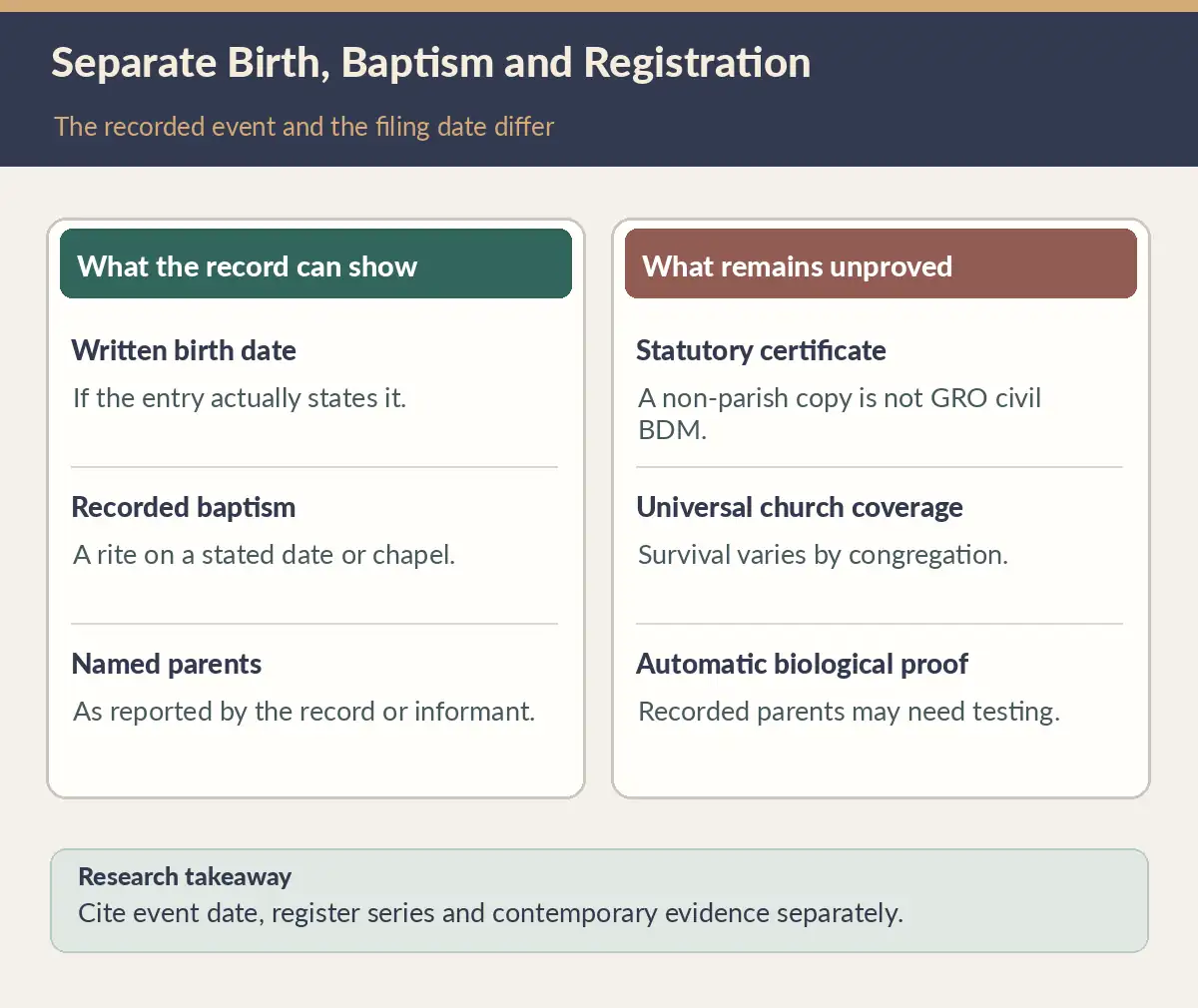
These are distinct administrative forms with different routes of creation and possible informant details. Do not describe every RG 5 entry as a baptism or assume a centralized registry required the event to occur at the same place as the filing office. Record the collection title and certificate or register page rather than relying only on an online transcription.
Recognize What RG 8 and the 1857 Transfer Mean
RG 8 contains non-parochial registers surrendered to the Non Parochial Registers Commission in 1857. The transfer year refers to the custody and selection of register books, not necessarily to the year the people inside them were born or baptized. Earlier nonconformist registers were collected through the General Register Office beginning in 1837 and again in 1857, so documents from multiple centuries can be in these archival collections.
The TNA digital collection guide lists the different series explicitly. Separate event date, transcription date and repository deposit date in the research log.

Learn the Scope Without Assuming Full Coverage
The broader selected nonconformist and non-parish holdings span records beginning in the sixteenth century and reaching the twentieth, but most genealogically common material concerns the eighteenth and early nineteenth centuries. The archive does not hold a universal series for every congregation, and not every denomination maintained the same register formats.
Some Catholic or institutional non-parish records occur alongside Protestant Dissenting material. The word non-parish does not always mean a Protestant dissenter. Check a chapel’s particular catalogue description and surviving years. A missing birth may reflect non-survival, different congregation, inconsistent indexing or a birth that was never entered in that record set.
Search Discovery Using Place and Denomination
The National Archives recommends Discovery catalogue queries using town, county, chapel name or denomination, with series restrictions such as RG 4 and RG 8 when appropriate. Terms including Baptist, Presbyterian, Independent, Congregational, Methodist, Wesleyan, Moravian and Unitarian may help refine a search.
The catalogue description identifies a record group, not necessarily a free name-indexed image. Partner services can offer searching or browsing, sometimes for a fee; check the actual provider and access terms rather than assuming all images are openly available. When an index has an ambiguous name, browse adjacent entries and headings in the underlying volume whenever possible.
Keep Birth and Baptism Dates in Separate Columns
A register may give a birth date, a baptism date, both or only one. A centralized birth declaration is not the same as a chapel baptism, and the date a certificate was recorded may differ again. In an evidence table, label each date according to the words in the original and preserve uncertainties about handwriting.
Do not estimate a birth day from a baptism date and then mark it as a primary birth statement. For example, a hypothetical child baptized in 1810 but reported born in 1809 should have two explicitly separate event rows. Such distinctions make it possible to resolve later census ages without creating a false exact birthday.

Understand the 1837 Civil Registration Boundary
Civil registration of births in England and Wales began on 1 July 1837. A nonconformist record made after that date may complement, rather than replace, an eligible civil registration record. Earlier entries can be valuable where no statutory registration existed, but their reliability depends on the person supplying information, the form’s purpose and when the event was copied.
The official birth, marriage and death guide points researchers toward separate civil indexes and record routes. A non-parish register cannot be labeled an official civil birth certificate just because it is now in a government archive.
Know Why Marriage Searches Need Different Rules
Between 1754 and 1837, most nonconformists in England had to marry through the Church of England for a legally recognized marriage, with important exemptions for Quakers and Jewish communities. Therefore a person whose birth appears in a dissenting chapel register may have an Anglican marriage entry.
RG 6 contains Quaker records, and RG 7 contains irregular or clandestine marriage material with its own authenticity concerns; neither should be silently lumped into RG 4/5/8. Follow the specific event, denomination and law of the period. The presence of parents in a baptism register does not by itself prove their own marriage occurred there.
How We Research the RG Non-Parish Collections
We first establish the likely chapel, place and event period from independently documented family information. We then compare the National Archives’ RG 4, RG 5 and RG 8 descriptions, inspect the exact register or certificate form and transcribe each original date with its proper label. We do not treat the 1837 or 1857 collection transfer as an event date.
We test names and parents against separate parish, civil or household sources and preserve unresolved identities. The method aims to clarify custody and evidence type rather than promise total denomination coverage. Our affiliate disclosure is available to readers.
More Records and Archives Guides
Cite the Series, Congregation and Entry Together
A full citation should identify The National Archives, the exact RG series and piece, the relevant chapel or registry, the entry or certificate number if shown, event date and page or image. Add the database access route separately if an online index led you there.
When distinguishing two same-name children, prioritize explicit parental names, chapel locality, dated birth or baptism statement and outside corroboration rather than a surname match. If a necessary original is not viewable online, follow its catalogue access instructions rather than fabricating missing fields. The strongest result is an accurately identified record with transparent limits, not a conveniently tidy but unsupported family link.
No. RG 4 includes varied non-parish registers, RG 5 centralized birth certificates and RG 8 registers surrendered in 1857.
No. The year refers to the registers’ transfer, while events in them can be much earlier.
No. Transcribe the two dates separately and use only the birth date actually reported by the record.
No. Most nonconformists faced Church of England legal marriage requirements in 1754–1837, with important exceptions.
Check statutory civil registration as a distinct source and compare its details to the chapel or central-registry record.