
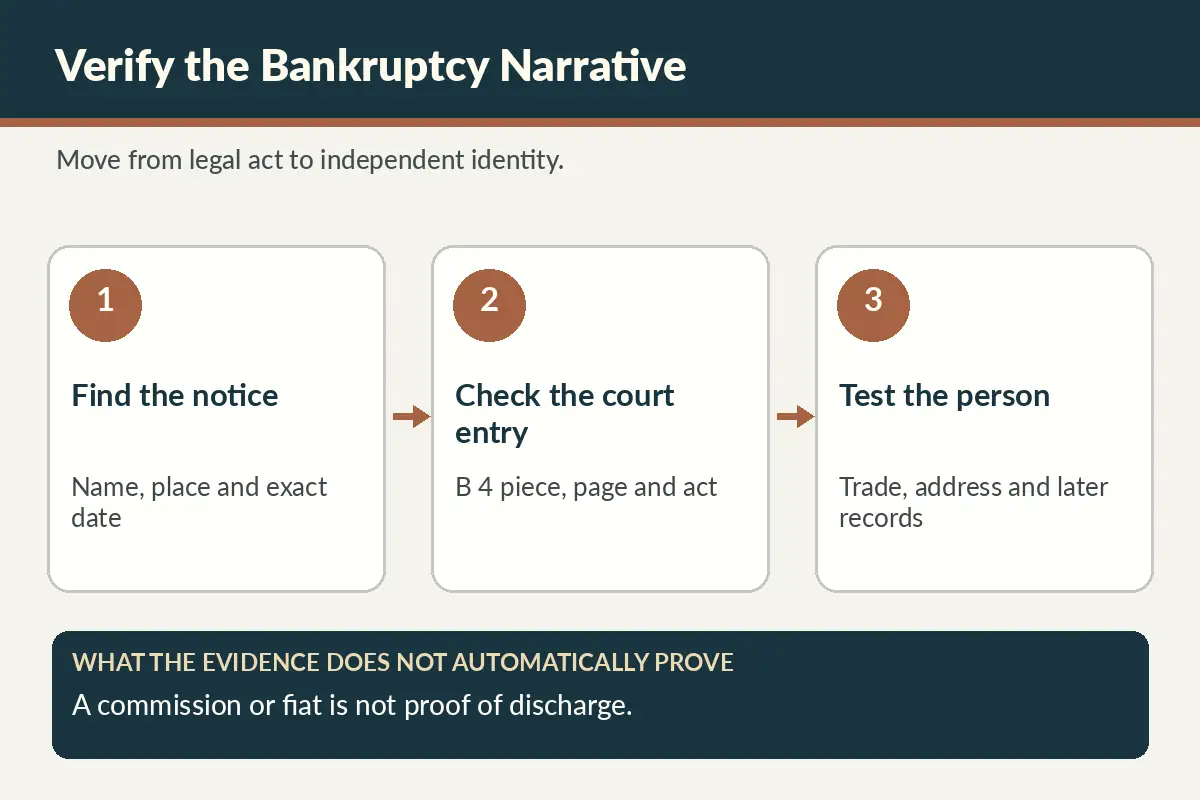
B 4 preserves registers and docket books for historical bankruptcy proceedings. A line can identify a commission or fiat and point toward another file, but it is not a biography of the debtor, a complete inventory, or proof of discharge. Start with a dated Gazette notice or a known trading address; then follow the B 4 entry to any surviving B 3 file and later court or creditor evidence. These are records of a legal process, not a single verdict about character or solvency.
Establish the Bankruptcy Procedure and Date
The first question is which legal procedure produced the entry. The National Archives distinguishes bankruptcy from insolvency: historically bankruptcy was associated with qualifying traders, while imprisonment for debt and petitions by insolvent debtors followed different routes. The word bankrupt in a family story may be a loose description, not an exact reference to the procedure appearing in a court book. Record the documentary language before choosing a series.
Begin a case sheet with the alleged debtor’s name, occupation, trading address, date of the reported event, court district and the source of each claim. An advertisement or newspaper allegation about financial failure does not necessarily establish an issued commission, still less an eventual discharge. Two people trading under the same name may appear in one town at different dates, so check streets, partnerships and occupations rather than relying on a surname alone.
For material earlier than the late nineteenth century, map chronology before searching. The 1832 establishment of the Court of Bankruptcy and later procedural reforms changed record vocabulary. An early commission, a fiat, an adjudication and a discharge are not interchangeable acts. If a dated entry does not match the terminology you expected, investigate the correct period rather than silently translating an old label into a modern one.

Use a Gazette Notice to Locate the B 4 Register
Search The Gazette by name, spelling variation and a suitably narrow date interval. The official Gazette guidance explains that older pages depend on historical scans and that text searches may miss names because of OCR and some undigitized issues. Browse the issue surrounding a known date if a modern text search returns nothing. Keep its issue number, page, published date and the exact wording of the notice.
In B 4, browse the appropriate time-ordered register for the commission or fiat. Some entries provide the address and trade, the petitioning creditors or representatives, and details of renewal. The National Archives notes that addresses and trades are not consistently present for 1770–1797, so an empty field for those years cannot be used as negative evidence against an identity match.
Create a crosswalk with four fields: Gazette lead, B 4 piece and page, legal action actually entered, and the next reference to inspect. Do not treat the date of publication, issue of commission, meeting of creditors and court decision as the same day. When the original entry uses an abbreviation or a clerk’s mark, transcribe it exactly and explain an expansion only if another source supports it.

Follow Docket Marks Without Inventing a Complete File
The National Archives indicates that some B 4 entries marked with an underline or tick suggest a related case file in B 3. That is a useful search lead, not a guarantee that the file survives or contains all papers. Search B 3 by the debtor’s name, address or trade, allowing for variant spellings and for one business to operate under more than one partner name.
A B 3 case file may contain schedules or balance sheets, but descriptions of assets are often general rather than a household inventory. Avoid using a reported estate amount to assign the ownership of every dwelling, workshop tool or family possession. Distinguish assets reported by the debtor, claims filed by creditors and amounts eventually paid; each refers to a different side of the procedure.
For commissions after 1758 and related fiats, consider whether an enrolment in B 5 is relevant. A second copy or enrolment may establish wording when the file is missing, but copies are not independent witnesses to the underlying debt. Record exact references for B 4, B 3 and B 5 separately to prevent one abbreviated index hit from being presented as three confirming accounts.
Separate Bankruptcy, Payment and Discharge Claims
A docket entry may establish that an official step was taken against a trader. It does not by itself prove that the debtor admitted fraud, that all creditors were satisfied or that the person lost every asset. Even when creditors’ names appear, the book does not automatically prove the relationship between a named creditor and the family being researched. Treat trade and location as identity clues rather than verdicts.
The National Archives describes certificates of conformity, later discharge practices and other records relating to the ending of proceedings. To assert discharge, identify a document actually recording that event and the conditions or date attached to it. A creditor payment, a property sale or the absence of later notices is not a substitute. Conversely, missing files after a thorough search do not prove that no proceeding occurred.
For a claimed ancestor, compare the debtor’s trade and address against a contemporary directory, parish register, deed, tax assessment or census where the period permits. If the independent source shows a different occupation or neighborhood, keep rival candidates open. A convincing family connection needs that identity bridge before a financial-history narrative can safely be written.
Record the Search for a Reproducible Result
Use a table headed record searched, search range, result and inference permitted. For each Gazette search note both the terms and the editions checked. For each B 4 volume record the year span and the pages examined. A negative online search can mean OCR failure, an alternative trade name, incomplete digital coverage or genuinely no matching entry; those explanations remain different until more evidence is gathered.
When a case appears to involve a district outside London, check the historical court route. The National Archives explains that district bankruptcy courts operated from 1842 and that local archives may hold the relevant proceedings. The fact that a central file is missing should prompt an archive-location check, not an invented outcome. Use the Discovery “held by” field before ordering or citing a document.
A defensible final sentence names the record and the act: “The B 4 register records a fiat connected with this trader on this date.” It does not say “the ancestor was ruined and discharged” unless separate, dated evidence supports both assertions. Include conflicting spellings and unresolved steps in the family-history footnote rather than hiding them.
More Records and Archives Guides
How We Research Early Bankruptcy Dockets
We use The National Archives’ bankrupts and insolvent debtors guide to distinguish B 4 docket books, B 3 files and B 5 enrolments. The Gazette’s official search instructions establish why an unsuccessful text query is not a complete negative search. These guides identify record types and search methods; they cannot authenticate a particular family claim without inspection of its relevant original entries.
Our checklist requires the debtor’s distinguishing occupation and address, date-specific procedural term, Gazette issue reference, B 4 piece and page, any explicit B 3 or B 5 lead, and an independent identity document. We preserve an “unresolved” status for discharge or payment where no document states it. This article describes evidence handling, not a judgment on any named person.
Authoritative repository guidance used for this article: The National Archives: Bankrupts Insolvent Debtors. The National Archives: 116. Confirm current piece-level access restrictions and ordering routes in Discovery before making a research visit or requesting a copy. The original record—not a search hit or a printed summary—must support every contested detail.
For our editorial and affiliate-policy statement, see the affiliate disclosure. This research plan does not require paid services; archive and document-copy costs depend on the repository and the material requested.
No. It records a step such as a commission or fiat. Discharge requires its own dated legal evidence.
The National Archives notes inconsistent address and trade details for 1770–1797.
No. It may indicate a linked file, but survival and content must be checked separately.
No. OCR errors and missing digitization mean that issue browsing may be needed.
No. Compare contemporary trade, address, dates, and other independently dated sources.