
To trace an ancestor in Canada’s Chinese General Registers, start with the LAC immigration search and follow any Ottawa serial, declaration and certificate numbers into RG76. The eighteen register volumes cover 1885–1949; the wider database contains other records and dates.
Start With the Ottawa Register, Then Follow the Numbers
Library and Archives Canada preserves eighteen Chinese General Registers in RG76-D-2-a, with entries covering 1885–1949. They were maintained by Chinese Immigration headquarters in Ottawa and record people under administrative serial and declaration numbers, roughly following the dates officials reported their arrival.
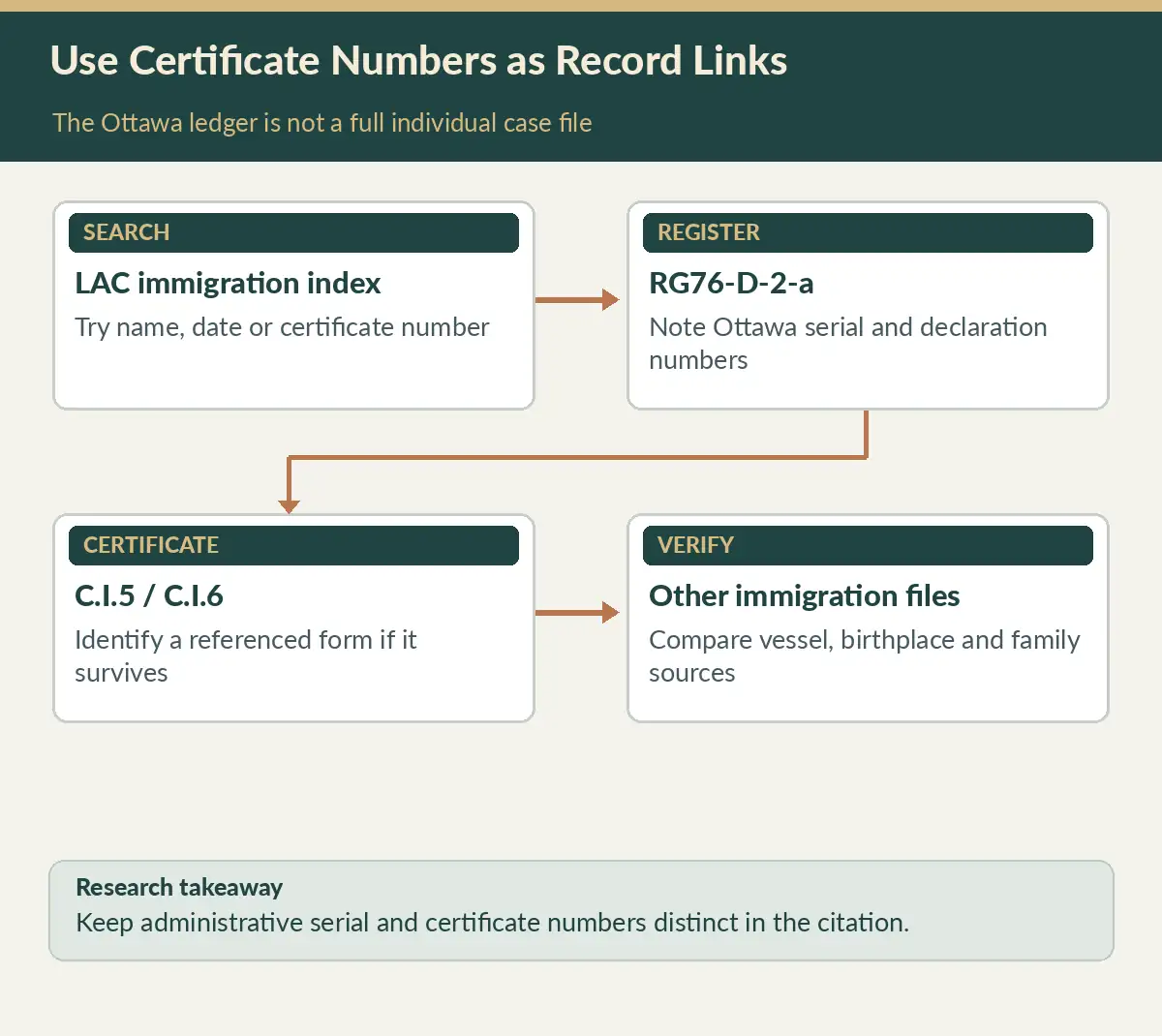
Search the LAC immigration database using a name or known certificate number, then identify the actual register volume and entry. The LAC collection description makes clear that the theoretical scope should not be mistaken for a perfectly complete index of every Chinese person in Canada.
Separate Eighteen Registers From a Larger Collection
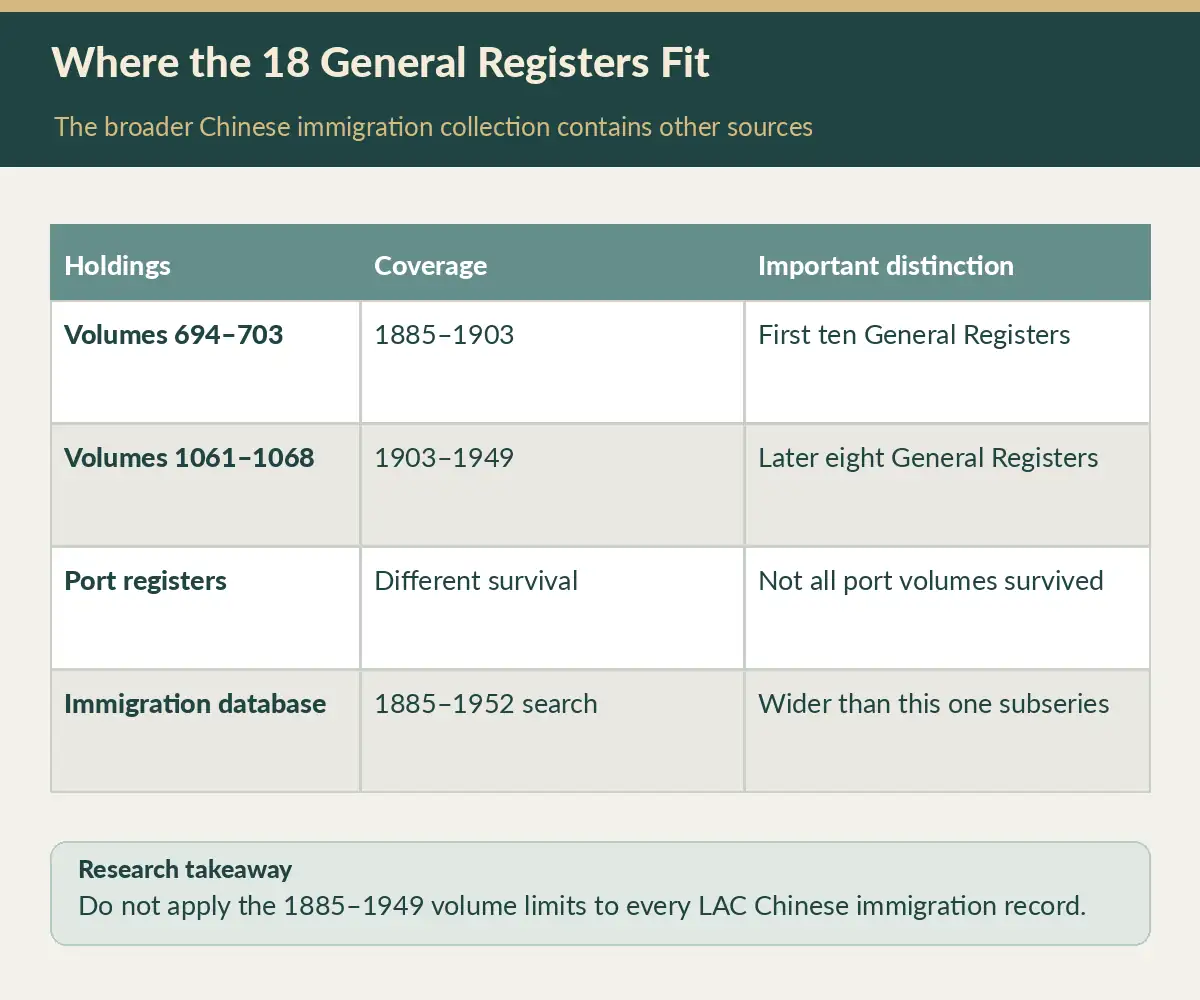
The initial ten General Register volumes are numbered 694–703 and cover 1885–1903, on microfilm reels C-9510 to C-9513. The subsequent eight are volumes 1061–1068, covering 1903–1949, on reels T-3484 to T-3486. These are archival volume groupings, not one alphabetical book arranged by surname.
The broader Chinese immigration series runs beyond this subseries, including port, certificate, outward registration and later case files. The parent collection record identifies those additional types. An absent General Register entry must not be treated as an absence from all immigration records.
Use the Current Immigration Search Interface
The official Library and Archives Canada guide for Immigrants from China, 1885–1952 explains searching by name, date span or a specific certificate number. A certificate number may be more discriminating than romanized spelling, particularly where historical clerks transcribed names inconsistently.
The database includes types of records outside the General Registers and some entries for people born in Canada to Chinese parents. Use the result’s record type to decide whether it points to an Ottawa register, a certificate, a port entry or a different collection. Do not call everything in the database a passenger list.
Capture the Entry’s Personal and Travel Fields
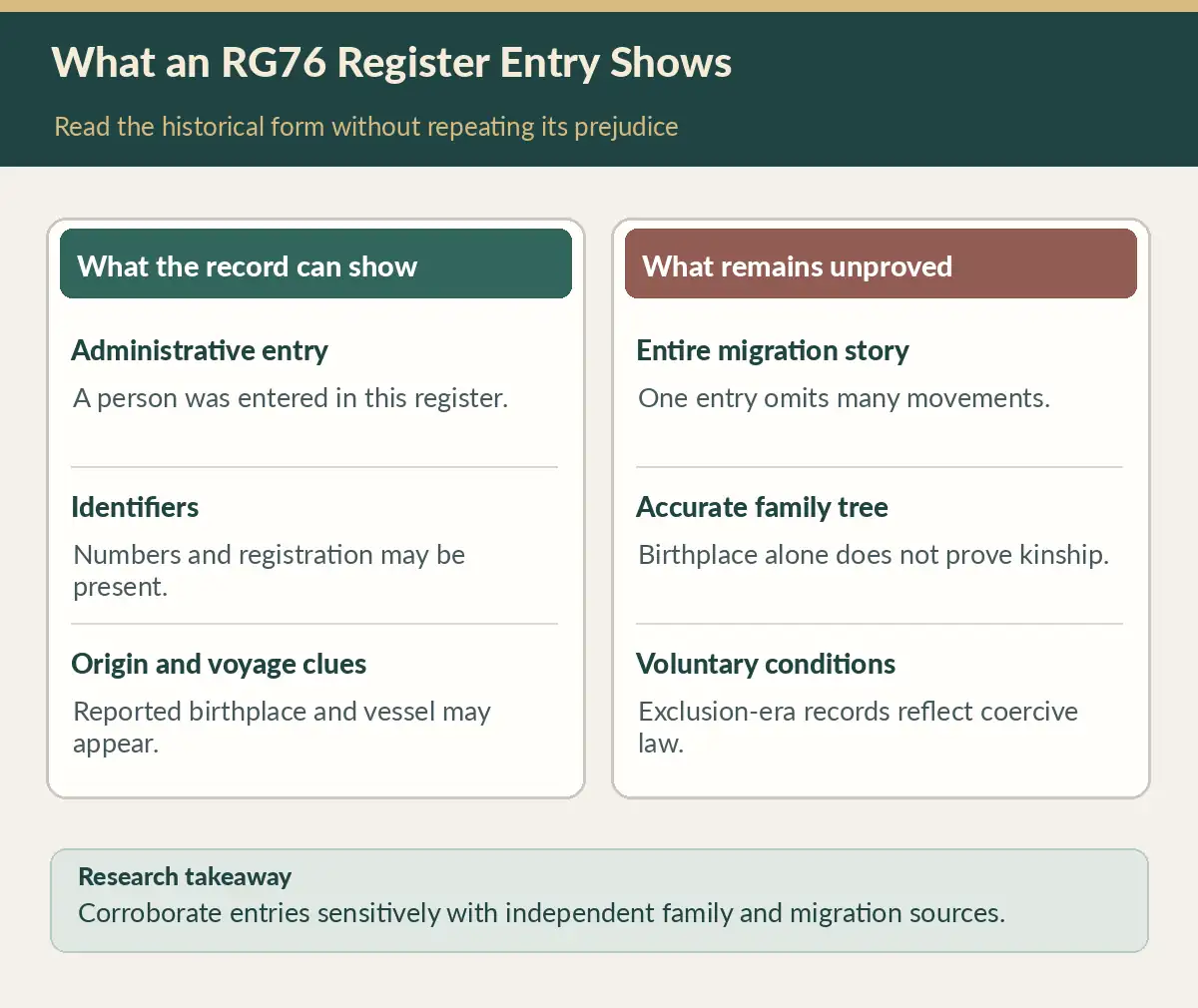
A General Register entry may supply sex, age, occupation, identifying description, last domicile, and a reported city, village and province of birth in China. It can also give port and date of arrival, vessel, registration place and date, head tax amount, and certificate numbers.
These fields can be extremely useful for placing a person within a specific regional migration history, but not every entry is identical. Preserve the historical name spelling and each place element separately, with a note about transliteration uncertainty. A recorded village is a search clue, not a genealogical proof connecting the person to every family of the same surname there.
Distinguish C.I.5, C.I.6, C.I.28 and C.I.36
The Ottawa register description identifies references to several forms, including C.I.5, C.I.6, C.I.28 and C.I.36, along with dates of issue where entered. Copy the form prefix exactly; a bare number without its prefix or context can lead to a false cross-match. The register does not guarantee that the corresponding individual paper certificate survives or is freely accessible.
Search the official LAC database for the specified form and number, then record whether you actually inspected the certificate image or only a cross-reference. Treat administrative identifiers as documentary links between records, not as proof of an uninterrupted residence or a family relationship.
Explain the Discriminatory Law Behind the Paperwork
These records exist within laws specifically aimed at Chinese immigration. The 1885 Chinese Immigration Act imposed discriminatory controls and a head tax; the 1923 Act heavily restricted entry, and the final legislative restrictions were lifted in 1947. LAC explains this context directly in its immigration guide.
The head tax entry is a record of state policy and administration, not evidence of a person’s economic status in an ordinary sense. Use historically accurate terms to describe the forms while keeping the individuals’ own identities central. Avoid presenting the register’s physical descriptions or racialized classification as neutral measures of family membership or social worth.
Check Ports and Outward Journeys Separately
The larger RG76 Chinese immigration series includes a surviving New Westminster port register for 1887–1898 and 1907–1908, as well as outward registration and exemption records for other time spans. The General Registers and port records may cross-reference a person, but a port entry should never be presumed to exist at every Canadian port.
Match on certificate number, recorded name, approximate year, village and vessel, then inspect the separate pages. A General Register arrival date could differ from a notice received in Ottawa. Record each date under its own label rather than forcing an apparently tidy migration chronology that none of the documents actually proves.
Resolve Same-Name Migrants With Several Fields
Suppose two hypothetical people named Wong Lee appear within a few years of one another. A shared romanized name is weak evidence; compare Ottawa serials, C.I. numbers, district or village in China, occupation, vessel and age where each form actually records them.
If an independent family letter names a certificate number, that is a stronger retrieval key than approximate age alone. Do not combine information from both entries into a single biography to fill blanks. If two records disagree about age or origin, preserve the separate transcriptions and investigate why the difference exists before assigning either record to a known ancestor.
How We Research RG76 General Registers
We begin with the official collection description, then use the current LAC immigration interface to locate a typed record and its original register context. We note which of the eighteen volumes was searched and separately record the Ottawa serial, declaration and certificate references.
Each purported arrival is compared to other contemporaneous migration or family evidence, with limitations and exclusion-era administrative context made explicit. We do not equate the full 1885–1952 database scope with the narrower 1885–1949 General Registers. See our affiliate disclosure for editorial transparency.
More Records and Archives Guides
Write the Next-Record Request Without Guessing
A reproducible citation includes Library and Archives Canada, RG76-D-2-a or R1206-165-1-E, the volume, relevant reel if used, Ottawa serial or declaration number, entry page or image and access route. If the desired certificate is unavailable in the immediate record view, seek the corresponding LAC form series rather than inventing an image.
Next choose one targeted independent comparison: a destination directory, a marriage or family document, a passenger arrival, or a surviving port record. Separate what the registrar stated from what descendants or later civil sources reported, and keep unmatched names as hypotheses.
No. The specific eighteen General Registers are dated 1885–1949; the broader LAC immigration database includes records through 1952.
Yes. The official LAC search guide explains certificate-number searching.
Ten earlier Ottawa general volumes cover 1885–1903 and eight later ones cover 1903–1949.
No. It records an individual administrative entry; family relationships need separate evidence.
They were created under discriminatory Chinese immigration laws; a recorded payment documents administration, not identity or kinship proof.