
To use a Chinese jiapu (clan genealogy book), identify your family’s ancestral village and branch before accepting any same-surname lineage. FamilySearch’s Jiapu Search supports searching by surname, ancestral village, ancestral hall, first ancestor and generation name; its online holdings encompass more than 65,000 books. Such compiled histories can preserve generations of kinship claims, but an entry in a clan-wide book is not proof that every modern household with that surname descends through the printed branch.
Collect the Village, Characters and Branch Clues First
Start with family-held documents, inscriptions and oral history, recording who supplied each claim. Write the surname in Chinese characters as well as romanization. Romanized forms can differ by language and dialect, and distinct characters can share a similar transliteration. Record the village, township, county or historic administrative unit as precisely as it appears in old documents. Ask whether relatives know an ancestral hall, a generational-name character or the name of a documented forebear. These pieces distinguish one clan line from another better than a modern English surname alone.
Do not pressure living relatives to disclose sensitive information or upload private family documents without permission. A clan book may omit women, adoptees or certain branches, depending on its time, compiler and purpose. The absence of a person’s name is not proof that the person never belonged to the extended family. Keep an evidence sheet with columns for original wording, interpreter, present location and confidence. If the ancestral village remains unknown, start with immigration records and family papers rather than selecting the first matching book.

Search the FamilySearch Jiapu Collection by Multiple Fields
The FamilySearch search interface specifically permits queries using an ancestral village or hall alongside a surname. Begin with the most specific combination you can substantiate. Then loosen one term at a time when no result appears, rather than dropping all place evidence at once. Some material may require a free sign-in and particular items can have differing access conditions. Save the bibliographic title, place, editor or compiler, edition date and permanent record link for each candidate book.
A surname search can produce many unrelated lineages, including volumes created centuries apart. One volume may cover a region, while another represents a village or named branch. Compare the original Chinese title page and table of contents rather than relying only on an English database description. FamilySearch also offers a broader Chinese research pathway for reading jiapu and finding local village chronicles. A catalog result is a promising container, not a verified link to your family.
Read Generation Names and Branch Structure Correctly
Clan books may include generation sequences, ancestral hall associations and diagrams or prose accounts of descent. A generational-name character can suggest where a person fits within one branch, but it is not a universal identity key: branches can use different sequences, names can be omitted, and naming practices change. Transcribe the original characters of the ancestor’s name and the intervening chain exactly. When reading across editions, mark the compilers’ names and revision dates because a later genealogy may repeat, correct or expand an earlier account.
Use a simple relationship worksheet: printed parent, printed child, generation marker, village, page reference and independent corroboration. The crucial question is not whether two entries share a surname, but whether the source actually depicts a documented relationship between them. If a chart jumps through an unnumbered generation, do not repair the gap from intuition. Translate uncertain characters with notes about alternatives, preserving the photograph or scan of the original page for another reader to review.

Separate Historical Claims from Primary Event Evidence
A jiapu is a compiled source whose genealogies may summarize older information, recollections or records now lost. It is valuable even when the original informants are unknown, but its authority for a specific birth, marriage or migration date depends on the underlying evidence. A twentieth-century edition recalling an eighteenth-century ancestor was created long after the event. Compare the statement with surviving land, ancestral-hall, epitaph, local gazetteer or immigration records when available. Record where corroboration is impossible rather than treating the printed claim as independently proven.
A fictional example illustrates the difference. Two men called Chen Ming appear in two books using related generational characters. If one book belongs to a neighboring village and the other lists a distinct ancestral hall, the shared name does not merge them. Test a documented descendant’s marriage, burial or immigration record for a specific village. If neither printed lineage connects to that person, keep both as candidates. Multiple websites repeating an image of the same book are not independent corroboration.
Use Village Chronicles Without Replacing the Jiapu
FamilySearch’s recommended research pathway includes village and street chronicles after basic jiapu reading. These sources can describe place-name changes, clan settlements and local historical context, but they may omit individual households. They can help resolve whether two place names refer to one locale or to different districts in different periods. Keep a historical place name beside a modern map location, never silently modernize it in a citation. When immigration papers supply only a broad province, a local chronicle cannot identify a village without further family evidence.
Coordinate romanized and character-based searches cautiously. A phonetic spelling in a passenger record may reflect Cantonese, Hokkien, Hakka, Mandarin or another language practice. Search variant forms without automatically treating them as identical characters. A neighboring clan’s occupation of a village does not prove descent from that clan. When translating inscriptions or researching religious and household traditions, seek context from reliable language and local-history resources and clearly label uncertain interpretations.
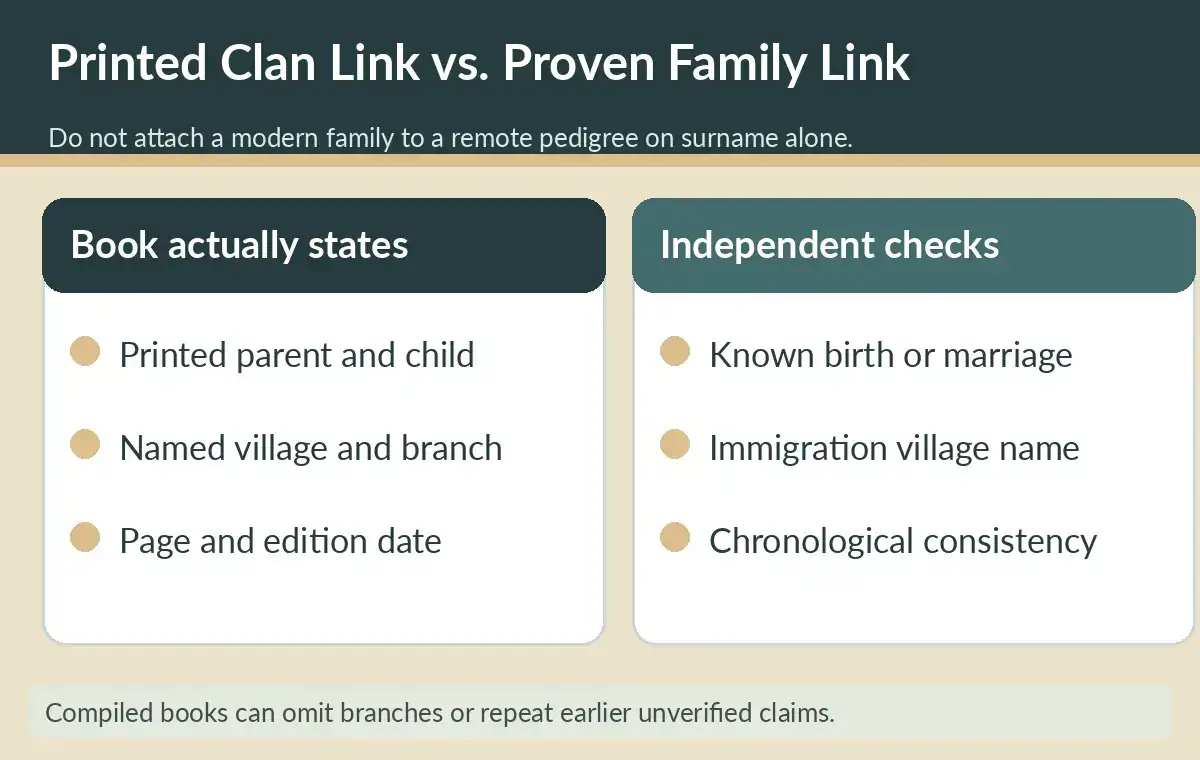
Cite the Edition, Line and Search Limitation
A reproducible jiapu citation records its Chinese title and translated description, compiling branch or clan, ancestral village, compiler when stated, edition date, folio or page, original collection and exact digital image link. Note if a page number is handwritten or supplied by the image viewer. A reader should be able to locate the same parent-child link and test your transcription without relying on a modern online tree. Include the edition’s date because several updates of the same genealogy can disagree.
End with a relationship statement scoped to the evidence: ‘This edition depicts X as the child of Y in the named branch.’ Add the independent source needed to attach your known ancestor to that chain. A missing search result may reflect access restrictions, different characters, a lost volume or an unindexed village, not proof of absence. See our affiliate disclosure; this source route does not imply a commercial partnership with the collections discussed.
More Records and Archives Guides
How We Research This Collection
We compared FamilySearch’s current jiapu search fields with its Chinese research pathway and explanatory guide. The article treats the compiled book as evidence for a documented branch statement, not automatic proof of a living person’s ancestry. Names in examples are fictional.
A compiled Chinese clan genealogy book that may record branches, generations and places.
Yes. FamilySearch Jiapu Search offers village, surname, hall, founding-ancestor and generation-name fields.
No. Match characters, locality, branch and links through known ancestors.
FamilySearch describes free searches with an account; individual access conditions should be checked.
Title, clan or branch, village, edition, page or image, and the holding or digital repository.