
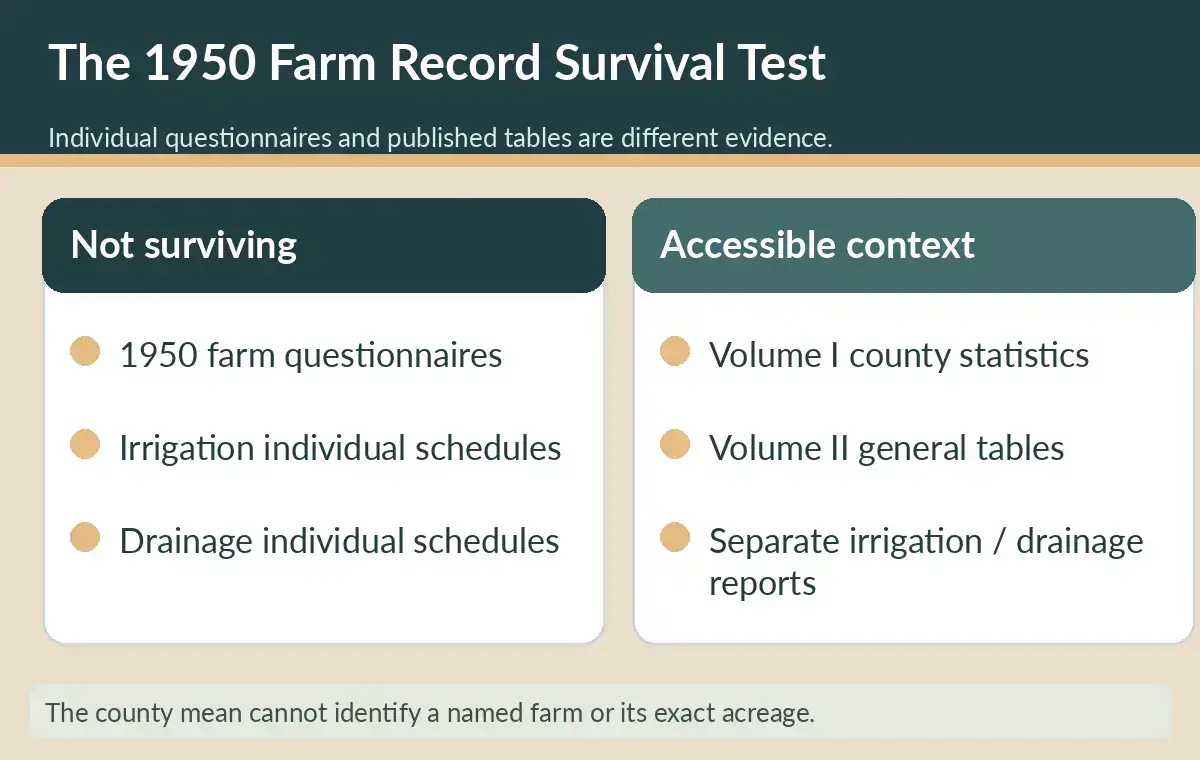
You cannot order a named farmer’s original 1950 U.S. Census of Agriculture questionnaire: the individual agricultural, irrigation, and drainage schedules were destroyed as temporary records. The National Archives confirms this survival limit. What remains is extensive published statistical material. You can use county and state tables to reconstruct the farming environment around an independently identified ancestor, but not to learn an individual’s crop acreage or farm income.
Distinguish the Lost Questionnaires from the Published Volumes
The most important first decision is whether the question requires a named farm or an agricultural trend. An original household or farm questionnaire would connect information to a particular operator; a printed county table summarizes many operations together. NARA identifies the 1950 agricultural schedules as records that were not retained. Consequently a database name search claiming to retrieve every individual 1950 farm return is not a route to an original federal document. Record that limitation before paying for a lookup or treating a modern statistical table as a family document.
The USDA’s 1950 archive organizes published volumes by subject and geography. Its Volume I covers counties and state economic areas. Volume II contains broader general statistics. Census Bureau listings identify separate irrigation and drainage reports. Those publications are primary records for aggregate statistical claims even though they are not primary farm-level interviews. Cite the report title, volume, county, table heading and printed page; do not cite a modern download as though it were a surviving farm schedule.
Start With the County and Then Read Table Definitions
Choose the county in which your subject demonstrably farmed around 1950. A federal population census, deed, tax roll or contemporary agricultural directory can provide a starting location. Go to Volume I and select the relevant state or state grouping. Compare the county heading, table date and units before transcribing figures such as farms counted, farmland acres, operator tenure or livestock totals. County averages are descriptive context; a high county figure does not establish that your own ancestor raised a particular crop or owned a certain machine.
Notice changes in boundaries, reporting categories and table denominators. The number of farms is not necessarily the number of farm families, and the number of acres is not equivalent to land legally owned by resident operators. Read the notes that define commercial farms, tenure and size groupings. Preserve a numerical figure only with its column title and whether it covers the county or a wider state economic area. Avoid converting the 1950 table into an undocumented personal farm valuation.
Compare Agriculture, Irrigation and Drainage Reports
The published report series answers different questions. Agriculture Volume I is the closest source for county comparisons of farms and acreage; Volume II gives larger cross-cutting categories. The Census Bureau’s list distinguishes Volume III on irrigation and Volume IV on drainage. Do not assume that a category present in one volume appears at the same geographic scale in another. For example, an irrigation basin measure cannot be assigned to a specific person by simply matching their township.
Create a short context table with three fields: reported geographic area, measure and limitations. A historical farming narrative can then truthfully say that a county had a certain number of farms in a given category, while separately citing a deed that places a particular household on land. If a statistic is suppressed, rounded or defined only at state level, preserve that restriction. Statistical data improve a family’s historical setting, but they cannot prove an unrecorded individual farm transaction.

Locate Named Farmers in Different Records
Because no individual 1950 agriculture schedule survives, construct a new records route rather than repeatedly searching the same absent collection. The 1950 population schedules can identify residents and reported work. Deed and mortgage indexes can test ownership, whereas property-tax assessments can show a different measure of financial responsibility. County agricultural directories, soil surveys, extension-service reports and newspapers may name farm operators, depending on what exists locally. Their survival and completeness vary considerably.
Suppose a fictional Anna Torres is identified as a farm operator in a county population schedule. The published agriculture report might show the county’s proportions of tenant-operated farms. That does not make Torres a tenant or an owner. Check the legal description in her deed or rental records before assigning the category. If a directory lists another Torres with the same occupation, keep both candidates in separate timelines until age, household, township or independent identity fields establish a match.
Avoid Misreading a Zero Search Result
A missing original schedule is a source-survival problem, not negative evidence about a particular person. It would be incorrect to write that an ancestor ‘was not in the 1950 farm census’ because no individual questionnaire can now be retrieved. The proper conclusion is narrower: the questionnaires were destroyed, so the proposed farm-level observation cannot be checked directly. That fact is materially different from searching a surviving index with several surname variants and receiving no hit.
When a commercial website advertises a 1950 census result, identify whether it refers to the public population schedule, an agricultural statistical volume, or an unrelated postwar directory. One person’s farm occupation appears in a population record, but that does not reconstruct the destroyed agricultural form. Keep a research log listing the repository searched, scope examined, why the required source is unavailable and which alternative record could actually decide the family question.

Document a Reproducible County Context Claim
A useful citation gives the issuing agency, ‘1950 Census of Agriculture,’ volume, state or regional installment, county, table, printed page and repository link. For a surviving family deed give grantor, grantee, date, record book, page, county clerk and image location separately. The two citations perform different evidentiary tasks. If an older report is available only as a scan, compare the printed pagination with the PDF image count so another researcher can find the cited table again.
Finish with a precise sentence: ‘This table describes farm characteristics in the county; it does not identify the family farm.’ Then name the next independent record, such as a dated deed transfer or farm operator listing, that could connect your individual to a property. Readers can review our affiliate disclosure; the recommended government archives are not an implied paid partnership. Preserve the distinction between published statistics, destroyed questionnaires and surviving named local records.
More Records and Archives Guides
How We Research This Collection
We checked the National Archives survival statement against the USDA 1950 AgCensus archive and the Census Bureau publication series. The diagrams separate unpublished individual questionnaires from existing county statistics and independent named-person evidence. The Anna Torres example is fictional.
No. NARA states those original individual schedules were destroyed.
Published 1950 county and state agricultural reports, plus subject volumes on irrigation and drainage.
No. It summarizes farms within a geographic area rather than naming individual operators.
No. Population sheets survive and may give a person’s occupation; the original farm schedules do not.
The 1950 printed volume, county, table, printed page and online repository.