
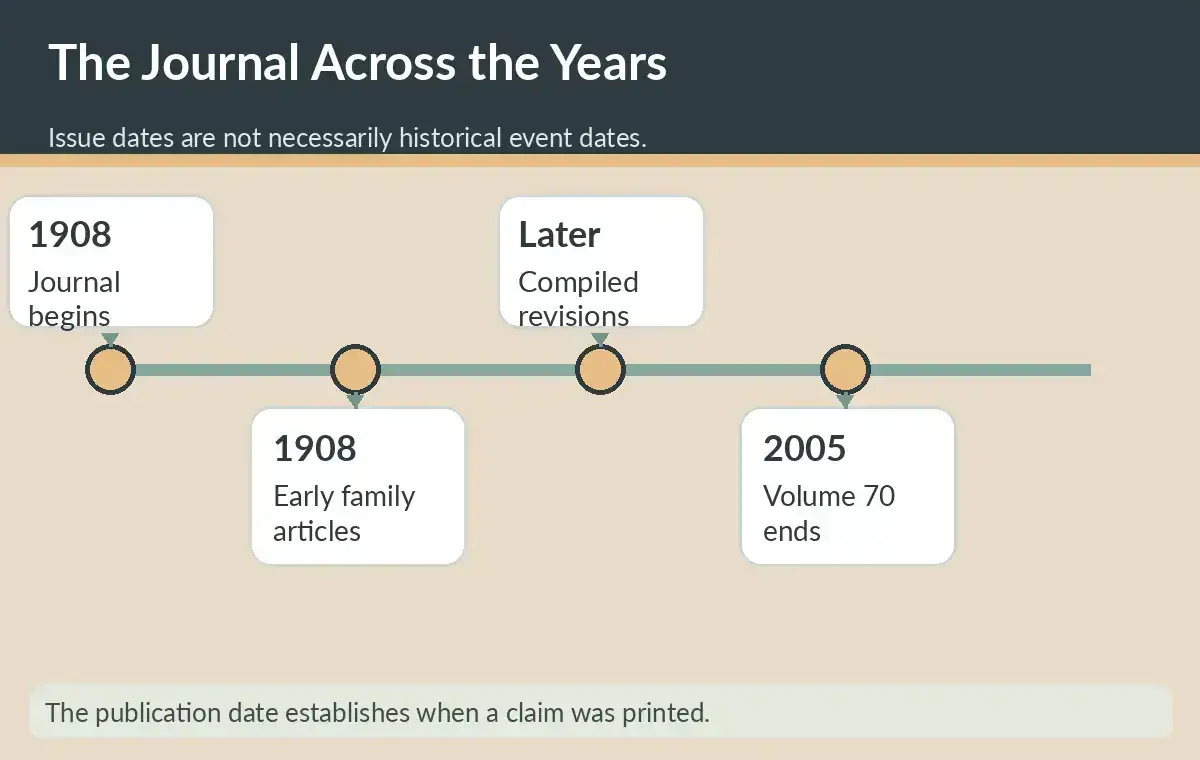
Use the Journal of the Dutch Burgher Union of Ceylon as a published family-history source, not as an automatic substitute for contemporary birth, marriage or burial registers. The journal began in 1908 and reached volume 70 in 2005, according to the University of Pennsylvania’s Online Books Page. Family genealogies appeared among broader historical articles. A sound search identifies the precise volume, issue and page, then tests every claimed parent-child link against independent records where available.
Identify the Correct Journal and Publication Period
The journal belongs to a particular historical community and publication setting in what was then called Ceylon, now Sri Lanka. The title’s colonial wording is part of the original citation, not an instruction to use colonial labels for people today. The American Institute for Sri Lankan Studies explains that all seventy volumes were digitized and that family genealogies were arranged in an index by name. Start by checking the journal’s exact title and the dates of the issue rather than typing a surname into an unsourced family tree.
A volume issued long after an ancestor’s lifetime might reproduce earlier records, incorporate family recollections or present an author’s reconstruction. Its date tells you when the genealogical statement was printed, not necessarily when the event occurred. Record the article author, journal volume, issue, year and page. The Online Books Page links to different archive copies, and it warns that an older publisher website may not remain fully accessible. Do not invent a direct PDF link when the portal offers only a bibliographic entry.
Search a Family Name, Then Find the Specific Issue
Historical journals often contain a surname in multiple contexts: a pedigree, an obituary, a committee list, an advertisement or a short historical note. A family-name index is an entry point, not a proof that every occurrence belongs to one lineage. Search the family spelling and variants, then confirm the article title and actual page in the scanned issue. OCR may miss a letter, diacritic or early typeface. When text search fails, browse tables of contents and chronological issues rather than concluding that no article was published.
The Noolaham listing for a June 1908 issue demonstrates that individual early numbers can be located outside the publisher’s site. That issue includes materials on family founders and historical lists, but a broad list of founders is not the same as a fully documented modern pedigree. Save the stable item citation and image page for each substantive claim. Record whether you saw a scan of an issue or only a modern index entry.
Read Historical Genealogies as Compiled Evidence
A published genealogy may supply exact-looking birth years, marriage links and lengthy lines of descent. Those claims must be evaluated according to when the author wrote, who provided the information and what underlying documents are named. A late editorial correction may reverse an earlier parent assignment; a second article may merely copy the first. For each relationship write the words printed, its volume and page, the event date alleged, and an independent evidence source to test. Never present a family chart as an authenticated civil register simply because it appears in a respected journal.
Suppose a fictional Perera family line in one article mentions a marriage around 1820, while another account gives an alternative spouse. Search an appropriate contemporary register before selecting either claim. If only secondary accounts survive, preserve both conclusions with attribution. The absence of a named female ancestor may reflect editorial conventions or incomplete access rather than absence of a relationship. Keep women’s recorded names, variants and positions legible in your own notes instead of reducing them to an inferred husband’s surname.

Use Parish, Church and Local Sources to Corroborate
The Victor Melder Sri Lanka Library describes its holdings of Dutch Burgher Union journals together with finding aids for Wolvendaal Dutch Reformed Church baptisms and marriages and other historical material. These are possible corroboration routes, not evidence that every specific certificate is available online. A register entry made near a baptism or marriage can help verify the names given decades later in a compiled family article. Different faith traditions, languages and locales may require different archives.
Place history matters. Historical spellings for Colombo, Galle and other settlements can vary, and colonial administrative boundaries may not match present-day ones. Record the event place as originally written, plus a carefully sourced modern location where useful. Distinguish a church register copy from a printed genealogy extract and a later online transcription. If access requires a library inquiry or on-site work, note the limitation; a repository’s holdings description is not a scan of the event itself.
Contextualize Colonial Community Categories Respectfully
The Union and its publications were shaped by historical definitions of community, descent and status. Those criteria were not neutral measurements of individual identity and cannot be used to determine how a living person identifies today. A surname in a colonial genealogical article is evidence of an author’s classification and narrative, not proof of an ethnic or cultural identity. Contemporary social rank, immigration restrictions and selective recording also shaped which families received detailed published attention. Explain these limitations when using the journal for a public family history.
The American Institute for Sri Lankan Studies identifies the journal as both a heritage source and a broader historical periodical. That dual nature is a strength: an article might help contextualize an occupation, institution or migration while still requiring independent proof of a familial link. Do not assert that a family is ‘not Burgher’ because it is not indexed, and do not collapse a diverse community into one European ancestry label. Every conclusion must be tied to a document and its scope.

Record the Volume, Article, Page and Next Test
A reliable citation gives the journal title, author when provided, article heading, volume, issue, publication date, printed page and the exact repository or scan link. Scanned PDFs can have preliminary pages, covers or advertisements, so the PDF image number may not match the journal’s printed pagination. Preserve both when needed. If an OCR index misreads the family name, record your corrected reading as a note without erasing the original transcription. This makes the source retraceable for readers unfamiliar with the collection.
Finish with a narrow claim: ‘The journal’s author recorded this parent-child relationship in volume X,’ rather than declaring the link proven without corroboration. The next step should identify a relevant church, civil, estate or contemporary newspaper source and state what result would challenge the journal. The site’s affiliate disclosure applies; this route through cultural archives does not imply paid relationships with their hosts. Keep the printed genealogy, its date and the independent evidence distinct.
More Records and Archives Guides
How We Research This Collection
We checked the UPenn serial bibliography, AISLS journal overview, Noolaham issue record and Victor Melder Sri Lanka Library holdings. The guide differentiates historic compiled genealogies, digitized issues and independently created event records. The example surname and disputed marriage are fictional.
The bibliographic record lists its run from 1908 through volume 70 in 2005.
Yes. The journal contains indexed family genealogies alongside historical and community articles.
No. Verify the branch and each relationship; a surname index is only a finding aid.
Try the university serial listing, Noolaham issue records or a library holding.
Article author and title, journal, volume, issue, year, printed page and scan location.