
The 1890 Union veterans and widows schedules survive separately from most lost 1890 population returns. NARA microfilm M123 covers surviving localities principally from Kentucky onward, with important gaps. Check the state before searching a name, then use regiment and dates as leads to independent service and pension files.
Check Whether the State’s Veterans Schedules Survived
A failed search for an ancestor in 1890 cannot be interpreted until you check the specific schedule’s survival. According to NARA’s 1890 census guide, the special veterans and widows schedules reproduced as M123 survive for many places, principally Kentucky onward; Kentucky survival is partial. Large portions for Alabama through Kansas do not survive.
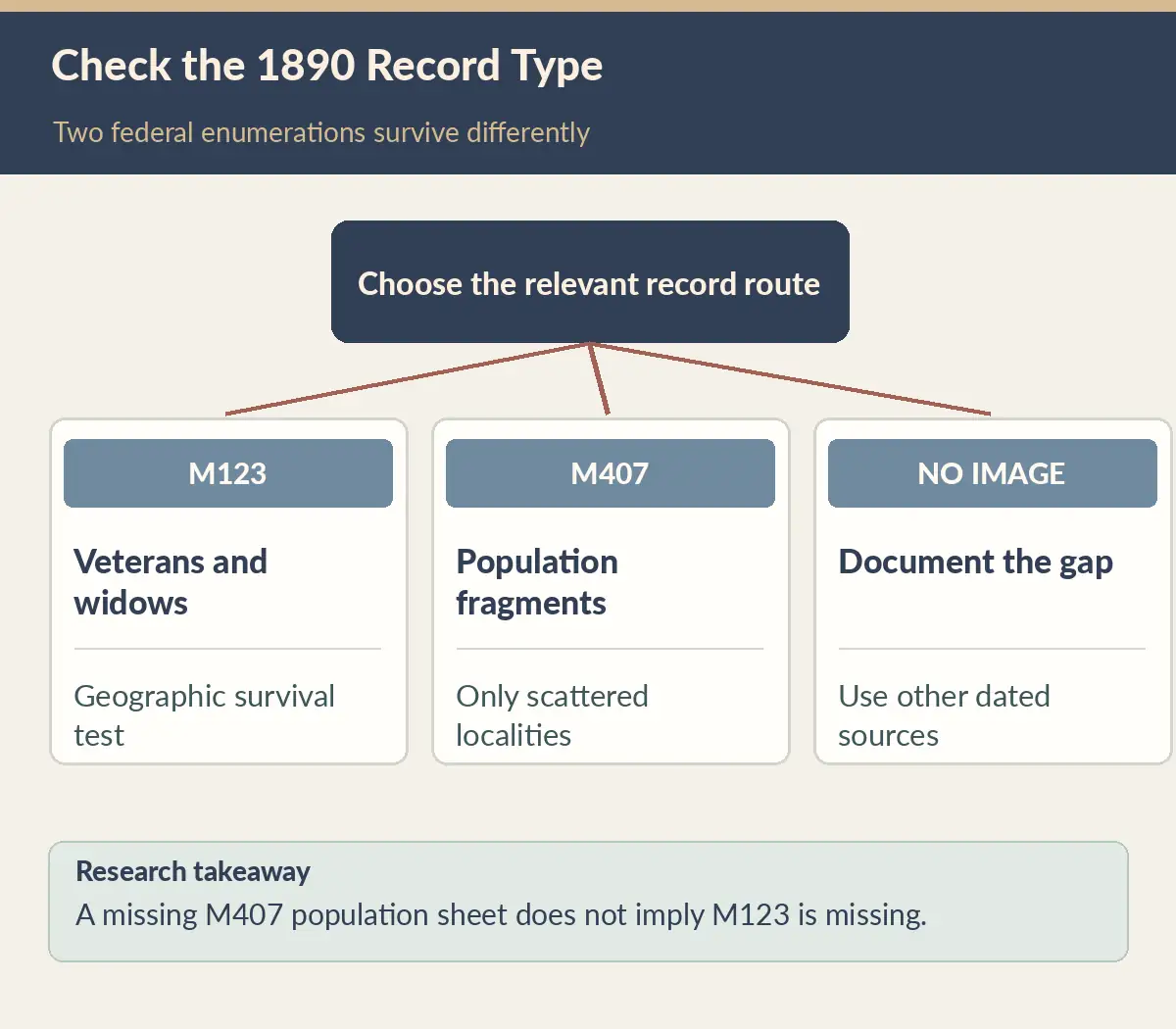
The surviving schedules are separate from a handful of population census fragments on M407. A resident in a missing locality could have served during the Civil War without being present in a surviving M123 image. Identify the 1890 state, county and town before any search.
Know the Exact Purpose of M123
An 1889 congressional act authorized a special enumeration of surviving Union veterans and widows of Union veterans of the Civil War. The schedules may name a veteran, or a widow along with her deceased husband. They were intended to collect information about U.S.
Army, Navy and Marine service during the rebellion. They are not an enumeration of every 1890 household, every Civil War veteran or every pension applicant. Some enumerators nevertheless entered Confederate veterans or individuals who served in earlier wars. Do not assume that everyone named qualified for a federal pension or served on the Union side without testing the original statements.
Read Rank, Company, Regiment, and Service Dates Together
NARA’s M123 catalogue describes a schedule showing veteran name, rank, company, regiment or naval vessel, date of enlistment, date of discharge and computed length of service. It also reports post office address, disability and remarks.
Transcribe a full page with column labels; abbreviation errors can turn one regiment into another. The war-service information was collected for the census and should be treated as reported evidence until confirmed by an independent compiled service record, muster roll or pension file. Keep exact dates as originally entered rather than changing them to fit a family story.
Distinguish a Widow Entry From a Marriage Certificate
A widow’s appearance in an 1890 special schedule is an important family clue, but not a legally complete proof of marriage. The entry can supply her name and the deceased husband’s name, plus his stated military details.
An age, married name and address still need matching to a civil marriage record, earlier census or pension claim. If the schedule includes two similarly named widows in the same county, compare the corresponding regiment and service dates before merging them into one person. Do not conclude that a reported husband died in combat; the veteran may have died long after discharge.
Never Merge M123 With the 1890 Population Fragments
The 1890 general population fragments are reproduced separately as M407; the veterans and widows lists are M123. They are different record types with different subjects and surviving geography. The fact that the main population schedule largely disappeared in the 1921 fire does not mean the M123 material has the same survival pattern or the same chain of custody.
A person can appear in the special schedule where no population image survives. The reverse can also be true. Cite the record series and local enumeration page precisely so later family researchers know which document you actually saw.

Use State, County, and Locality to Recover Missed Names
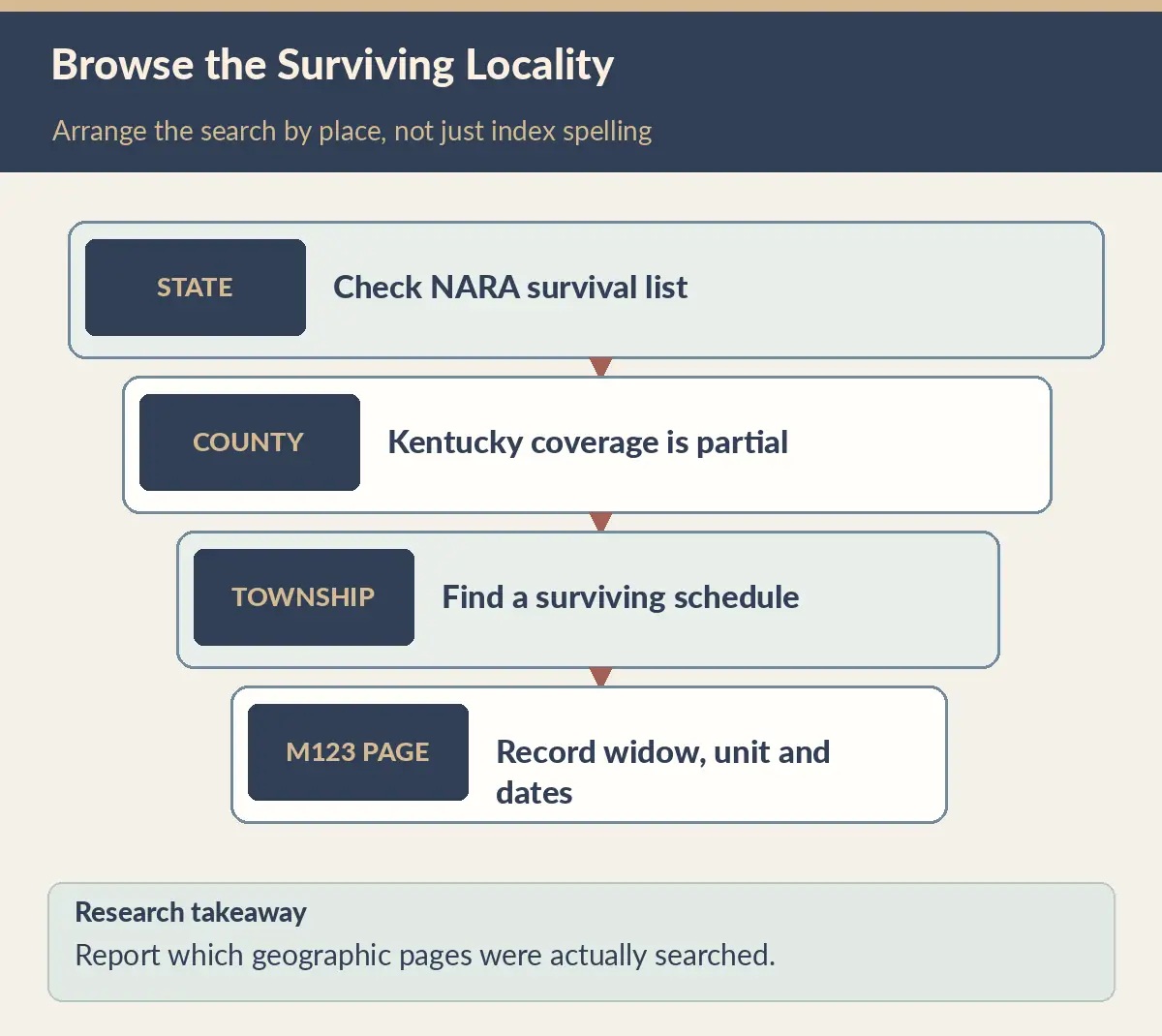
M123 is arranged geographically, generally state to county to locality. A surname-only index can miss misspellings, illegible writing, abbreviated given names or wrongly indexed widows. When a town and family residence are known, browse the appropriate surviving locality rather than accepting a database no-result message.
If the target lived near a county boundary or moved around 1890, inspect the known residence at the enumeration date first, then alternative places supported by real evidence. Keep a log of exact areas and image ranges examined. The claim “absent from this indexed dataset” is weaker than “not found in every surviving page of this locality.”
Compare a Veteran With the Original Military File
Use the regiment, company, rank and enlistment dates from the special schedule to search compiled military service records. A separate pension file may contain sworn affidavits, dependency claims or later address evidence; those are different from enumerator reporting.
Write two rows for each claim: M123 wording and independent military wording. If a unit number or date conflicts, flag the inconsistency and consider transcription errors or a different veteran. A soldier discharged in 1865 might be living in another state in 1890, so residence at enumeration and wartime service geography must never be treated as the same place.
How We Research M123 Against Survival Gaps
We begin with NARA’s state-by-state survival account and the M123 roll description, then identify the precise historical locality. We examine the original schedule where an image is available, preserving the widow name and military fields together. Each service claim is checked against a different military or pension record, with conflicts retained in the research log.
We never describe M123 as a surviving population census page or general list of all residents. The affiliate disclosure sets out editorial and commercial relationships. Absence is interpreted only within an explicitly searched surviving area.
Record a Proper Reference for a Reproducible Search
A sound citation identifies the National Archives, special 1890 schedule of Union veterans and widows, publication M123, state, county, locality, page or roll and the person as spelled on the document. Save the image or its stable provider record identifier. If the county is missing, cite NARA’s survival guide and describe the gap rather than citing a nonexistent roll. An ancestor’s location from an 1880 or 1900 population schedule may help choose where to look in 1890, but a decade-wide guess is not proof that a person resided in the guessed township on census day.
More Records and Archives Guides
Build a Next-Record Plan, Not a Service Myth
The best result is a dated research conclusion: the schedule reports a person of this name, in this locality, with this rank and regiment, and independent records support or challenge the identification. Disability remarks can be historically meaningful but may reflect uncorroborated reporting and should not be converted into a modern medical diagnosis.
For widows, the record may launch a search for a marriage and pension claim without proving entitlement. A service history requires service documentation, not a copied list of the unit’s battles. Preserve uncertain handwriting readings and conflicting dates so other researchers can test your work.
No. M123 is a separate special enumeration, not the largely lost 1890 general population census.
No. Substantial southern and central-state material is missing and Kentucky coverage is partial.
Yes. Enumerators sometimes recorded Confederate veterans despite its intended Union focus.
No. Verify the named husband and relationship through marriage or pension evidence.
It is the National Archives microfilm publication for the special Union veterans and widows schedules.