
For Regular Army enlisted research, select the correct period in NARA M233 before searching a surname. An enlistment record does not prove a full service career.
Search the Enlistment Period Before the Soldier’s Name
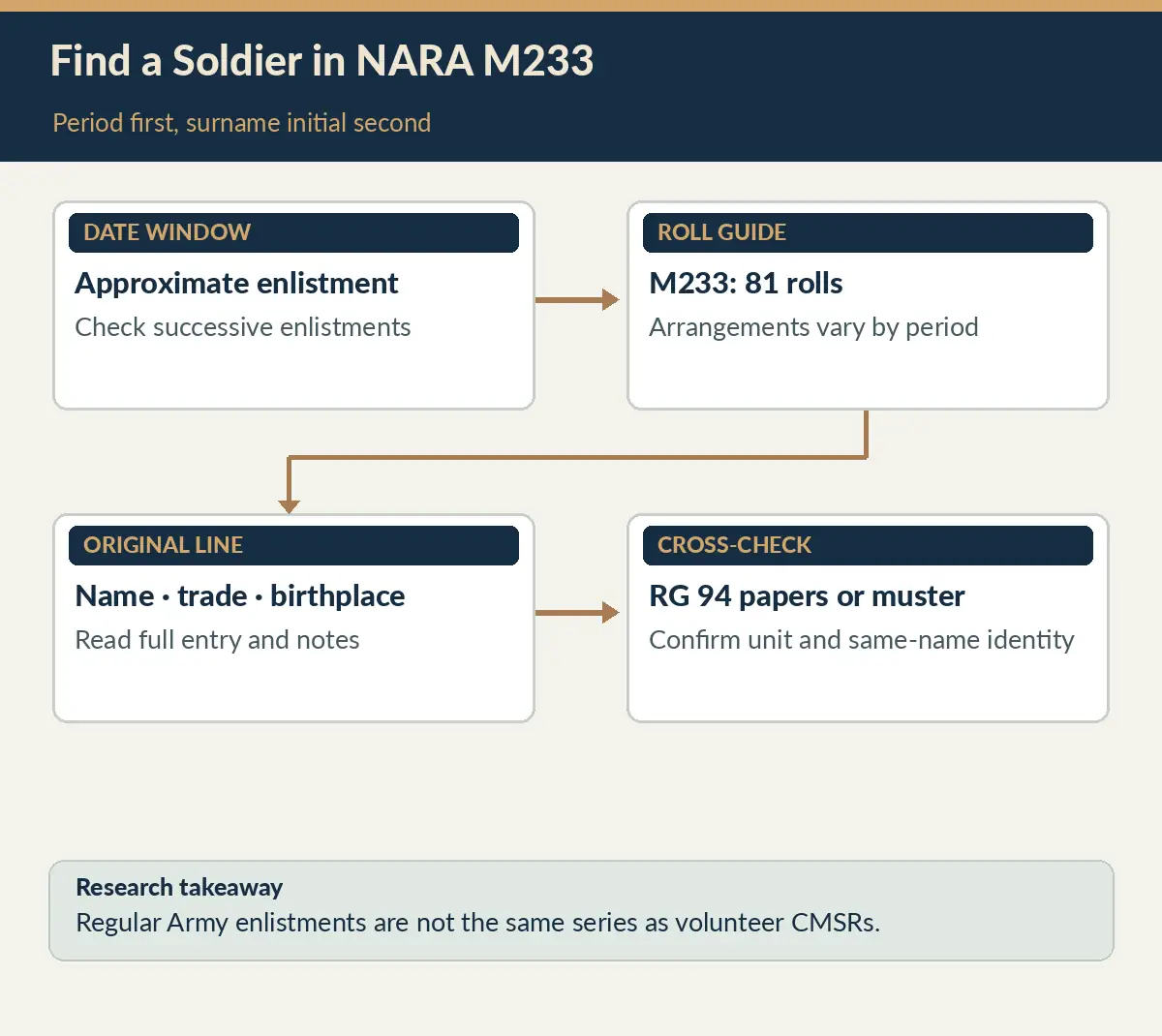
The U.S. Regular Army registers reproduced as NARA microfilm M233 cover enlistments from 1798 through 1914. Start with an approximate year when the person joined, find the appropriate roll range in the official M233 contents list, and then search the surname initial within that period.
M233 is not one uninterrupted national A-to-Z index. If a researcher starts with a surname search and never checks the roll arrangement, a missed entry may look like a nonexistent soldier. Search neighboring years when dates come only from a later pension or family account.
Distinguish Regular Army from Volunteer Service
NARA explains that the War Department did not compile conventional compiled military service records for enlisted soldiers in the Regular Army. M233 registers and original enlistment papers in Record Group 94 serve a different archival function from compiled service records for volunteers raised by states during particular wars.
The NARA enlisted-service reference report describes the register and its role. Before researching, write one question: was this person enlisted in the Regular Army, enrolled with volunteers, or perhaps recorded in militia records? Choosing the wrong military system wastes searches and creates false negatives.
Understand the Eighty-One Microfilm Rolls
M233 comprises 81 microfilm rolls, but the internal organization changes by date. The earliest grouping from 1798 to May 17, 1815 is arranged alphabetically by surname initial within the listed block. Subsequent groups begin May 17, 1815 and June 1821; later runs include chronological spans and special categories.
Use the published roll inventory to confirm each range rather than relying on a simplified chart as a complete substitute. Where two time spans overlap in the guide, check both relevant rolls and record the exact printed coverage. A soldier who enlisted twice may be present in separate date groups.
Transcribe the Full Column Set and Remarks
NARA notes that a register entry can state enlistment date and location, period of enlistment, age, birthplace, occupation, physical characteristics and assigned unit. Not every year uses identical fields, and remarks can document transfers, discharge, death, or references to other records.
Copy the original wording for complexion, place and occupation if these fields matter, without turning historical labels into a modern identity classification. Photograph or accurately cite the page header and year, which can disappear in cropped indexed views. Distinguish the date of enlistment from a reported service termination or muster date. These are different events.
Compare the 1798–1815 and Later Layouts
Early enlistment information sometimes includes the recruiting officer, physical description and later notations about the soldier’s whereabouts, as described in NARA’s military records overview. Later registers may emphasize different columns or organization.
It is dangerous to copy a field interpretation from a nineteenth-century website screenshot onto a different-year image without reviewing its column headings. Build a two-column transcription: actual handwritten wording on one side and a modern explanation on the other. If a page has abbreviated symbols or an uncertain mark, leave that reading unresolved until another entry from the same volume explains it.
Find Earlier or Later Entries for the Same Soldier
An enlistee could reenlist, transfer, be discharged, or appear in multiple units. A repeated name in consecutive years may represent one person or two namesakes. Create one row per enlistment, listing roll, page, date, age, birthplace, trade, physical description, unit and remarks.
If these records point to distinct places of birth or incompatible enlistment dates, do not merge them to create a tidy career. Equally, a change of regiment does not always mean a new enlistment. Seek muster rolls and original enlistment papers before deciding whether the person returned to the Army or was simply assigned elsewhere.

Use a Hypothetical Same-Name Soldier Test
Imagine an indexed “John Martin” in an 1847 entry and another in 1851. The first gives a birthplace in Ohio; the second, one in Ireland. Both are old enough and use a common occupation, so neither should be assigned automatically to your Ohio ancestor. Save two separate citations, assess the original handwriting, and look for an independent census, pension or discharge record giving unit and exact date.
A surname and nearby year are weak discriminators. A combination of unusual trade, approximate age, documented residence, regimental history and continuous service references can produce a stronger identity argument, but conflicting evidence must be shown.
How We Research Regular Army Identity Matches
We begin with the documented period of suspected enlistment and find every plausible M233 roll before consulting an index. We transcribe the entire entry and store the exact roll and page, then compare it against RG 94 enlistment papers or muster rolls as a genuinely separate source.
We do not classify the person as a combat veteran from a recruitment date, and we do not infer disability or pension receipt without a pension file. NARA’s field descriptions guide our transcriptions, while the site’s affiliate disclosure explains editorial relationships. We record which primary images were accessible and which were not.

Handle a Missing Result and Access Restrictions
If a database search fails, try alternate forenames, initials, spelling changes and a broader enlistment date range. Check whether the provider has digitized the roll or merely indexed selected names, and examine the M233 roll inventory before concluding an entry is absent.
If a soldier served only as a state volunteer, the relevant record may not be an M233 entry at all. If your target served after the endpoint of this series, pursue the corresponding later Army personnel system rather than stretching the dates. Log negative searches with roll numbers and the extent actually inspected so a future researcher can repeat or challenge them.
More Records and Archives Guides
Prepare a Reproducible Archival Request
A useful citation names NARA, Record Group 94, M233, the exact roll, year or date range, image or page and the soldier’s original recorded name. If you located an online image through a partner site, include its stable identifier but keep NARA as the source custodian.
When requesting original enlistment papers, supply the name variant, date, location and regiment suggested by the register instead of asking vaguely for all military records of that surname. Limit the conclusion to an observed enrollment or service notation. Service across additional years, engagement in combat and pension eligibility require separate documentation.
No. It chiefly covers Regular Army enlistments, not every volunteer or militia member.
The NARA inventory lists 81 microfilm rolls.
Yes. Reenlistments or separate entries may appear, so compare them rather than merging automatically.
No. A register entry establishes administrative enrollment details, not specific combat.
NARA describes Regular Army enlisted papers in Record Group 94 alongside the registers.