
Search the Argentine census taken May 10, 1895 by person and locality, then inspect the original household image. FamilySearch offers indexed entries and scans of an enumeration preserved by the Archivo General de la Nación; province, department and local district are essential for verifying a common-name match.
Start With One Documented Argentine Location
The second national census of Argentina was taken on May 10, 1895. Search the FamilySearch Argentina 1895 collection using an individual’s name plus the narrowest locality supported by an earlier record. If you know only Buenos Aires, decide whether you mean the city, its surrounding province or a different district.
Search alternative spellings, maternal surnames or omitted middle names only as search variants, not as invented facts. Record the index result and its image reference independently. A database match is not the same thing as finding the right person in the original schedule.
Understand How the Original Census Was Organized
The Archivo General de la Nación retains the 1895 original sheets in volumes organized by administrative units. FamilySearch describes provinces and territories, then departments or partidos and smaller districts; the capital city may be divided into barrios, police sections and city blocks.
Consult the Argentine government account of the census collection for original custodianship and the archival context. An older locality name may differ from today’s map label, and barrios and departments are not interchangeable. When an index is unhelpful, navigate the image browse hierarchy by known place before declaring someone missing.

Read the Spanish Headings on the Actual Image
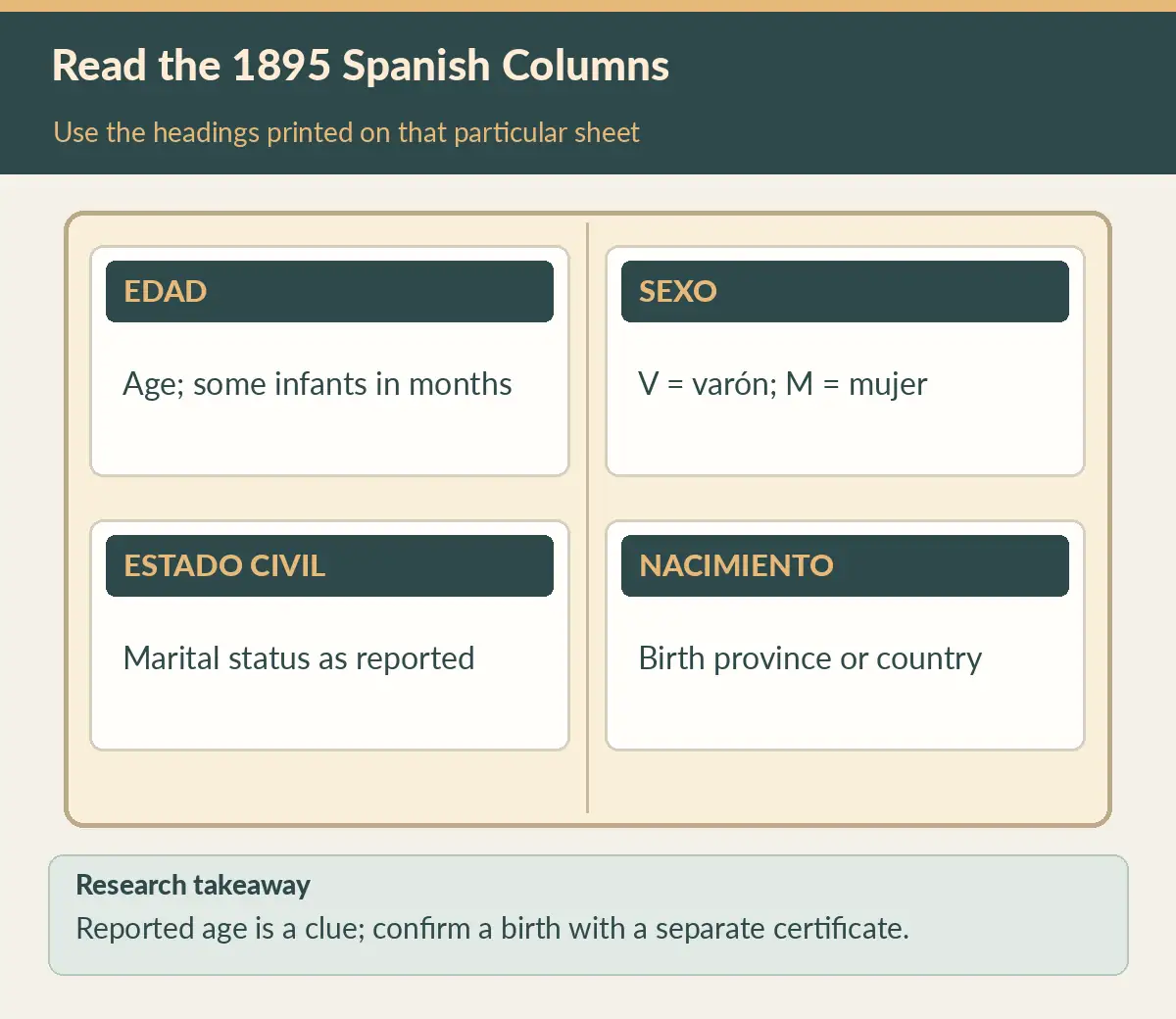
The collection can report names, age, sex, marital status, birthplace and residence. Other fields or categories depend on the page and its original headings. In this period the sex abbreviations can appear as V for varón and M for mujer, so a reader should not import English column abbreviations without checking.
Infants’ ages may appear in months. Copy the recorded form precisely, including unclear diacritics and overwritten figures; place an uncertain reading in brackets in your notes rather than silently replacing it. A census-recorded birthplace is a reported place, not a certified birth entry.
Treat Ages as Calculations, Not Birth Certificates
For an adult said to be 27 on May 10, 1895, the likely birth year is an approximation rather than a confirmed exact date. Depending on whether that year’s birthday had passed, two calendar years may be consistent with the reported age.
If a person’s stated age changes by more than expected across records, consider reporting mistakes, a transcription error or a namesake. For infants, pay attention to the month unit rather than interpreting a single numeral as a number of years. Use a parish baptism or civil birth act before converting the approximate age into an exact birth date.
Separate a Recorded Household From Proven Relations
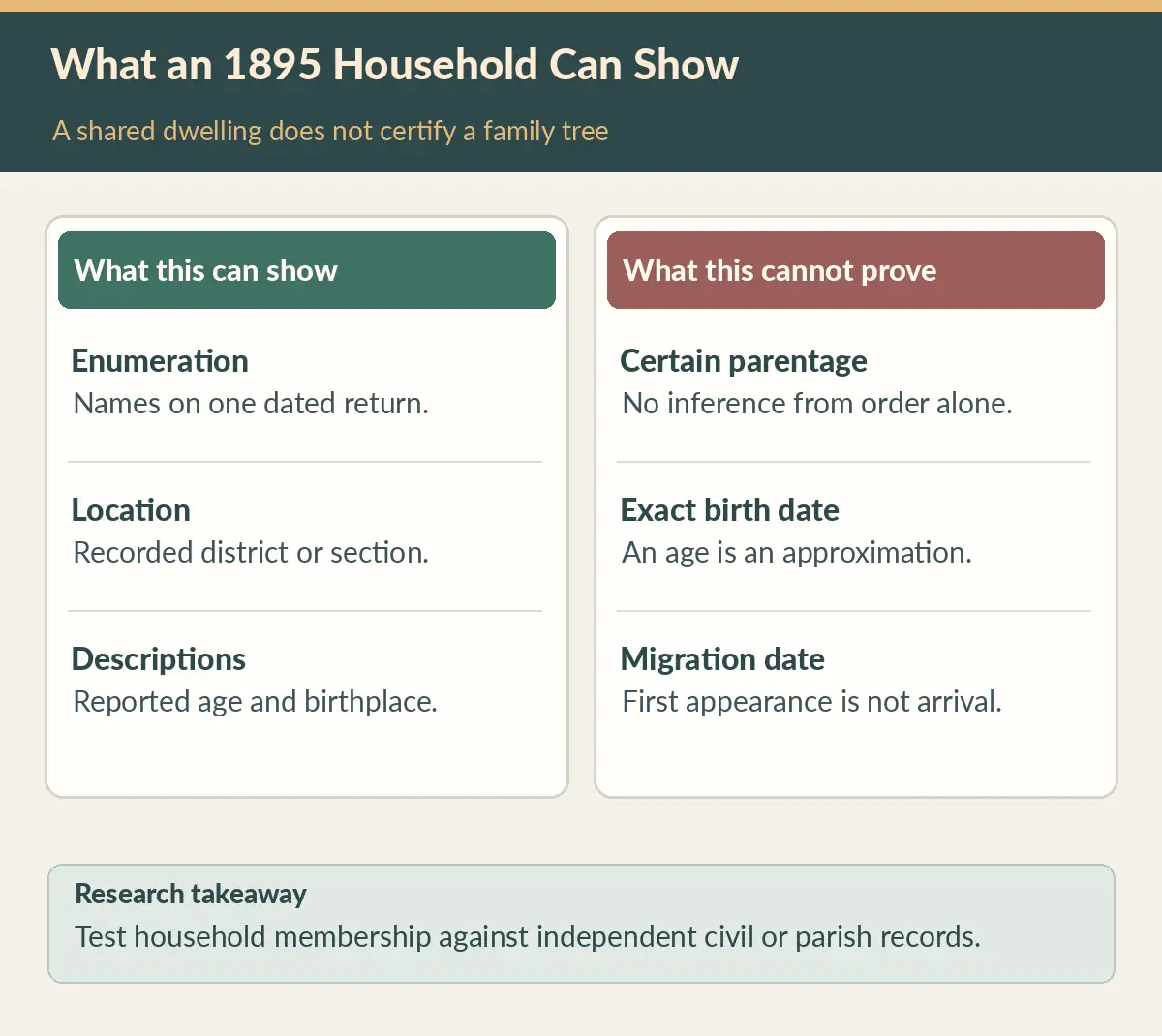
Names on a single page or sharing an address are evidence of enumerated co-residence, not proof of biological parentage or a particular marriage. A man and woman with the same surname may be spouses, siblings or unrelated boarders depending on other documentary evidence.
Build a household table with the person’s recorded name, age, birthplace and relationship information only when an actual printed field provides it. If the schedule lacks a direct relationship field for a candidate, label kinship a hypothesis. Validate links to older generations using vital or parish registers, and record competing explanations when several adults share names.
Use the Capital’s Police Sections Correctly
In Buenos Aires city, the original volumes can be organized by neighborhoods and police sections that also reference block numbers and street names. A present-day neighborhood may encompass an earlier police subdivision or bear a changed name. If you know a nineteenth-century street, work from a contemporary directory or map to a plausible section and inspect neighboring census pages.
Do not confuse the Buenos Aires province with Capital Federal in a collection selector. An index that lists only a city label may be less precise than the handwriting or image waypoint. Record both, and do not manufacture a street number when it is absent.
Compare the 1895 Enumeration With 1869 and Later Sources
The first national Argentine census was conducted in 1869; the second in 1895. A family name repeated across these enumerations may represent the same household’s descendants or entirely different people. Calculate plausible generational intervals and compare documented place, occupation and age before joining records.
A household in 1895 can also be corroborated with a later civil marriage, birth or death certificate, or immigration paperwork where available. The original schedules show the population as enumerated, not every person ever born in a province. Do not claim an immigrant arrived in 1895 simply because that is the first surviving census where they appear.
How We Research the Argentine 1895 Census
We verify the census date and original custodian, search variants conservatively and work from person indexes to the archival page. We capture the full place hierarchy and original Spanish headings, especially when a capital-city police section provides a more exact locator than an index. We distinguish observed co-residence from family relationship, and compare approximate age with an independent civil or church entry.
We document the image’s availability and save its stable reference. The site’s affiliate disclosure explains editorial relationships. We do not substitute a modern place label for a historically documented district without evidence.
Build a Two-Candidate Worksheet for a Common Surname
Imagine two men named José Rodríguez in the same province, one stated to be a 35-year-old Argentine-born farmer and the other a 39-year-old Spanish-born merchant. Your family tree proposes a Spanish-born ancestor. The latter is a plausible lead but may still be the wrong man.
Compare spouse, neighborhood, reported occupation and later civil records, and keep separate image citations. Do not fix an age conflict by rewriting the manuscript. The names in this example are imaginary and demonstrate how a small group of independent attributes tests a plausible match more effectively than a familiar surname.
More Records and Archives Guides
Cite the Volume and Page, Not Only a Web Profile
A useful research citation identifies the 1895 Argentine national census, its province or territory, department or partido, district or city section, original household page, person and the institution holding the originals: Archivo General de la Nación. Add the FamilySearch image identifier and access date for retrievability.
An indexed record should be cited as an index if the image is unavailable or uninspected. If a target is missing, document search spellings, jurisdiction and page ranges checked instead of asserting the family emigrated or died before May 1895. This makes a negative search repeatable.
On May 10, 1895, according to the FamilySearch collection description.
At the Archivo General de la Nación in Argentina.
Yes. Use the collection’s image browsing and available locality waypoints.
No. A reported age or birthplace is not a civil birth certificate.
No. Compare the household with separate marriage, birth or parish evidence.