
The Minnesota Historical Society confirms that Minnesota conducted state censuses in 1865, 1875, 1885, 1895, and 1905. The 1895 return is especially useful between the 1890 and 1900 federal census dates because it records names, occupation, birthplace, and for qualifying adult men, duration of residence in the state and enumeration district. Use the free Minnesota People Records Search to locate a candidate and view the page. Do not convert a duration into an exact arrival date until you have checked who was asked the question and how the column was filled out.
Select the 1895 year rather than another Minnesota census
Minnesota’s state census dates do not match the decennial federal pattern. The Minnesota Historical Society lists the 1895 enumeration between the 1885 and final 1905 state counts. Its 1895 guide states that the relevant residence was in the family on June 1, 1895. A database may default to many years or record classes, so use a year filter after making an initial name search. Copy the exact census year and county before assuming a candidate belongs to this schedule rather than a nearby federal or territorial enumeration. For the fuller picture, see our guide “Minnesota State Census Records”.
Search Minnesota People Records with spelling and county filters
Choose the Census record type in Minnesota People Records Search, then filter by the desired year, a county, and a practical range of name spellings. The Historical Society advises that enumerators could write names phonetically or reduce given names to initials. Try “starts with” and “ends with” searches or a wider county when a narrow query fails. Open the result for a view of its original page, not just the index fields. A free image is available through the state institution; a paid commercial search is not required for the first pass.
Read who actually received the residence-duration questions
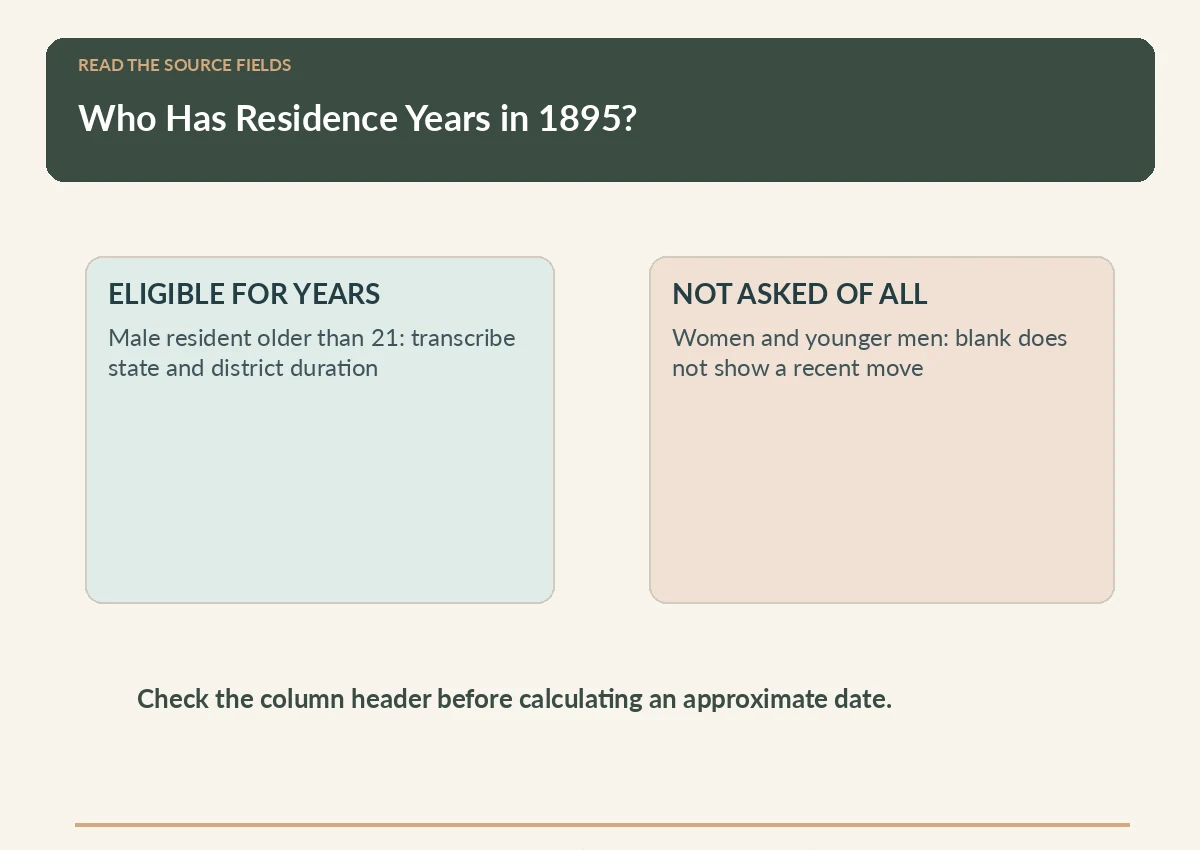
The 1895 question list says that the residence in Minnesota and in the enumeration district, recorded in years and months, was asked for males older than 21. This is a crucial eligibility rule: a blank beside a woman or a younger male is not a lost immigration story or evidence of a recent move. Only interpret that pair of columns for an eligible person with legible values. Even then, months and years are reported quantities that need independent corroboration.

Convert a residence report into a bounded search window
Suppose an eligible resident has a state duration of “8 years, 6 months” on June 1, 1895. That suggests a reported start near late 1886, but not a certified arrival date: counting conventions, enumerator rounding, and temporary moves can change the result. Record the raw years and months exactly, then label your arithmetic as an approximate inference. Compare land, city directory, naturalization or earlier census records within a broad window rather than expecting to find a passenger manifest on an exact calculated day.
Do not confuse a district duration with a state duration
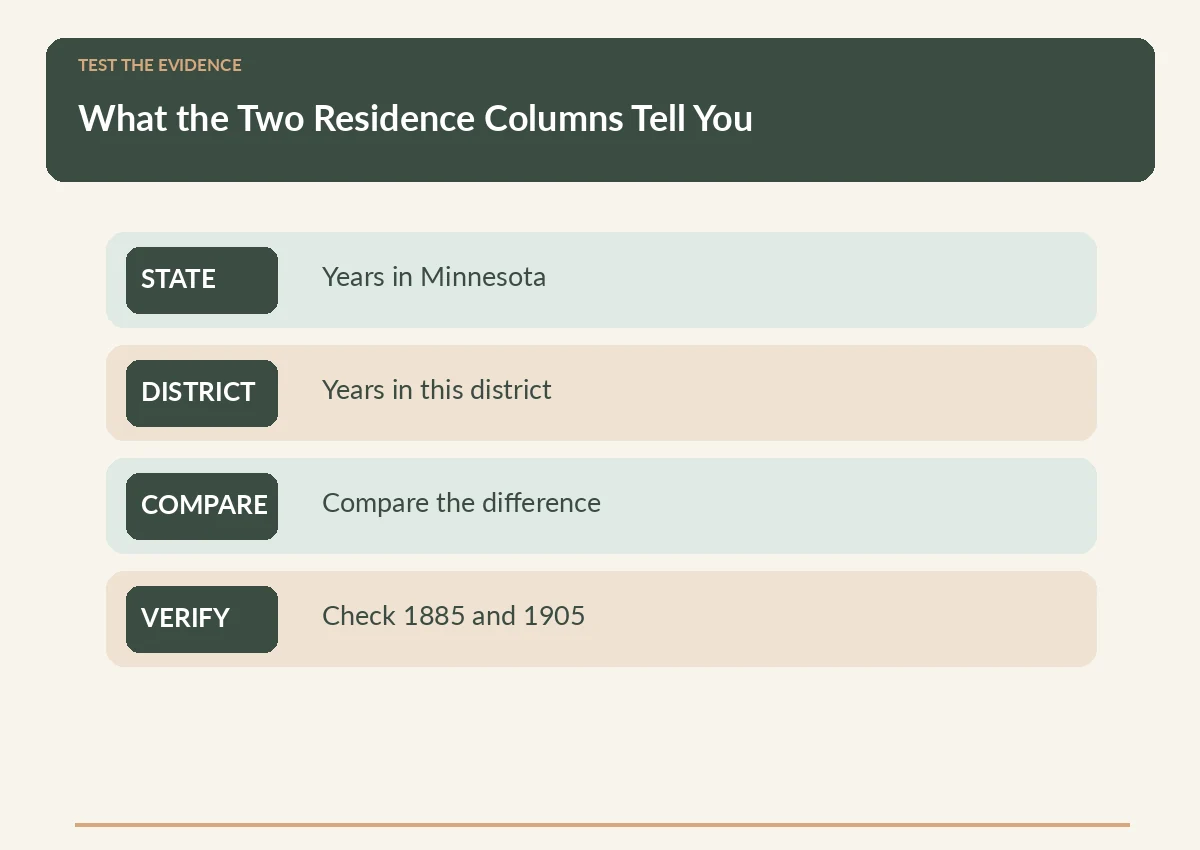
The paired 1895 fields answer different questions. A resident may have spent many years in Minnesota but only a few months in the present enumeration district. That mismatch can support a within-state relocation hypothesis, not prove a specific county of origin or a family breakup. It is also possible for the same person to be counted in another household or appear under a variant surname. Compare 1885 and 1905 schedules, employment descriptions, and a dated directory before linking the changing district to a particular move.
Use the occupation and birthplace fields cautiously
In 1895 the schedule asks for regular occupation, time employed at that work, birthplace, and whether a father or mother was foreign-born. A reported birthplace is a place category, not a named parent; “father of foreign birth” cannot identify the father. The Civil War soldier or sailor column is a clue to seek a pension or service source, not direct proof of regiment or combat experience. Keep the actual wording and values; translating older racial or disability labels into modern identities without explanation can misrepresent what the historical enumerator recorded.
| 1895 entry | Useful inference | Cannot prove |
|---|---|---|
| State duration | Rough period in Minnesota | First physical arrival date |
| District duration | Possible within-state movement | Previous exact address |
| Foreign-born parent mark | Parent birthplace category | Named parent or kinship |
Create a targeted 1885–1895–1905 comparison sheet
The 1885, 1895, and 1905 state censuses offer three candidate snapshots. Their questions are not interchangeable: the 1905 return records its own residence information and parents’ birthplaces. Track each person’s age, location, reported work, birthplace, and household companions. If a surname changes spelling, look for stable associates and dates before merging. A missing 1895 index result might be an OCR or indexing problem; an image-level and county-level search is still needed before asserting that the resident left Minnesota. Our guide “1857 Minnesota Territorial Census” adds more detail on this.
Capture the original image and distinguish transcription from handwriting
Open the manuscript via the MNHS detail page, zoom in, and check the column header above every number. A “1” and a “7” can be hard to distinguish; a total may have been entered in the wrong column. Transcribe the line with its page, district or county, original name spelling, and adjacent household residents. Write your interpretation beside the literal reading, rather than silently replacing the manuscript. If the page contradicts the name index, cite the image and document the error for your research log. For the next step, our guide “Minnesota Death Index, 1904–2001” explains how to find the certificate behind the name.
Prioritize independent records using the reported duration
A promising 1895 clue can direct practical next searches. An occupation can guide a city directory or employment register; a reported state arrival window can guide land and naturalization records; a district duration can suggest a county change worth testing. None alone establishes the exact journey, legal citizenship, relationship to other residents, or a permanent residence. A proof worksheet should have separate columns for “reported in census,” “supported by another record,” and “still unresolved.” That separation is more valuable than calculating a plausible exact arrival day from uncertain data.
More Records and Archives Guides
How We Research the 1895 Minnesota census
We used the Minnesota Historical Society’s year-specific question guide, its state census collection explanation, and the live People Records Search. Our audit checks that duration fields are interpreted only for the age-and-sex group specified by the official guide, and that a result is verified on a manuscript image. We do not identify an ancestor from a surname alone. No paid search provider is endorsed; see the site affiliate disclosure.
Yes. Minnesota Historical Society offers searchable state census records and original images through its People Records Search.
No. The official 1895 question guide specifies those duration entries for males over age 21.
No. It is a reported duration; calculate only an approximate search period and seek independent records.
The Historical Society identifies June 1, 1895 as the household residence reference date.
Yes, but the form’s fields differ, so transcribe and label each year’s questions separately.