
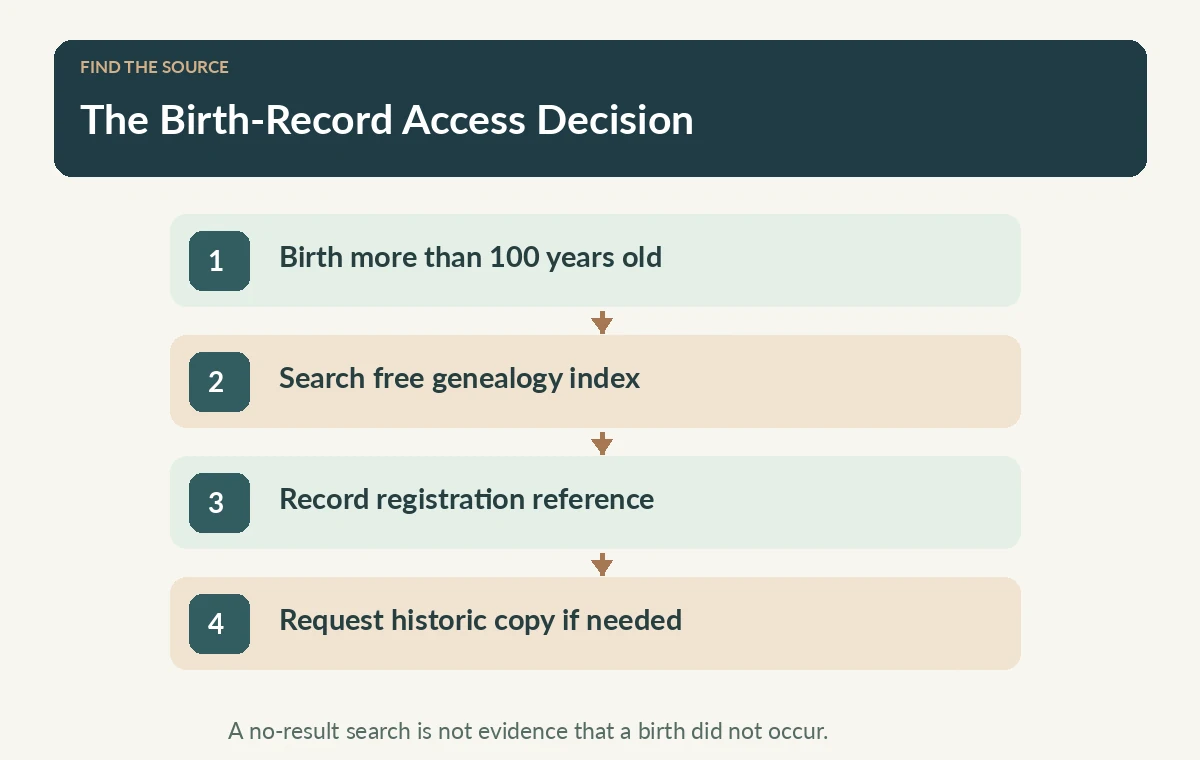
The practical starting point for historic Saskatchewan births is eHealth Saskatchewan’s genealogy service. Its public index is free to search; birth registrations are eligible for genealogical access once they are more than 100 years old, subject to applicable restrictions. A matching result is an index entry about an event, not a complete certificate and not independently established parentage. Keep the registration number and recorded spelling, then consider requesting the genealogical copy when the identity question needs the original details.
Test the historical access threshold before searching
eHealth defines genealogical birth records as births registered in Saskatchewan more than 100 years ago. The critical word is registered: a family story about a birth occurring one year earlier cannot by itself establish when the event was registered. Calculate eligibility cautiously and consult the current government guidance rather than assuming that a birth exactly 100 years old is available. Record the day of your search and the original year you requested. Different rules apply to recent records; this guide does not attempt to work around privacy protections for living people.
Search the free eHealth genealogy index for several spellings
Start with the person’s surname and a plausible year window, then vary given names, initials and spelling. A child recorded with one given name might later use another; a family surname may appear in English, French, or a transliterated form. If a result appears, copy every field shown, including registration number, place, and year where provided. Avoid turning a missing search result into a conclusion that no birth occurred. The historic online index is a finding aid, and indexing can be incomplete, imperfect or unable to capture every early registration.
Differentiate a registration index from a birth registration copy
A name in the searchable genealogy index helps direct a record request. eHealth describes a genealogical copy of a birth record as a copy of the original registration for an event more than 100 years old. It is not the same product as a short-form or long-form modern birth certificate, which serves different purposes. Ask what information the original registration actually recorded for that date and location, rather than expecting every field of a contemporary form. Always cite the exact document type you received. For a related choice, see our guide “Alberta Historical Birth Records”.
Handle the early-registration gap as a coverage problem
Saskatchewan’s political boundaries changed, and communities that are now in the province may have older church, territorial or locally maintained registers. A family recollection of an 1880s birth is not a guarantee that a modern Saskatchewan genealogy search will find an eHealth entry. Search baptism books, church marriage registers, later census pages and local newspapers for the same child. Mark the birth date from a later source as reported, not confirmed. Look for the historical jurisdiction at the event date rather than assuming provincial custody retrospectively. Our guide “Saskatchewan Historical Death Records” goes into more detail.
Use a child-and-parents matching worksheet
Separate the indexed birth name from the parents’ names suggested by family tradition. Match the claimed event against a later census family, a marriage document, and any baptism; note disagreements. A birth index may identify a candidate child but does not link vital events into a ready-made family tree. eHealth specifically warns that birth, marriage and death registrations are individually recorded rather than automatically linked. Therefore, two events sharing a surname and town are not automatically the same family. Preserve alternate hypotheses until direct parental evidence is in hand. Our guide “Manitoba Historical Vital Records” covers a related question.

Request a genealogical copy through the government route
Use the eHealth birth-record guidance to understand the genealogical-copy product and follow the application linked on the genealogy page. The stated fee was $55 when checked for this article, but check the current price and legal eligibility before paying. Supply the most precise known registration reference and requested person. If the office cannot locate the entry or access is restricted, retain the response as evidence of that search, not proof the underlying birth never happened.
| Evidence | Can help establish | Cannot assume |
|---|---|---|
| Genealogy index | An indexed historic registration | A complete parent-child proof |
| Genealogical copy | Information in the original registration | Every detail is accurate |
| Church baptism | A recorded religious event | Exact civil birth registration |
| Later census | Reported household, age, place | An exact birth date |
Do not infer legal identity or parentage from a surname alone
A registration documents an event reported to an official under the practices of the time. It can be powerful evidence about a reported date, place and named parent, but the identity link to your ancestor still depends on cross-record correlation. Compare parental names, their residence and occupations where the document provides them; do not invent fields absent from the copy. If a later marriage supplies a different birth year, quote both dates and explain whether either informant likely knew the facts firsthand. A disagreement is a research lead.
Log negative index searches so they can be repeated
For each unsuccessful attempt, retain the date, the exact index searched, surnames and variants, year boundaries, and the result count. Try surname-only or alternate year windows before declaring no index entry. If the likely date falls outside the historical public access window, stop rather than treating a blocked result as archival loss. For an older event, compare church holdings and census evidence and contact the official office with the details you have. Distinguish access restrictions, missing coverage, misspelling, and genuinely conflicting evidence.

Record the source trail from index to registration
A solid citation identifies eHealth Saskatchewan as keeper, the index title, the recorded person and reference, the date of lookup and the subsequent registration document if obtained. Preserve both: they answer different questions and could disagree. If an index result lacks parents, never quote parental names as though they appeared there. Note whether you saw a certified document, a genealogical copy, an image or a transcript. Keep downloaded documents out of public trees when they involve living people or restricted details.
More Records and Archives Guides
How We Research Saskatchewan birth evidence
We checked the eHealth Saskatchewan genealogy guide and its birth certificate service description for the historical threshold, distinction between free indexes and paid copies, and application limits. We separate a search hit from an independently verified identity and direct readers to the government’s current access instructions. No provider was paid for inclusion; review the site affiliate disclosure.
The eHealth genealogy index is free to search; ordering a genealogical copy of the registration involves a fee.
The official genealogy service describes births registered in Saskatchewan more than 100 years ago as the historical category, subject to legal restrictions.
No. A matching indexed event must be checked against the actual registration and independent records; vital events are not automatically linked.
Do not assume so. The genealogical copy is an archival product with different uses from a modern legal birth certificate.
Record your variants and dates, confirm eligibility, then examine church or later census evidence and ask eHealth about the search scope.