
Most of the 1890 U.S. population census does not survive. That does not mean you should stop at an empty search box, nor that every record labeled ‘1890 census’ is a complete population enumeration. Start by testing whether your target locality survives in National Archives microfilm M407. If not, identify which different 1890 schedules, local enumerations, and contemporaneous documents can answer the narrower question you actually have. The workflow below is a coverage audit, not a promise that every household can be recovered.
Identify which 1890 schedules actually survived
The National Archives explains that most federal population schedules were damaged or lost after the 1921 Commerce Department fire and subsequent administrative decisions. NARA’s surviving population fragments comprise just over 6,160 people from ten states and the District of Columbia; the microfilmed fragments are M407 and their separate name index is M496. Check the specific surviving counties and streets before searching a surname. A missing state or county is a records-coverage problem, not evidence that a person never lived there.
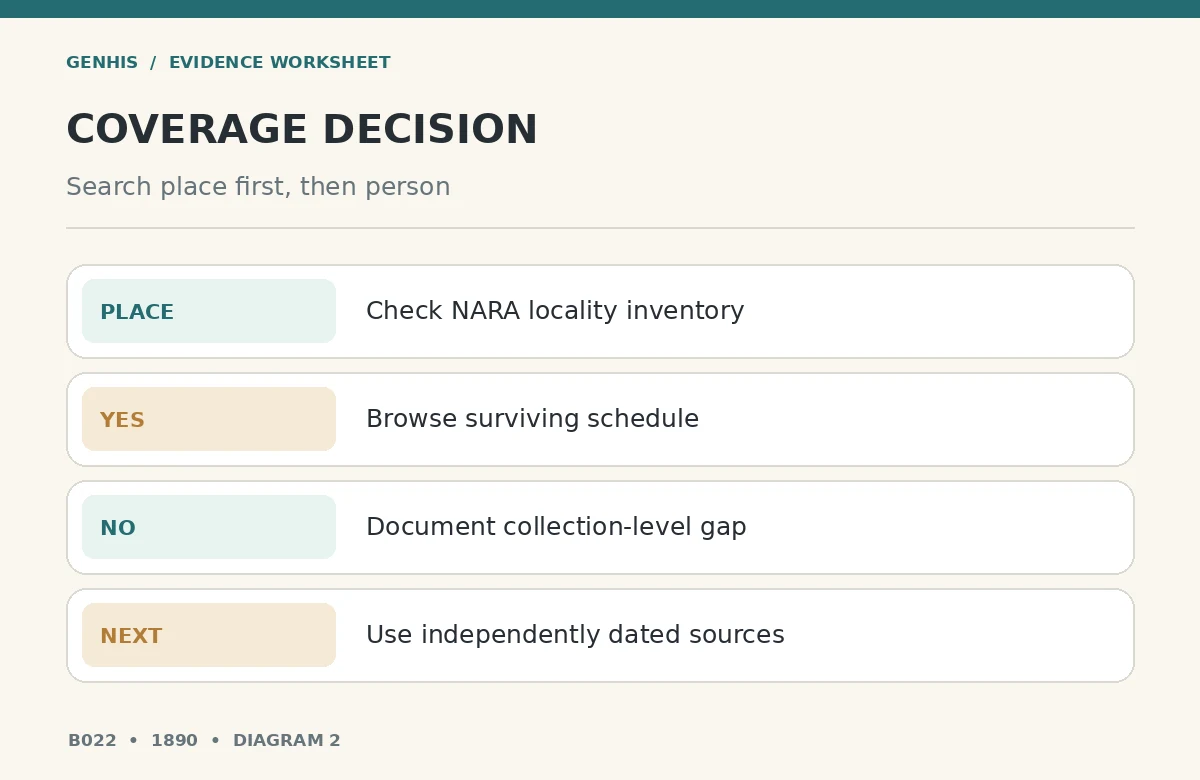
Write your question as a place-and-date test: ‘Was this household enumerated in a surviving 1890 schedule for this particular district?’ Search the M407 locality inventory first. If the precise neighborhood is listed, browse the actual page, not just the name index. If the location is absent from the inventory, document that finding and shift to substitutes. Resist claims that a statewide index must have been lost when a modern platform simply has not indexed an existing fragment.

Use veterans schedules without mislabeling them population lists
NARA microfilm M123 contains special schedules enumerating Union Civil War veterans and widows in 1890, with major coverage gaps. These records may give a veteran’s unit, service dates, post-office address and disability or remarks, but are not general lists of all residents. Although intended for Union service, other veterans may appear; neither inclusion nor absence settles a service claim on its own. Check the state-and-county inventory, particularly the lost schedules for many southern locations, before drawing an inference.
For a possible match, capture the reported soldier’s name, widow if applicable, regiment, dates and full citation, then compare with compiled military service or pension records. A name match is only a lead when multiple soldiers share it. Do not convert a veteran’s residence into an inferred spouse or child relationship; the schedule was designed for a different administrative purpose and frequently contains only the veteran’s service details.
Build a substitute-record ladder for the missing decade
For locations with no population fragment, construct a year-by-year ladder using the 1880 and 1900 federal enumerations, existing state or territorial counts, tax lists, directories, voter rolls where applicable, deeds, newspapers, and church or probate records. The exact sequence depends on whether the person was a city resident, farm owner, laborer, renter, or migrant. State census years vary dramatically, so verify the holding institution before promising a record for 1890 itself. Our guide “Florida State Census” covers a related question.
A useful substitute must answer a defined question. A city directory may establish a listed adult’s address but omit other residents; an estate file may identify heirs at a later date but not 1890 co-residence; a land conveyance can prove a recorded transaction but not continuous occupancy. Place the type of claim next to the source so a reader cannot mistake three different facts for one definitive reconstructed census household.
| Finding | Meaning | Next action |
|---|---|---|
| M407 locality survives | Population fragment can be reviewed | Browse image; cite district and page |
| Only M123 coverage | Special veterans/widows schedule | Check military files; do not assume household |
| No surviving federal image | Collection-level absence, not missing person | Seek state counts, directories, county records |
| Index gives no name | Search result only | Try spelling variants and original pages |
Compare 1880 and 1900 without inventing a household
Create two literal transcriptions, one from 1880 and one from 1900, before connecting people across twenty years. Write the names, ages, birthplace statements, addresses, occupations and recorded household relationships exactly as they appear. Mark each name-change hypothesis or life event that occurred between enumerations as an inference. The loss of the middle census increases uncertainty; it does not justify rounding all ages until the records seem to agree. Our guide “1925 Iowa State Census” covers a related question.
Use independent records dated inside the gap to test the proposed continuity. A marriage register can explain a changed surname; a school admission may show a child in the area; a newspaper death notice may explain a missing person. Each source has its own limitations, and none automatically reproduces the 1890 family composition. Retain multiple candidates if two residents with the same name remain plausible.
Record searches that cannot establish a negative fact
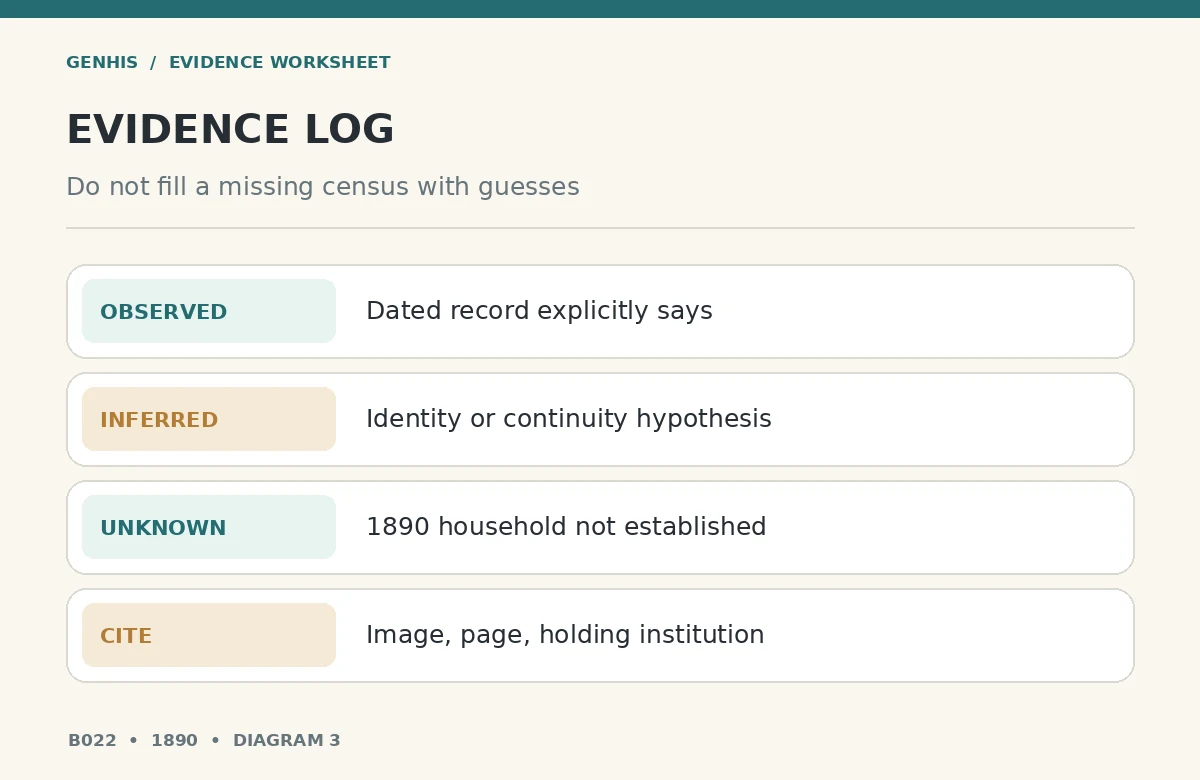
Separate four statuses in your log: no surviving schedule for the place; surviving schedule not yet viewed; original page viewed but person not located; and index search returned no hit. Those are different research outcomes. An absent name in an incomplete online index is not comparable to an absence from a complete surviving district image. Save the repository’s coverage description and date consulted along with each result.
Never claim that an ancestor moved simply because the census is unavailable. If coverage is unknown, label it unknown rather than lost. If a fragment survives, inspect spelling variants and adjacent pages, paying attention to historical ward boundaries. Where no enumeration is held, record a specific next repository and record group rather than adding a fabricated 1890 location to your working tree.
Write a defensible conclusion and a reusable audit table
End with three columns headed ‘Observed,’ ‘Inferred,’ and ‘Not determined.’ For example, a dated directory entry may observe an address and occupation; the proposed identity linking that entry to a family in 1900 is inferred; the entire 1890 household remains undetermined. Include citation elements for each image: repository, collection or microfilm, locality, schedule and page or image identifier when available. This supports later rechecking as collections are digitized.
The article’s practical result is a prioritized request list rather than an imaginary replacement of the destroyed census. Rank the next search by expected information: residence, parent-child connection, military identity, or timing of a migration. Use NARA’s destruction history only to understand the loss; use actual original local records to establish what a particular family did.
How We Research the Record Claims
We audited the specific NARA lists for M407, M496, and M123 and read the Archive’s historical analysis of the federal census loss. The guide therefore distinguishes population-fragment holdings, the veterans’ special schedules, and outside record series. No surviving NARA page was presented as a complete household reconstruction. Illustrative source links are custodian descriptions, not claims of firsthand inspection of a particular family’s 1890 record. Before adopting any residence hypothesis, verify locality survival and reproduce the original schedule citation.
More Records and Archives Guides
Custodian Sources and Practical Disclosure
The coverage references are NARA’s surviving schedule inventory, its administrative account of record loss, and the federal online collection directory. Those are records-custodian guides, not surname searches on behalf of a reader. The page supplies a decision workflow for determining whether a named district survives before pursuing other evidence.
No commercial census product is endorsed here, and the page contains no paid links. GenHis explains affiliate relationships separately. The reader’s next task is to verify an 1890 locality in M407 or document its absence, not to infer names for unrecorded residents. Any proposed bridge from 1880 to 1900 must name its intermediate, independently dated documents.
No. Most population schedules are lost; the National Archives identifies specific surviving fragments and separately preserved schedules.
No. They are special schedules of veterans and widows, with their own purposes and significant geographic gaps.
Possibly in a locality with surviving state records, but verify that the correct county and year were actually preserved.
No. Incomplete coverage, transcription errors and variant spellings must be considered before making a migration claim.
State the observed place and date from each substitute source, explain any inferred identity link, and leave unproven household relationships unknown.