
The 1925 Iowa state census may offer something a federal household page cannot: statements about a resident’s parents, including a mother’s maiden name and the place of the parents’ marriage. The crucial catch is that relevant questions extend across three pages. A search result giving only the person’s name may hide the most useful details. This guide shows how to retrieve, transcribe and test the full set without treating an informant’s statement as an original birth or marriage certificate.
Start with the full 1925 three-page census set
FamilySearch’s 1925 Iowa State Census guide provides an indexed, image-based collection and explains that its questions extend across three pages. These pages are connected parts of an enumeration rather than three independent sources. When an online hit looks relevant, browse the neighboring page images or the site’s linked sequence to locate the corresponding person across the full form. Do not stop after reading the first screen or assume a missing index field means the original document lacks it.
Before extracting parent information, write the precise residence, person’s name as recorded, age or year, and the identifying sequence available in the image. Check headings on all three pages so you do not shift an adjacent resident’s parent details onto your target. Pencil, ink, damage and taped repairs may make columns hard to read; if you cannot distinguish an entry, mark it illegible rather than replacing it with a familiar family-tree spelling.

Transcribe both parents before interpreting names
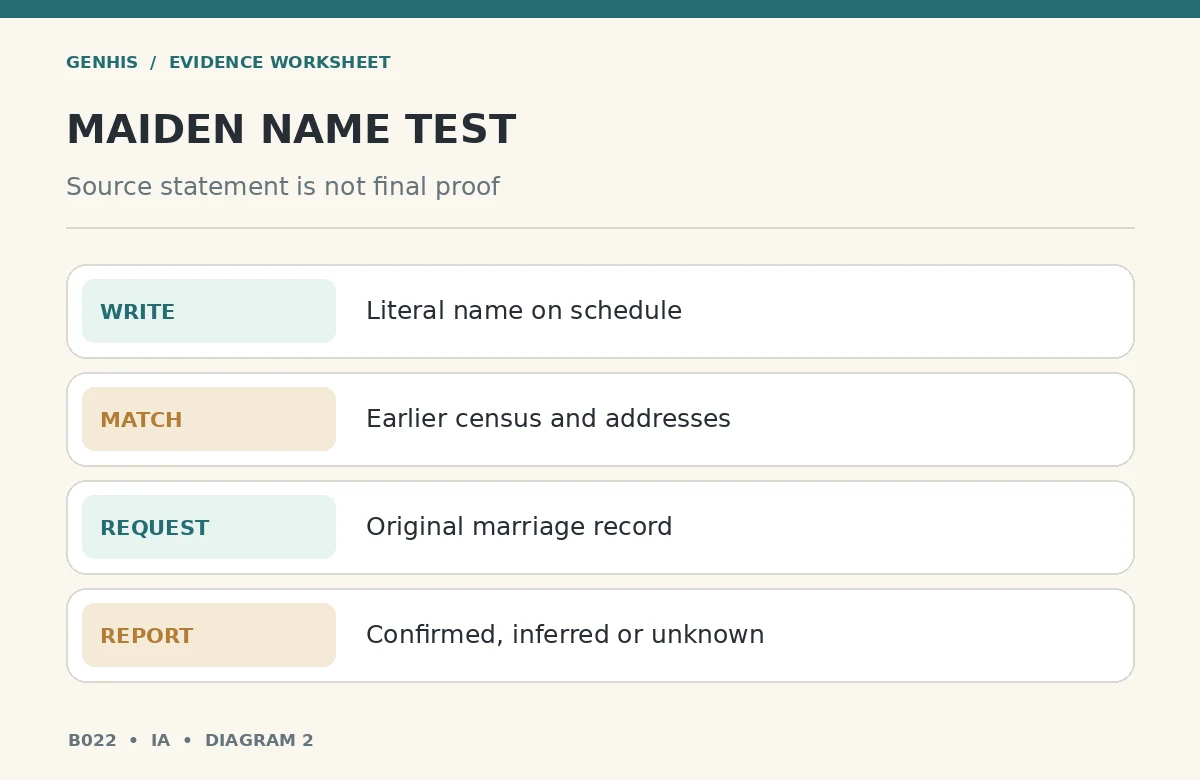
The 1925 collection description explicitly identifies names of parents and a mother’s maiden name among its especially useful fields. Copy each field under the original heading, distinguishing an explicit maternal maiden name from a surname you infer through a child’s later marriage. Where a parent is deceased or unnamed, record exactly how the form represents that fact. A parent reference can be a powerful clue even when the person being enumerated is an adult living apart from the parents.
Do not immediately merge the named father with the first online tree bearing the same given and family names. Compare parent birthplaces, marriage place, reported religion where present, ages and the household’s earlier Iowa or federal census appearances. In populations with repeated names, a listed parent may refer to more than one possible person. The census is a secondary report about events often occurring decades before enumeration; original parental marriage and birth records remain the stronger tests.
Use the parental marriage location as a search route
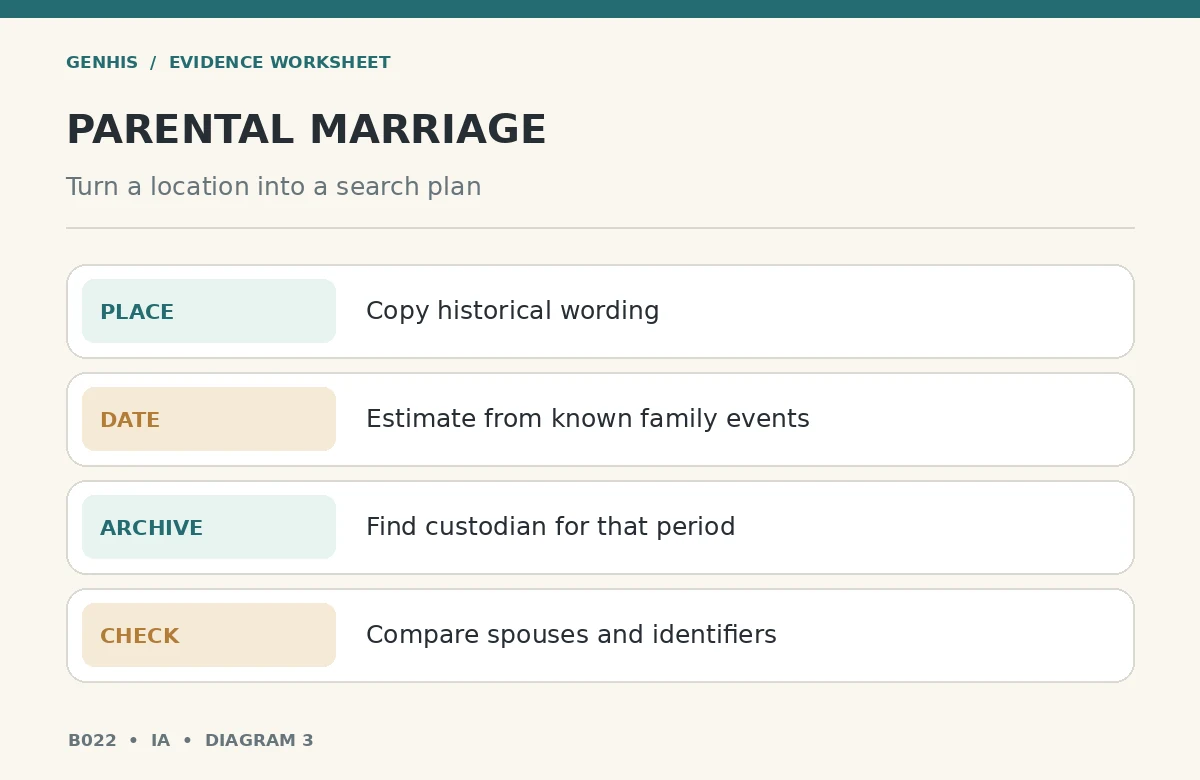
The Iowa census guide identifies the place of parents’ marriage among details reported in 1925. That place is not a marriage certificate, but it can reduce an otherwise unmanageable search to a historical county, state or foreign jurisdiction. Capture the exact wording, including an abbreviated county or outdated country name. Research the jurisdiction as it existed at the reported time, not as it is mapped today.
Create a two-column task: reported marriage place on the left and actual custodian of marriage books on the right. First check whether that local authority kept marriage records in the relevant period. If the family moved, a marriage outside Iowa is entirely possible. A successful record search should verify the spouses, approximate date and other identifiers; a non-result means only that the searched collection did not yield the record, not that the census named the wrong parents.
| Reported field | What it can suggest | Independent next record |
|---|---|---|
| Resident and address | Where person was counted in 1925 | Directory or other census |
| Father name and birthplace | Candidate earlier generation | Birth, church or probate |
| Mother name / maiden name | Possible maternal surname | Marriage or baptism register |
| Parents marriage location | Target jurisdiction | Original local marriage record |
Compare Iowa state years without borrowing fields
Iowa conducted enumerations in numerous nineteenth-century years as well as in 1905, 1915 and 1925, according to the state-census collection descriptions. Different years used different forms and availability varies. The 1895 Iowa collection names individual household members and gives a year list, but you should not expect a parental maiden-name section just because 1925 contains one. Pick the year that fits the person’s known location and the question you need answered.
For a person listed in Iowa in 1915, try 1925 to check migration or marriage changes; for a parent born much earlier, move back through state or federal enumerations. When records appear to contradict each other, transcribe both and ask who likely supplied each piece of information. The census respondent might not have been the subject, and many years can separate a person’s birth from the recorded recollection.
Test family links with independent certificates
Use a confidence matrix with three statuses. Recorded: the 1925 schedule names a father and a mother, with the mother’s reported maiden name. Inferred: those same people are the biological parents of a person in a separate historical record. Unverified: the exact parental marriage and birth information before viewing corresponding original records. This approach avoids confusing a valuable lead with proof of an entire ancestral generation.
Search available county marriage and birth records, church registers, obituaries, wills or burial records as appropriate to the event and jurisdiction. A census entry can have an error in spelling, memory or household reporting; corroboration should come from records created closer to the event where possible. Never copy a standardized index name into the source transcription when the image shows a different spelling. Our guide “New York State Census Records” covers a related question.
Preserve the page grouping and citation trail
Cite the collection title, year, jurisdiction, individual’s entry, and the image references for all three pages of the set you actually reviewed. If online presentation exposes only one image at a time, store the sequence or film/image identifiers so another researcher can reproduce the reading. Treat three pages from the same enumeration as parts of one source, not as three independent confirmations of a parent’s name.
Finish with two action items: a specifically targeted record request for the reported parental marriage and an alternative search for a birth or baptism record. If neither can be located, a carefully worded provisional family connection may be appropriate in research notes, but it should not be expressed as proved. The unique value of 1925 Iowa is how many leads a single correctly read three-page return can produce—not the certainty of those leads.
How We Research the Record Claims
This article starts from FamilySearch’s unusually explicit description of the three-page Iowa census form instead of relying on a person-name result. We examined the named parental fields in the collection guidance and compared earlier Iowa state census coverage only as a location-checking aid. The article makes no claim that a parent’s reported marriage location has been validated against an original certificate. Its example worksheet carefully separates a field transcription from an evidence-based conclusion.
More Records and Archives Guides
Custodian Sources and Practical Disclosure
The 1925 Iowa index and images explains the multi-page return, mother’s maiden-name field and place of parental marriage. The 1895 state census description supports the earlier enumeration context, and the Iowa collection directory provides year-specific navigation. These custodian pages are not substitute certificates for unnamed families.
No commercial DNA, family-tree, or paid archive offer appears in this Iowa guide. Our disclosure information remains available separately. Before entering a maternal surname into a verified pedigree, readers should request a relevant marriage or birth record and check the original form against the index, including page alignments and damaged handwriting.
The FamilySearch collection guide identifies parental names, including a mother’s maiden name, among its fields.
The 1925 form spreads relevant questions across three pages, and a single indexed hit may show only part of the evidence.
It reports a marriage place as given to the enumerator; check an original marriage record for independent support.
No. Forms, fields and survival vary by year; do not assume 1895 or 1915 asks every 1925 question.
It is a recorded relationship claim worth testing, not by itself proof of every asserted genealogical link.