
The 1939 Register is not the 1939 census. It is an administrative snapshot of the civilian population in England and Wales on 29 September 1939, produced at the start of the Second World War. It can provide a precise birth date, address and occupation, but some entries are legally closed and some groups or regions are not covered. Start by checking whether the person could have been enumerated and whether the record should be open. This guide avoids trying to expose living people’s details.
Distinguish the Register from decennial census returns
The UK National Archives explains that the 1939 Register was created for national registration and later used in administering identity documents and rationing. It covers much of the civilian population of England and Wales but is not an ordinary census. Because the 1931 census of England and Wales was destroyed and no census was taken in 1941, the Register is often an important bridge between 1921 and 1951. This explains its historical value; it does not extend the document’s actual coverage.
Record 29 September 1939 as the reference date. Later changes noted in some copies should be interpreted in their own administrative context and should not be mistaken for the date every field was first entered. If you are tracing a family elsewhere in the United Kingdom, switch records by region: Scotland has its own registration material, while the Isle of Man and Channel Islands were not in the England-and-Wales civilian Register as described by The National Archives.

Confirm who can be missing before searching surnames
A person serving outside civilian enumeration arrangements, living outside England and Wales, not yet born on the reference date or moving into the country later may have no entry here. The National Archives describes exceptions around military personnel and other groups. An absent result therefore cannot prove someone had emigrated, died or changed their name. Start with a known pre-war or wartime address and determine whether it belongs inside the Register’s actual geography.
Search variant surnames, given names and birth-date tolerances, especially when registration and later civil records disagree. If you are researching a woman whose surname changed through marriage, examine the source’s annotation context rather than assuming the later name was used in September 1939. A date of birth on a registration page is useful corroboration, but a corrected or self-reported administrative detail is not identical to an original birth registration.
Read address and registration district together
The Register is arranged around local-government registration districts and enumeration units rather than being a modern searchable national family tree. Record the locality and visible district identifiers, address, occupation, exact date of birth and names as the image presents them. A transcription may standardize dates or omit context; consult the photographed entry when access is available. Compare addresses with a local directory, school record or earlier electoral register to distinguish people with common names.
A shared address shows people were recorded at the same place on the reference date; it does not by itself prove marriage, biological kinship or property ownership. Occupation can be particularly useful for identifying two same-name adults, but jobs can change rapidly in wartime. Read neighbors and surrounding institutional entries if they are relevant, yet do not reproduce personal details about unrelated living individuals in a public family-history post.
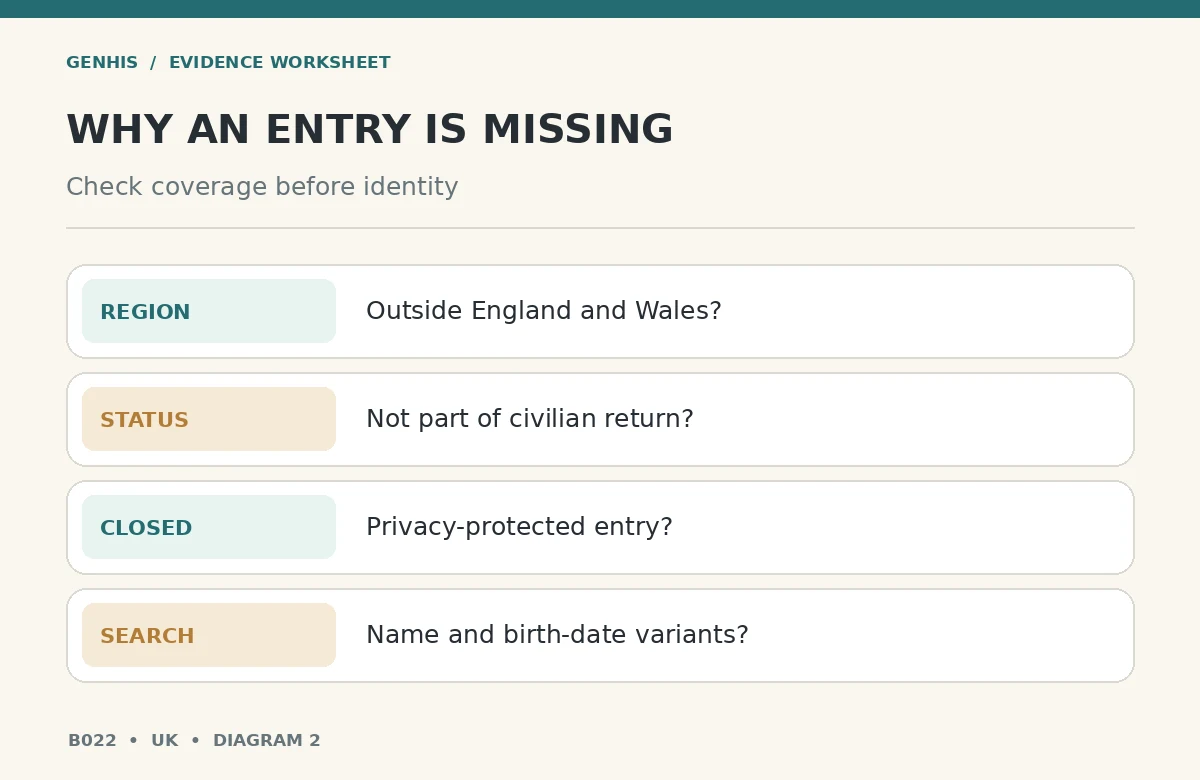
| Question | What to establish | Research rule |
|---|---|---|
| Location | England or Wales on 29 Sep 1939? | Other regions need other custodians |
| Record type | Civilian register, not decennial census | Do not infer census household fields |
| Entry blanked | Likely closed under privacy rules | Use authorized official process only |
| Matching identity | Date of birth plus address | Confirm via independent records |
Respect closed records and living-person safeguards
The National Archives notes that many entries remain closed for roughly 100 years from birth unless proof of death has been established. A blanked-out line does not allow you to infer or publish the person’s identity; it signals a privacy restriction. Even a death overseas may not have been registered in the system in the way needed to open the record automatically. Access and release rules are subject to provider and legal processes, not a genealogist’s intuition.
For a closed line, follow only the official guidance on closed entries and the authorized request route where appropriate. Do not advise scraping, guessing hidden names, or bypassing an access control through reconstructed households. If a living person’s information is unexpectedly visible, avoid publishing it and use the listed correction or closure channels. This article is intentionally about historical methods, not living-person discovery.
Choose an access route without inventing free availability
The National Archives lists digital access through licensed commercial partner services, including Findmypast and Ancestry, and describes possible charges. Do not confuse free public search with unrestricted free viewing of every original image. Provider interfaces, subscription offers and access rights may change; check current information on the custodian’s page before choosing a route. The original physical volumes are not simply available for researchers to browse at The National Archives.
Keep a citation containing the title ‘1939 Register,’ reference date, name as recorded, registration area, identifiable page or line reference where available, the host, and the date consulted. If all you have is a search-result snippet, label it a provisional lead and do not quietly turn it into a full transcription. Compare a candidate with civil registration, a known marriage or an earlier census before merging identities. If you are starting from scratch, read Why There Is No 1930 UK Census.

Use a privacy-aware historical evidence worksheet
Use three evidence columns: the Register explicitly states an address and date of birth; a linkage to a named person in a different document is a working hypothesis until checked; undisclosed or closed lines remain unknown. Record any reported surname updates separately from the original reference date. This is more reproducible than a screenshot caption saying that the 1939 entry ‘proves’ every person’s relationship in the household.
Complete the research by moving backward to documented pre-1939 family records and forward only where public sources appropriately allow. When the target’s identity is uncertain, note two or more candidate households and what would distinguish them. The productive outcome is a properly sourced wartime civilian residence, with uncertainty and access restrictions preserved, not a claim to know every resident hidden by privacy rules.
How We Research the Record Claims
For this article we followed The National Archives’ distinctions between the national registration system and an ordinary population census. The geographic exclusions, reference date and blank-line policy come from the custodian’s current research guide; we did not treat a closed record as a puzzle to reverse-engineer. We also checked the official authorization page so the suggested route cannot be mistaken for permission to identify living people. The document supports cautious historical identification, not access avoidance.
More Records and Archives Guides
Custodian Sources and Practical Disclosure
The 1939 Register research guide covers eligible civilian populations, digitized access providers, closed entries and updates. The England and Wales census guide provides the broader census gap, while the official closed-record search route explains when authorization is relevant. No names from restricted records are reproduced in this article.
This guide does not claim a free subscription or partnership with a Register provider. The GenHis disclosure statement describes link practices; pricing and rights should be verified directly before viewing. If a person’s line is restricted, respect the restriction and pursue other lawfully accessible historical evidence rather than publishing deductions about a possible living resident.
No. It is a civilian national registration system for England and Wales, not a decennial census.
No. The National Archives directs researchers to separate Scottish registration holdings.
It may be legally closed to protect a person who might still be alive or whose death has not been established for release.
Do not bypass closure. Any eligible request must follow The National Archives authorization and applicable privacy rules.
It can document co-residence and other reported details; an independent birth or family record is needed to confirm parentage.