
The 1921 census of England and Wales recorded people on 19 June 1921, not the originally planned April date. To identify an ancestor, begin with a name-and-place search, inspect the complete original household schedule in The National Archives series RG 15, and copy its enumeration district and schedule reference. This census can supply unusually useful employment details, ages in years and months, and information on parents of children under 15. Yet a reported employer does not prove attendance at every shift, and a household entry is not proof that everyone listed was biologically related. Check every inference against the actual question asked on the image.
Start with 19 June 1921 and the right archive series
The National Archives gives 19 June 1921 as census day and explains that industrial unrest delayed enumeration from 24 April. That date matters when you compare an infant age, a marriage, an occupation or a household move with other events. Write the census date into your timeline before you use an approximate birth year. Search the 1921 England and Wales collection using a known person and locality, adding a plausible age interval rather than assuming every transcript is exact.
The household returns are preserved as original schedules in RG 15. Unlike the 1911 census, there are no enumerators’ summary books for 1921; Plans of Division describe enumeration boundaries instead. Do not cite a 1911-style RG 78 book when researching 1921. Search services may add their own database IDs, but the archival identity of the source begins with RG 15, the actual image and its district and schedule identifiers. If you are starting from scratch, read Why There Is No 1930 UK Census.
Record the RG 15 piece, district and schedule together
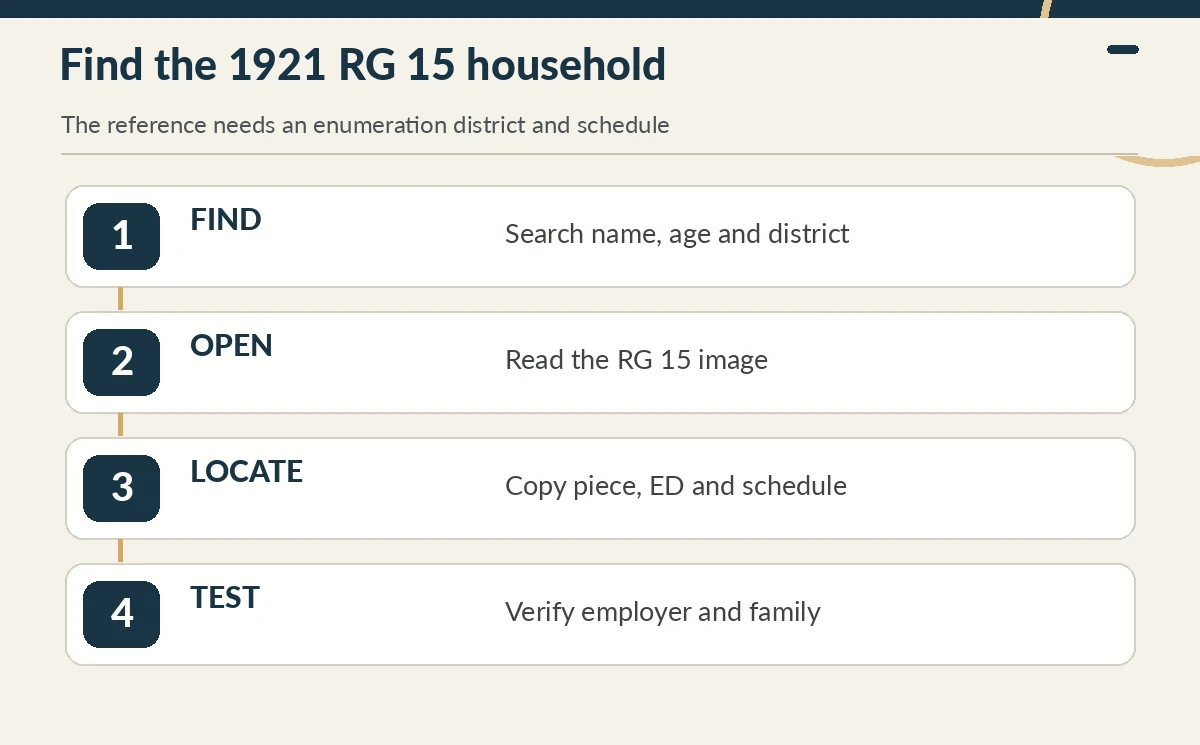
Once you locate a likely household, read the form rather than importing a tree hint. The National Archives illustrates a 1921 reference as RG 15/12199, ED 7, Sch 43. Capture the piece number, enumeration district and schedule number exactly as your own page shows. One piece can cover more than one small enumeration district, so a piece number alone may not be a complete locator. Preserve the provider, image identifier and access date alongside the government reference.
Read the address, household headings and any added notations. For an institution or vessel the surviving record may use a numbered page instead of the ordinary household schedule number. If an indexed name looks misplaced, search the street or neighboring schedule rather than repeatedly changing surname spelling. Compare the image with another contemporary address from an electoral roll or directory before concluding that two similar people are the same resident.
Use employer and workplace details as research leads
The 1921 form expanded questions on employment: many respondents were asked for their employer’s name and business and the address of the workplace. It also permitted answers such as working at home or having no fixed place of work. These are reported circumstances at census time, not a certified occupational history. Copy the answer literally before normalizing a business name, spelling or address. A shop name can be a powerful locator in city directories, company records or newspapers. Our guide “1891 England and Wales Census” shows how to read RG 12 work and Welsh language clues.
Consider a fictional clerk who reports a textile firm in one town while appearing at a household address in another. The workplace is not necessarily their home or birth town. Check the firm’s address against a directory printed close to 1921 and test the commute or movement with independent sources. If a workplace line is blank, first ask whether that question applied to the person and whether the form was completed; blank should not automatically be transcribed as unemployed.
| 1921 source element | Best research use | Do not conclude |
|---|---|---|
| RG 15 schedule | Named residents and reported details | Proven biological relationships |
| Years + months | Approximate birth interval | Certified birth date |
| Employer and address | Workplace research lead | Exact service duration |
| Plans of Division | District boundaries and coverage | 1911-style household summary |
Interpret ages, education and children without false precision
Unlike many older census returns, 1921 reported ages in years and months. A person aged 32 years 7 months on 19 June suggests a birth window around late 1888, but the answer is still self-reported and may be rounded or incorrect. Record the exact entry and show your calculated interval separately. The form also asked whether a child was in full-time or part-time education. Such an answer suggests schooling status at that point; it does not reveal a named school or an uninterrupted attendance record.
For children under 15, the household schedule asked whether both parents were alive, or the father, mother or both were dead. It did not automatically name the parents, explain a step-parent relationship or establish legal guardianship. If a child was reported with a surviving mother and a deceased father, test the situation against civil registrations, guardianship documents or earlier census returns. Where a household lists a cousin or boarder, respect the literal relationship label and do not turn it into a constructed pedigree.

Audit same-name households and access costs
Suppose two fictional households contain a William Cooper of similar age in nearby registration districts. Compare full names, reported age in months, employer, workplace, birthplace, address and household associates. Record contradictions before favoring the first indexed hit. A correct surname plus occupation may not be enough when the occupation is common. Search neighboring names and address variants if optical transcription or indexing omitted the target.
Online searching may be free while images cost money through a provider. The National Archives says that the records can be viewed at no charge on site in Kew; free on-premises viewing is also described for Manchester Central Library and the National Library of Wales. Other availability and subscription arrangements may change, so check the current access terms rather than promising every platform is free. Never invent an image transcription for an item you have not opened.
Write a bounded census conclusion with one next test
Build a two-column worksheet: “1921 schedule explicitly says” and “independent record still needed.” The schedule can support reported age, occupation, presence in a particular household and an address on census day. It cannot independently prove a marriage date, biological parentage, an employer’s exact payroll dates or lifetime residence. For each event create a source citation that includes RG 15 and the schedule locator. Preserve disagreements with earlier census returns rather than adjusting dates to make the story smooth.
Finish with a concrete next action. If an employer is distinctive, locate a directory, personnel record or surviving company collection. If a child’s parental-survival answer raises a question, check death indexes and civil certificates with dates that fit the family. Also, if only an indexed match exists, mark identity as provisional until the image has been read. A useful family-history claim is narrow, traceable and capable of being disproved by a better record.

How We Research 1921 England and Wales Census Records
GenHis starts with the official archival description and distinguishes an index, the original record and any inferred family claim. For this guide we examined the repository instructions, stated date coverage, available search fields, documentary limits and relevant historical terminology. The sample identity checks are hypothetical and not records of identified ancestors. This is historical research guidance, not a guarantee that every record survives, is indexed or is free to obtain.
More Records and Archives Guides
Official archives and collection guides for The 1921 Census
TNA census guide: RG 15 references, 1921 questions, date and distinction from 1911 (nationalarchives.gov.uk).
National Library of Wales: 1921 viewing options and census context (library.wales).
Collection guide for household images and Plans of Division; platform terms can change (findmypast.com).
Editorial disclosure: This guide includes no paid recommendation or verified affiliate partnership. See the GenHis affiliate disclosure. Record holdings, image availability, access restrictions and prices can change. Verify them with the cited repository before ordering documents; protect information about living people and present uncertain family conclusions as hypotheses.
The enumeration date was 19 June 1921, after a postponement from April.
The original 1921 household schedules and relevant special returns at The National Archives.
The 1921 census has Plans of Division, not the 1911-style summary books.
No. It is a reported detail for census time and needs separate employment evidence.
The National Archives and certain named libraries offer free on-site viewing; other access terms vary.