
The 1851 census of England and Wales was taken on the night of March 30, 1851. Start with a dated locality and a possible household, then inspect the enumerator’s book in The National Archives series HO 107. Unlike the 1841 schedule, the 1851 return reports each person’s relationship to the household head and a more specific birthplace. These entries help direct searches for baptisms and earlier residences, but a reported birthplace is a clue, not a birth certificate, and a household label is not by itself proof of biological kinship.
Know exactly which 1851 census source survives
The National Archives explains that individual household forms were collected and usually copied by enumerators into books. Most original household schedules were later destroyed, so the surviving page a family historian commonly views is an enumerator’s transcription, not the informant’s own handwriting. A transcription may reproduce a household answer imperfectly, omit a word, or place a name on a neighboring line. The source type belongs in your citation and your confidence assessment. HO 107 covers both 1841 and 1851; do not assume the collection code alone establishes the year without an image heading.
An enumeration district is an administrative route, not necessarily a parish or a family’s permanent neighborhood. Institutions, vessels, lodging houses and households may follow different layouts. Check the county, registration district, subdistrict, enumeration district and street or hamlet on the page. The person recorded in a dwelling was counted for census-night presence. A child staying with grandparents or a married worker away from home might not be found with the expected nuclear family. Record the precise residence and the date before building a multi-decade timeline.
Move from a name search to the original HO 107 image
Begin with the strongest independent identifier available: a marriage place, baptismal parish, trade, or known neighbor. Search one plausible surname spelling, then use a year-of-birth range instead of an exact age if results are thin. Widen the query to a given name and locality, then try surname variants and initials. A database result may normalize a birthplace or interpret a shortened relationship label. Treat the index as a finding aid and open the scan to read what the enumerator actually wrote.
On the image, capture the archive series, piece number, folio and page as well as the locality and enumeration district. Folios and printed page numbers are not interchangeable: both may be needed for another reader to locate the entry. Browse the previous and next pages to see whether the household begins earlier or continues after a page turn. If a street is not obvious, consult the opening district description and nearby address entries. This route works when a name index fails because you can browse a known street or village.

Read relationships, ages and birthplaces without overclaiming
The 1851 columns include name, marital condition, relationship to the head, age, occupation, birthplace and a disability question using historical wording. Copy labels literally in your transcription while avoiding the assumption that historical categories describe a person accurately or respectfully. A “daughter” entry describes how that resident was reported in relation to the head; it cannot alone exclude stepchildren, informal fostering or enumeration errors. Birthplace usually points to parish and county within England or Wales, while foreign births may be reported less specifically. Normalize a modern place name only in a separate research note.
Construct a claim-specific comparison: list the precise birthplace wording, the reported age, the occupation and the named household members. Then compare with a baptism entry, marriage certificate, another census or trade directory. A consistent parish across two enumerations is useful corroboration but still relies on possibly repeated family recollection. Conversely, two ages a few years apart are not necessarily two different people. Resolve a mismatch through independent records rather than silently editing the census transcription to match the tree. Our 1841 England census genealogy guide adds more detail on this.
| Check | Evidence to record | Do not infer |
|---|---|---|
| KNOWN PLACE | Anchor residence near 30 March 1851 | A name alone is proof of identity |
| SECOND CENSUS | Compare an independent year | The index replaces the original |
| UNKNOWN | Record unresolved contradictions | Unverified kinship or an event |
Use neighboring entries and local geography as identity tests
Household composition can separate two residents of the same name when birthplaces overlap. Extract the neighbors above and below the target household; then check directories or parish registers to see whether these associates appear near the same person again. Houses can be subdivided, and multiple households may occupy the same address, so preserve the book’s household marks rather than drawing assumed property boundaries. An occupation shared by several relatives may support a hypothesis but never uniquely identifies an individual.
Historical county and parish names demand special care. A place described as “Yorkshire” is not a definite parish, and an enumerator might write a nearby market town instead of the actual birthplace. Verify spelling using a contemporary gazetteer and compare the 1851 entry with the 1861 census or a church baptism in the proposed locality. If the likely parish has several same-name baptisms, record all candidates. The purpose of the birthplace field is to choose the next constrained archival search, not to declare a parent-child link from one name match.

Audit a fictional two-household match before merging
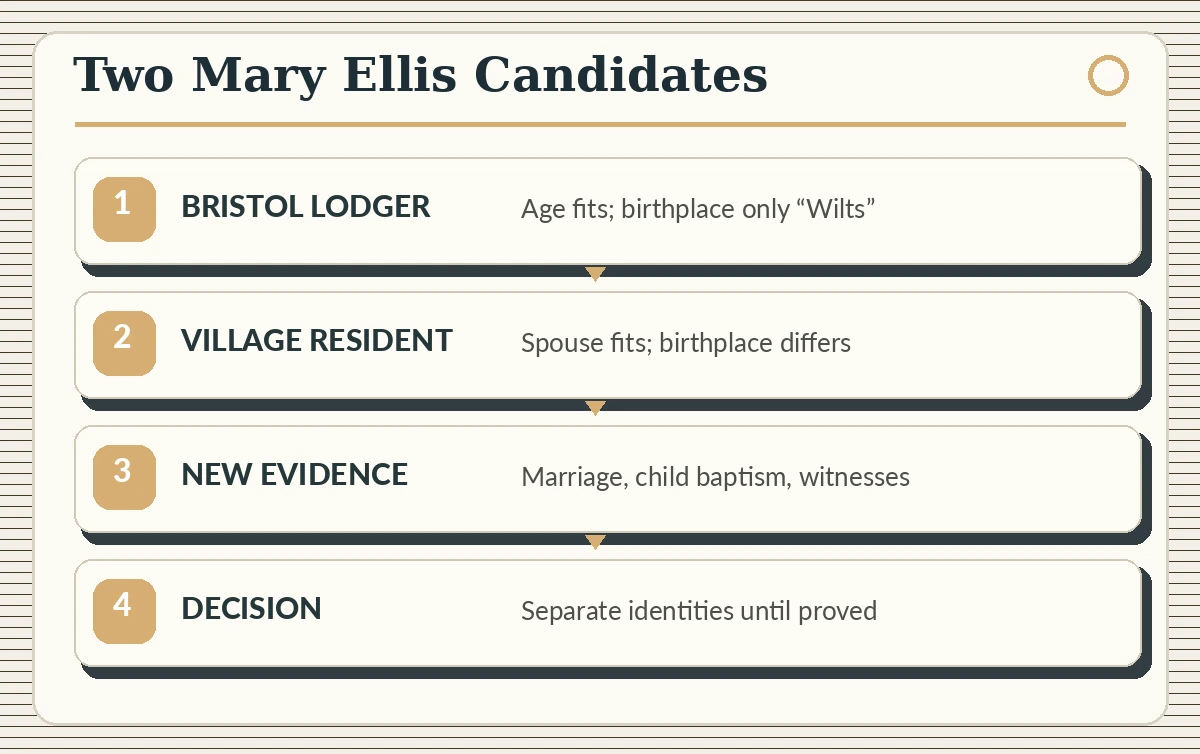
Consider a fictional Mary Ellis, approximately 29, known independently to have married in a Wiltshire parish. One 1851 index hit shows a Mary Ellis of the right age lodging in Bristol, with birthplace “Wilts”; another has a married Mary Ellis in an expected village but reports a different birthplace. Neither is established as the target. Create separate candidate rows with the original HO 107 references, age, condition, exact birthplace, associates and occupation. Do not combine the fields into one imagined life story.
Next obtain the marriage record and any baptism for a child independently linked to the target. Compare the spouse, witnesses, residence and subsequent census households. If the documents distinguish the candidates, record exactly which evidence resolved the conflict. If not, label the case unresolved and seek an additional locality or relationship clue. An attractive age-and-name match is weaker than a documented sequence of events. Use the exercise as a repeatable method whenever the 1851 birthplace seems too convenient. If that is your next decision, our guide “1861 England and Wales Census” explains how to find households in RG 9 records.
How We Research 1851 England Census
We reviewed The National Archives census guide for the exact 1851 date, HO 107 reference system, enumerator-book survival, and fields specific to 1851. Our fictional Mary Ellis example is an illustration only. We require a full image citation before treating an indexed result as evidence and independent records before identifying parents, children or an exact birth parish.
More Records and Archives Guides
Official archive guides for 1851 england census
The National Archives: census years, 1851 HO 107, fields and surviving enumeration books (www.nationalarchives.gov.uk).
The National Archives: documented 1851 HO 107 household example and transcription (www.nationalarchives.gov.uk).
FamilySearch: historical 1851 collection and index field example (www.familysearch.org).
These sources are provided for archival research, not as paid endorsements. Review the GenHis affiliate disclosure. Coverage, digitization and access conditions can change. Historical documents may contain outmoded or biased labels; interpret them in context, and avoid sharing private information about living people.
The enumeration referred to the night of March 30, 1851; a person could be away from their usual home.
The National Archives uses HO 107 for 1841 and 1851; include the piece, folio and page when available.
No. It is a reported place and a lead for a separate parish-register search.
No. Verify the relationship with vital, church and other independently created records.
Try name variants, search by locality, and browse enumeration districts, neighboring folios and page images.